
J&K recruitment board powers have become a political issue after an alleged cheating network surfaced during a recruitment examination. The dispute raises questions about accountability in a Union Territory; explore more polity current affairs.
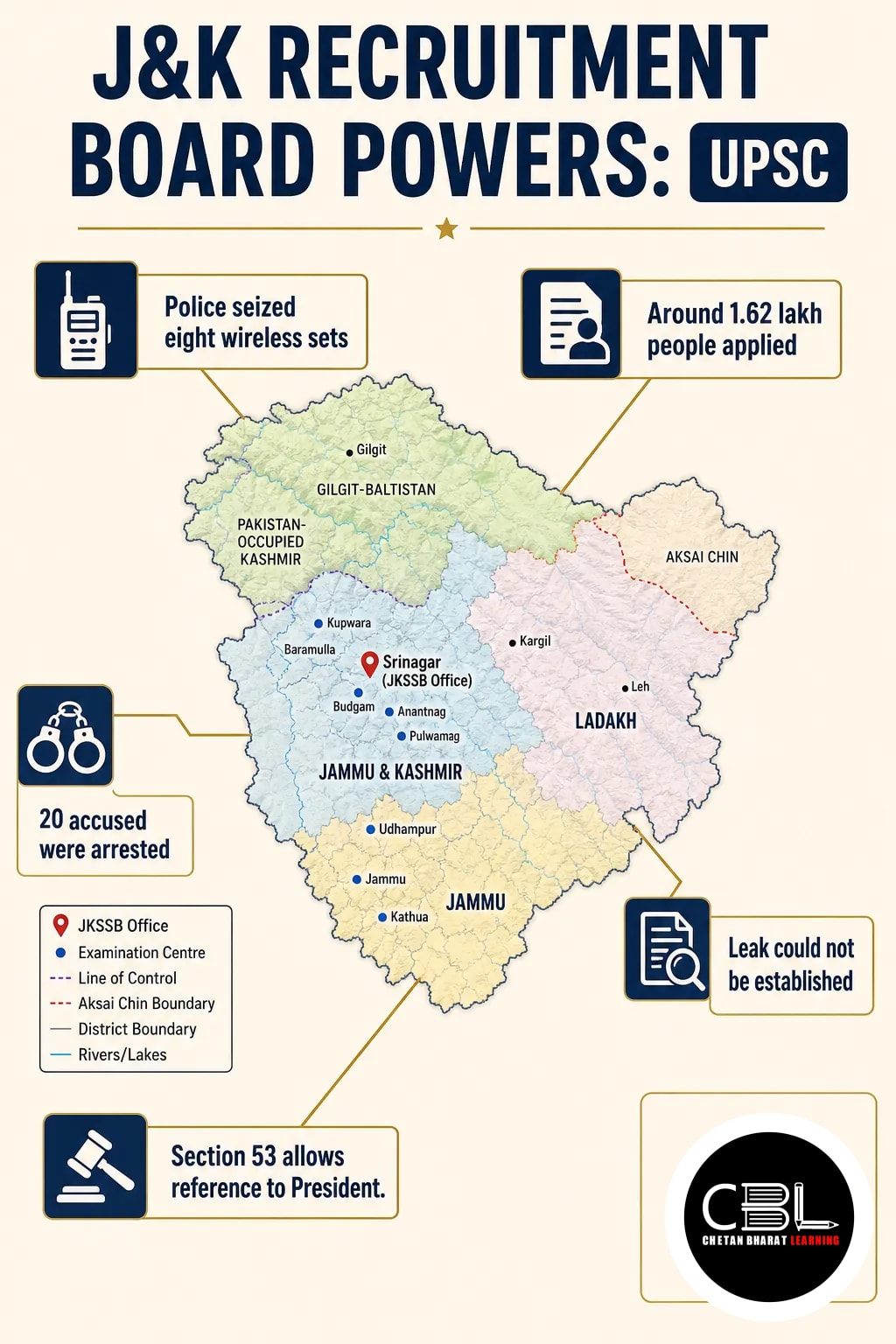
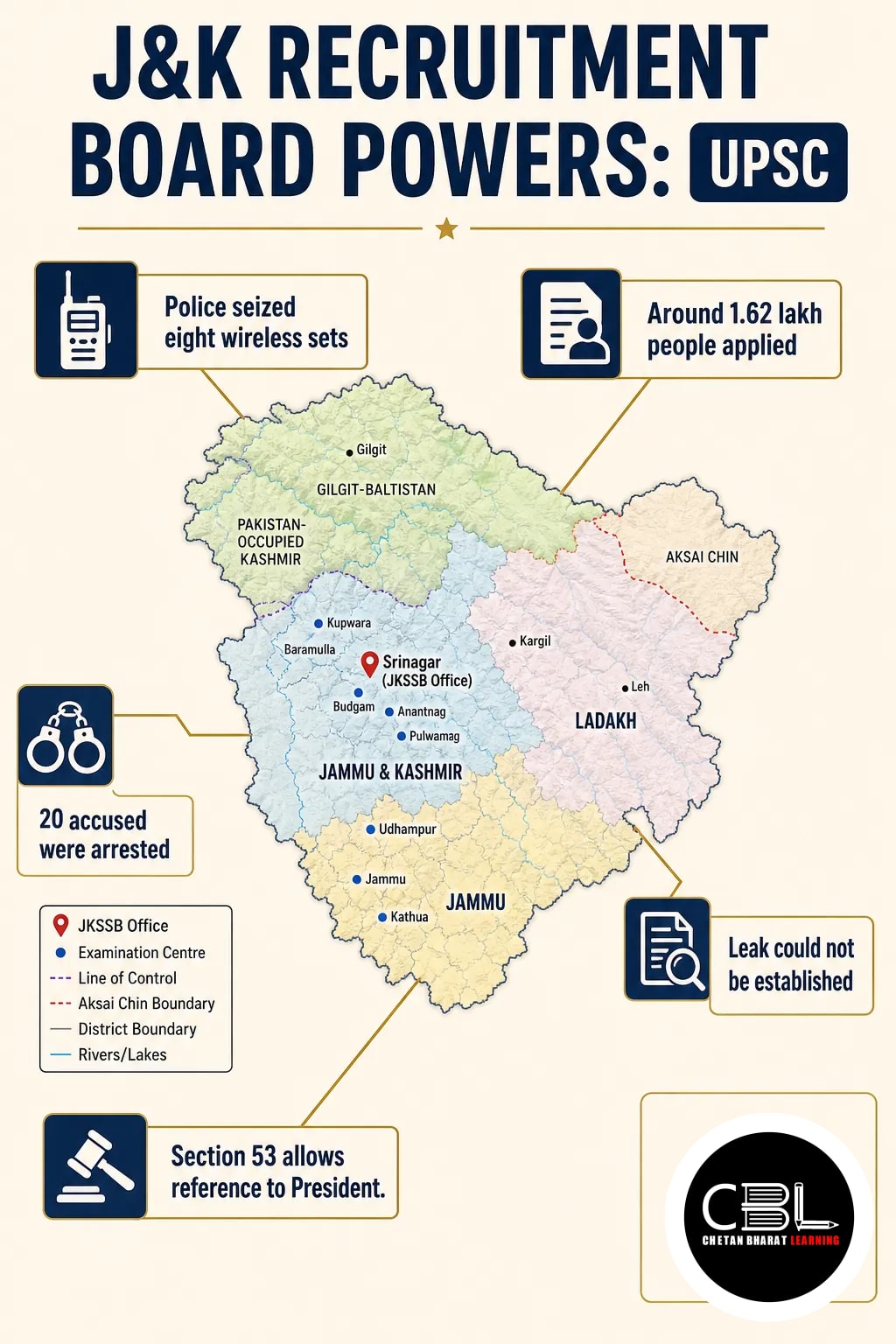
Quick answer: J&K recruitment board powers came under scrutiny after police investigated alleged unfair means in the Finance Accounts Assistant examination in Jammu on 15 November 2026. Around 1.62 lakh people had applied, and police arrested 20 accused. The elected government claimed the Lieutenant Governor ran the board and the Chief Minister’s office was not informed.
What happened in the recruitment examination?
Jammu and Kashmir Police investigated alleged use of electronic devices to help candidates in the Finance Accounts Assistant (FAA) examination. The Jammu and Kashmir Services Selection Board (JKSSB), the Union Territory’s main recruiting agency, conducted the examination.
Acting on information about unfair activity, police tracked examination centres and broke up four alleged modules. They seized eight wireless sets, about 22 phones and five four-wheelers. Among the 20 people arrested were government employees, candidates, intermediaries and the alleged kingpin.
Police said teams operated inside and outside an examination hall. However, Jammu Senior Superintendent of Police Joginder Singh said the malpractice was confined to a particular centre and a paper leak could not be established. The allegations and arrests do not by themselves establish guilt.
According to police, an accused contacted 20 to 22 additional candidates and collected original documents and four to five blank cheques. The negotiated amount was ₹10–12 lakh per candidate. Meanwhile, candidates protested in Jammu and Srinagar, seeking an investigation and a revamp of the board.
Why are J&K recruitment board powers disputed?
The dispute concerns who directs the board and who must answer for recruitment failures. The elected government claimed that the Lieutenant Governor (LG), rather than Chief Minister Omar Abdullah, ran the board and that the Chief Minister’s office was not informed.
That is a claim by the elected government, not a legal finding established by the source. The available account does not identify the specific appointment orders, business rules or delegation governing the board. Therefore, it cannot settle which office possessed each power over the examination.
In addition, investigating a criminal allegation differs from administering a recruitment body. Police action against suspects does not automatically resolve who supervised the board or whether any official neglected a duty.
What is the constitutional and legal framework?
The Jammu and Kashmir Reorganisation Act, 2019 creates a Union Territory framework with an elected legislature and an LG. However, its general provisions must be read alongside the applicable recruitment rules before assigning responsibility for a particular board decision.
| Provision | Relevance |
|---|---|
| Constitution, Article 239 | A Union Territory is administered by the President through an appointed administrator, subject to the Article. |
| 2019 Act, Section 32 | The Assembly can legislate on applicable State and Concurrent List matters, except public order and police; Parliament retains its legislative power. |
| 2019 Act, Section 53 | The Council of Ministers aids and advises the LG in matters within Assembly competence, subject to specified exceptions and the procedure for differences. |
| 2019 Act, Section 55 | The Council of Ministers is collectively responsible to the Legislative Assembly. |
| Constitution, Articles 14 and 16 | Equality before the law and equality of opportunity in public employment provide important standards for recruitment. |
Under Section 53, the LG can refer a difference of opinion with ministers to the President. In urgent cases, the provision also permits the LG to act pending the President’s decision. These general rules do not, by themselves, establish who controlled the JKSSB examination.
For broader context, see the discussion of J&K statehood and federalism. The distinction between state and Union Territory powers matters when assessing democratic accountability.
What earlier recruitment cases provide context?
Previous allegations make the latest investigation a question of institutional safeguards as well as individual conduct.
| Year | Event |
|---|---|
| 2020 | The administration cancelled the selection of 65 Jal Shakti junior engineers after discrepancy allegations. |
| 2022 | A police Sub-Inspector examination faced irregularity allegations; the Central Bureau of Investigation arrested 20 people in the case. |
| 2025 | The J&K Anti-Corruption Bureau found irregularities in Fireman and Fireman Driver selections, including answer-sheet tampering and merit-list manipulation. |
These cases involved different recruitment processes and allegations. Therefore, their outcomes cannot substitute for evidence in the current FAA investigation.
Why does the dispute matter for governance?
The controversy tests whether authority, information and responsibility align in public recruitment.
- Democratic accountability: Ministers answer to the Assembly; however, effective scrutiny also requires clarity about decisions outside their control.
- Equal opportunity: Cheating can disadvantage honest candidates and undermine confidence in selection on merit.
- Institutional coordination: The board, administration and investigators have different roles; therefore, each role needs a clear decision trail.
- Due process: Authorities must investigate fairly and protect evidence; allegations alone should not determine guilt.
A related Punjab recruitment stay also illustrates why aspirants should follow procedural safeguards in public appointments, without equating the two cases.
What measures could improve recruitment accountability?
A credible response requires evidence preservation, clear authority and safeguards throughout the selection process.
- Preserve evidence: On 22 November, the J&K Students Association sought preservation of closed-circuit television footage, records, devices, call details and financial transactions.
- Test the investigation: The association sought an independent Central Bureau of Investigation probe, arguing that a Special Investigation Team was insufficient given the history. That demand is distinct from a decision to transfer the case.
- Clarify responsibility: Publish the applicable delegation and decision-making chain, so the public can identify who appoints, supervises and reviews the board.
- Protect future selections: Audit examination security and result processing; meanwhile, explain any postponement decisions to candidates. The association sought postponement of upcoming police recruitment examinations.
Overall, clearer J&K recruitment board powers would help connect administrative control with answerability. However, both governance reform and criminal findings must rest on the applicable rules and verified evidence.
Source: The Hindu National, 23 November 2026
Asked in UPSC: Previous Year Questions
- UPSC CSE Mains 2025 (GS Paper II): Discuss the nature of the Jammu and Kashmir Legislative Assembly under the Jammu and Kashmir Reorganisation Act, 2019, and briefly describe its powers and functions.
UPSC connects the Union Territory’s institutional structure with its legislative powers; therefore, revise the Act alongside current developments.
State PCS questions may test equality in public employment and safeguards for recruitment examinations. In addition, compare accountability in a Union Territory with the institutional arrangements of a state, without assuming their powers are identical.
Prelims Practice Corner
Mains Practice Questions
Frequently Asked Questions
Who controls the J&K recruitment board?
The available source does not establish the board’s complete legal chain of control. The elected government claimed the LG ran it; however, determining specific powers requires the applicable rules and orders.
Did police establish an FAA examination paper leak?
No; police said a paper leak could not be established. However, they investigated alleged unfair means and arrested 20 accused.
Can the J&K Assembly legislate on police?
No; police is excluded from its legislative competence under the 2019 Act. Parliament, however, retains its power to legislate for the Union Territory.
Related Current Affairs
Preparing for UPSC, PCS or HCS?
Talk to a mentor at Chetan Bharat Learning, Chandigarh. Free guidance on choosing the right exam and building a study plan.
Chat on WhatsAppCall 97793 53345UPSC / IAS / PCS coaching in Chandigarh · Trusted by aspirants across Punjab & Haryana






Leave a Reply
You must be logged in to post a comment.