

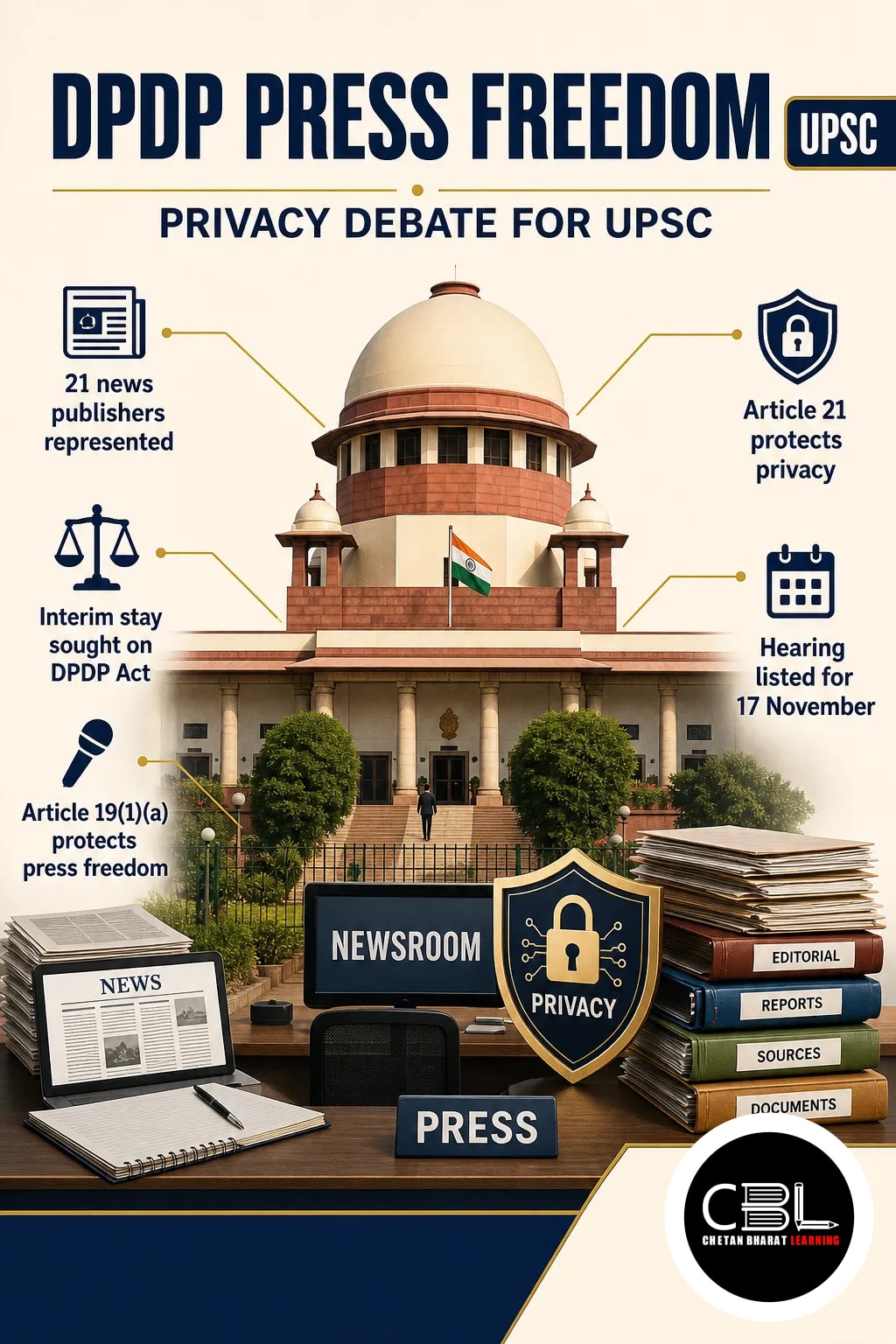
DPDP press freedom concerns have reached the Supreme Court, raising questions central to constitutional rights and governance. The dispute tests how personal data protection can coexist with investigative journalism.
Quick answer: The DPDP press freedom dispute concerns a challenge by the Digital News Publishers Association (DNPA), representing 21 publishers. On 27 October 2026, it sought an interim stay on provisions of the Digital Personal Data Protection (DPDP) Act, 2023. It argues that the absence of a specific journalistic exemption threatens reporting. The Supreme Court listed the matter for 17 November.
What is the DPDP press freedom dispute?
The dispute asks how data protection requirements apply when journalism uses personal information for public-interest reporting. The DPDP Act establishes a framework for processing digital personal data; meanwhile, the press investigates conduct that subjects may prefer to keep private.
The DNPA argues that the Act lacks a specific journalistic exemption. It fears that applying data protection obligations to reporting could restrict investigations and expose confidential sources. These are the association’s contentions, not findings by the Supreme Court.
However, the public interest in a story does not automatically make every personal detail necessary for publication. The constitutional challenge is therefore to protect both meaningful scrutiny and individuals against avoidable intrusion.
Why is the challenge in the news?
The DNPA sought an interim stay on provisions of the Act before the Supreme Court on 27 October 2026. Its petition, filed on 6 October, identified risks to investigative work, sources and whistleblowers.
The association also contended that the law could force removal of published reports. Senior advocate Madhavi Divan, appearing for the DNPA, warned that requiring journalists to obtain subjects’ consent could amount to pre-censorship. The Court listed the matter for further hearing on 17 November; the source does not establish that a stay has been granted.
For background, see CBL’s earlier coverage of the publishers’ privacy and press freedom challenge and the data protection law dispute.
Which constitutional and legal principles apply?
Articles 19 and 21 provide the principal constitutional framework for balancing expression and privacy. The DPDP Act adds a statutory framework for digital personal data.
| Provision | Relevance |
|---|---|
| Article 19(1)(a) | Protects freedom of speech and expression, including press freedom. |
| Article 19(2) | Permits reasonable restrictions on expression on specified grounds. |
| Article 21 | Protects life and personal liberty; privacy is an intrinsic part of these rights. |
| DPDP Act, 2023 | Provides for processing digital personal data and recognises certain rights of individuals. |
The Act provides for processing with consent and for specified legitimate uses. It also excludes certain personal data made publicly available by the individual or under a legal obligation. Consequently, a claim that every use of personal data requires consent would oversimplify the law.
In K.S. Puttaswamy v. Union of India, the Supreme Court recognised privacy as a fundamental right. However, neither privacy nor expression is unlimited; a restriction must be assessed against the applicable constitutional standards.
Why does journalism need protection?
Journalism can reveal wrongdoing that affected parties have strong incentives to conceal. Therefore, rules designed for ordinary data processing may have unintended effects on investigations.
- Public accountability: Reporting can scrutinise the conduct of officials and other powerful actors, enabling informed public debate.
- Confidential sources: If sources fear identification, they may withhold information; consequently, investigations can become harder to pursue.
- Whistleblowers: The DNPA warns that uncertainty could deter people from sharing evidence of wrongdoing.
- Prior consent: If an investigation required the subject’s permission, the subject could obstruct scrutiny before publication.
These concerns depend on how the law applies to particular activities. Thus, the petition should not be treated as proof that every investigation must obtain consent or remove reports.
Why must privacy also be protected?
Privacy safeguards matter because publication can expose people to lasting harm unrelated to the public purpose of a story. Digital circulation can also amplify that harm.
- Unnecessary disclosure: A report may reveal family, health or contact details that add little to its accountability value.
- Unequal exposure: Sources, witnesses and people connected to a subject may face risks despite not holding public office.
- Overbroad protection: A blanket journalistic exemption could shield intrusive data practices with little connection to public-interest reporting.
Moreover, what interests readers is not always the same as what serves the public interest. The distinction helps assess whether identifying a person or publishing a sensitive detail is necessary.
How can privacy and the public’s right to know be balanced?
A workable balance would protect genuine reporting while limiting unnecessary personal-data exposure. The following are policy options, not a description of the Court’s decision.
- Clarify journalistic treatment: Lawmakers could specify how data protection duties apply to reporting and define safeguards against misuse.
- Apply a public-interest test: Decision-makers could consider the story’s accountability value, the information’s sensitivity and the harm from disclosure.
- Minimise disclosure: Newsrooms can omit identifiers or sensitive details when they are not needed to establish the facts.
- Protect sources: Procedures should avoid unnecessary exposure of confidential sources while allowing legally justified scrutiny.
- Provide proportionate remedies: Corrections or limited redaction may, where appropriate, address harm without automatically suppressing an entire report.
Ultimately, judicial interpretation and legislative choices must remain distinct. The pending case may clarify the position; meanwhile, the competing rights require fact-specific assessment.
Source: The Hindu, 16 November 2026
- DPDP Act challenge: Privacy and Press Freedom for UPSC (31 Oct 2026)
- Digital Data Protection Act Challenge: UPSC Analysis (30 Oct 2026)
Asked in UPSC: Previous Year Questions
- UPSC CSE Mains 2024 (GS Paper III): Describe the context and salient features of the Digital Personal Data Protection Act, 2023.
- UPSC CSE Prelims 2024 (GS Paper I): Under which Article of the Constitution has the Supreme Court placed the right to privacy?
UPSC tests both the constitutional basis of privacy and the features of the data protection law.
Punjab PCS and Haryana HCS General Studies can test Articles 19 and 21 alongside the DPDP Act. For governance answers, also consider how public-interest reporting and protection of personal information can coexist.
Prelims Practice Corner
Mains Practice Questions
Frequently Asked Questions
Why did the DNPA approach the Supreme Court?
It sought an interim stay on provisions of the DPDP Act, 2023. The association argues that the absence of a specific journalistic exemption threatens reporting and sources.
Which constitutional provisions protect privacy and press freedom?
Article 21 protects privacy, while Article 19(1)(a) protects freedom of speech and expression, including press freedom. However, constitutional restrictions and competing rights must also be considered.
Has the Supreme Court granted a stay in the publishers’ case?
The source does not establish that the Court granted a stay. It states that the matter was listed for further hearing on 17 November 2026.
Does the DPDP Act require consent for every use of personal data?
No, the Act also provides for certain legitimate uses and excludes specified publicly available data. Therefore, its application depends on the facts and the relevant provisions.
Related Current Affairs
Preparing for UPSC, PCS or HCS?
Talk to a mentor at Chetan Bharat Learning, Chandigarh. Free guidance on choosing the right exam and building a study plan.
Chat on WhatsAppCall 97793 53345UPSC / IAS / PCS coaching in Chandigarh · Trusted by aspirants across Punjab & Haryana









Leave a Reply
You must be logged in to post a comment.