
Parliament special session discussions have returned after a report that the Centre is planning an early sitting on delimitation and women’s reservation. For related constitutional topics, see CBL’s polity current affairs.
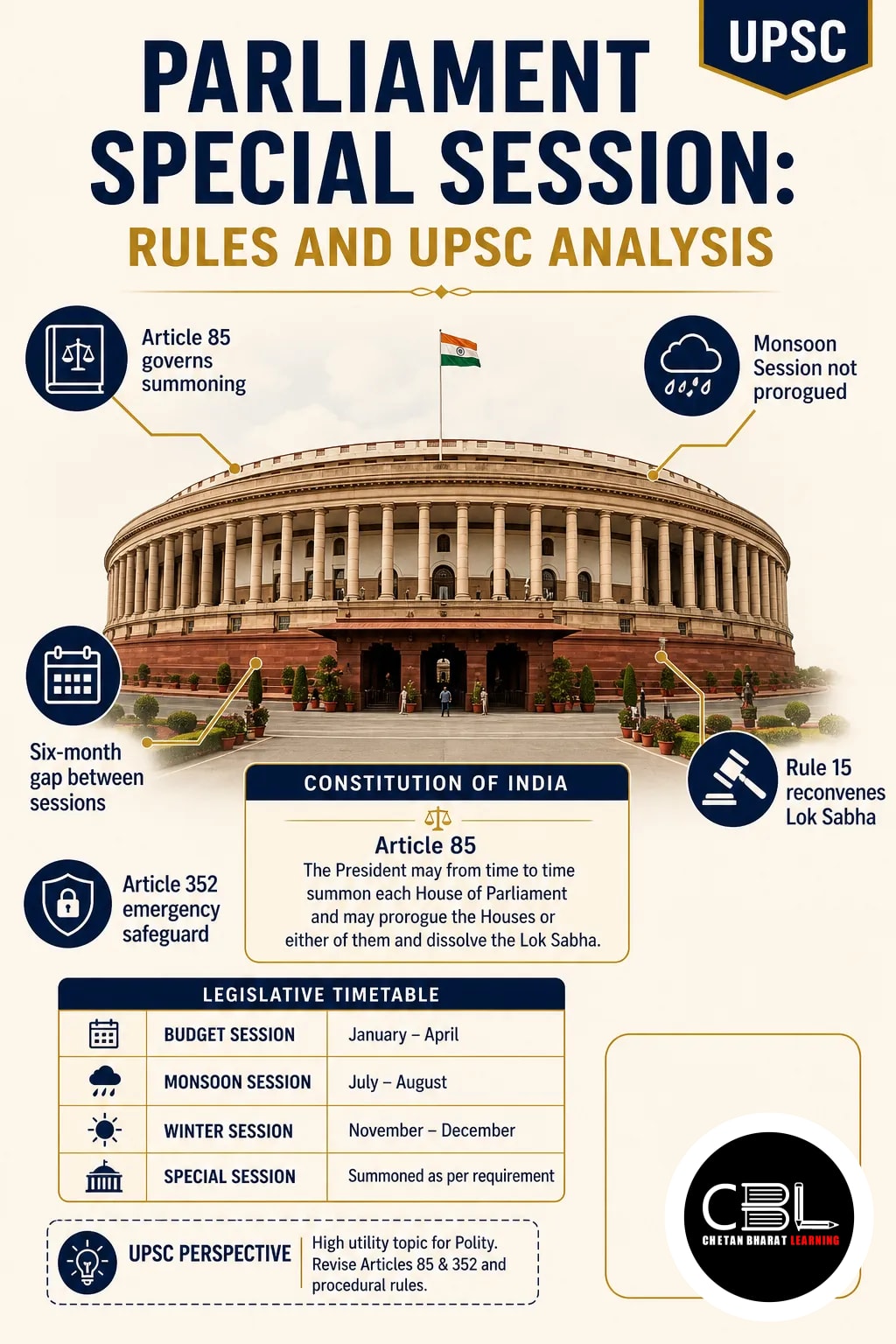
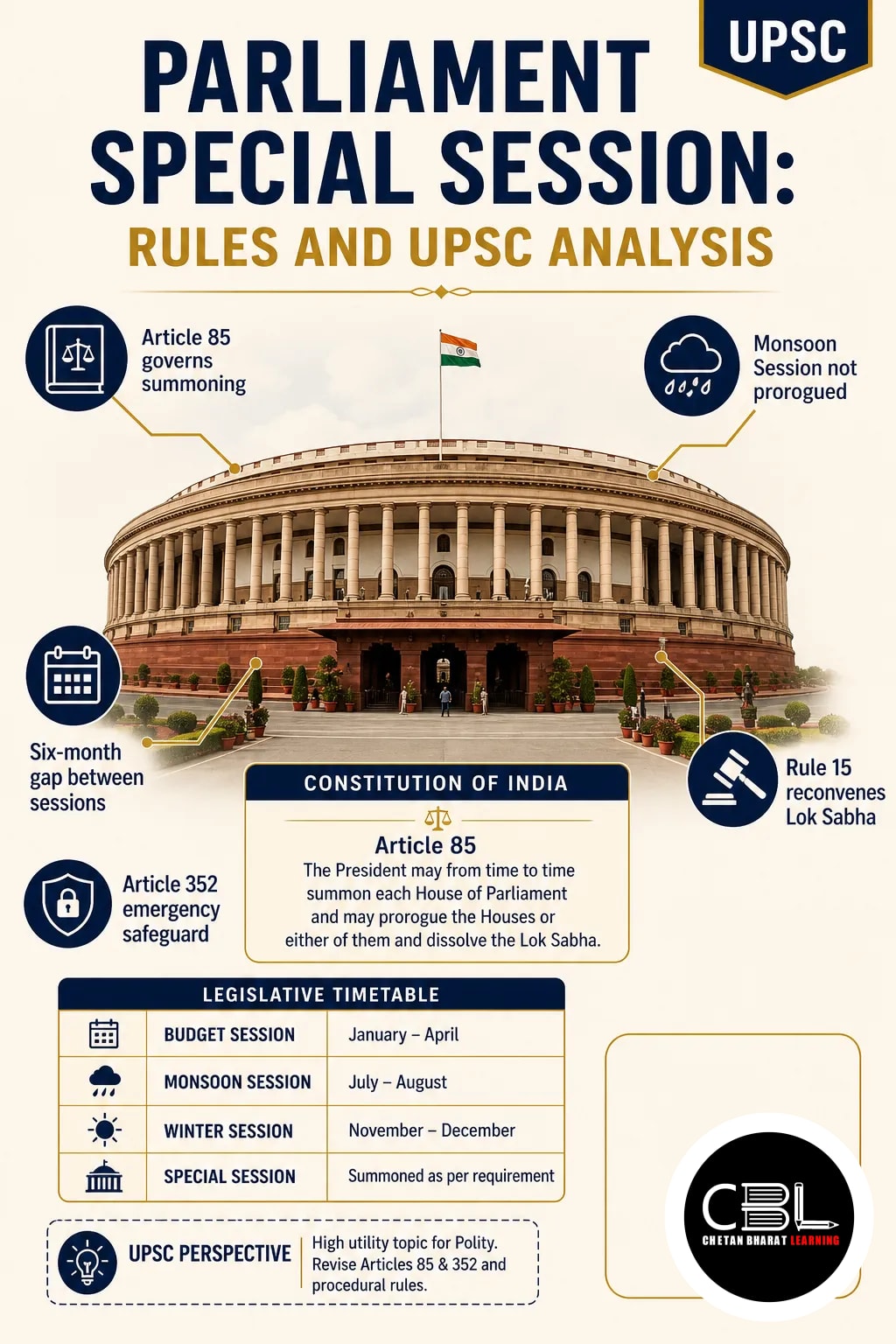
Quick answer: A Parliament special session is an informal term for a meeting convened outside the usual schedule or for a specific purpose. On 13 November 2026, The Indian Express reported plans for one before the Winter Session. Article 85 governs summoning; an unprorogued House, however, may instead be reconvened.
Why is a Parliament special session in the news?
The Centre is planning an early meeting to advance its legislative agenda on delimitation and women’s reservation, The Indian Express reported on 13 November. However, the report describes a possible session, not an announced date or enacted legislation.
Delimitation means redrawing electoral constituency boundaries. According to the report, sources viewed the proposed timing as potentially the last window to advance women’s quota implementation to the 2029 Lok Sabha elections.
The Constitution links implementation of the women’s reservation provisions to delimitation after publication of the relevant census figures. Therefore, a proposed sitting alone does not establish when reservation will take effect.
How are sessions summoned and scheduled?
Article 85 empowers the President to summon each House of Parliament, subject to the six-month limit between sessions. The President acts on the aid and advice of the Council of Ministers under Article 74.
The Cabinet Committee on Parliamentary Affairs takes the government’s scheduling decision. The President then formally summons members of Parliament; the committee currently includes 10 ministers, including those handling Defence, Home and Finance.
India has no fixed parliamentary calendar. Instead, convention provides for three annual sessions, while Article 85 requires that no more than six months pass between the last sitting of one session and the first sitting of the next.
| Session | Usual schedule |
|---|---|
| Budget | Late January to late April or early May, with a recess for committee scrutiny |
| Monsoon | Usually July to August, for about three weeks |
| Winter | Usually November to December, for about three weeks |
These dates can change. For example, the 2017 Winter Session was delayed because of the Gujarat Assembly elections; in 2011, parties agreed to shorten the Budget Session for state election campaigns.
What distinguishes a special session from a regular session?
The Constitution does not define a special session as a separate category under Article 85. Instead, governments use the expression for meetings outside the usual schedule or for particular occasions.
A Parliament special session can be called at shorter notice than a regular session. For regular sessions, the convention is approximately 15 days’ notice; the source also cites government sources on a 14-day notice requirement for summoning a session.
The presiding officers control proceedings in their respective Houses. Consequently, they can limit business and procedural opportunities, such as Question Hour, depending on the sitting’s arrangements.
Nevertheless, the label does not automatically create a distinct legislative procedure. The applicable constitutional requirements and rules continue to matter when Parliament considers legislation.
How do adjournment and prorogation differ?
Adjournment suspends a House’s sitting, whereas prorogation formally ends its session. Adjournment sine die means that a House stops sitting without fixing a date for its next meeting.
If a session remains unprorogued, it continues to exist despite adjournment sine die. Therefore, under Rule 15 of the Lok Sabha Rules of Procedure, the Speaker can reconvene the Lok Sabha at short notice.
The source reported that the Monsoon Session had not been prorogued for 91 days after its 13 August 2026 adjournment, as of 12 November. Government sources told the newspaper that this allowed Parliament to reconvene without the notice required for summoning a new session.
This distinction matters: reconvening an existing session is not the same procedural step as summoning a new session. Moreover, the reported plan does not by itself settle which route the government will use.
Which constitutional provisions should aspirants remember?
Articles 74, 85 and 352 address different aspects of executive advice, sessions and Emergency oversight.
| Provision | What it provides |
|---|---|
| Article 74 | A Council of Ministers aids and advises the President. |
| Article 85 | The President summons and prorogues the Houses; the gap between sessions cannot exceed six months. |
| Lok Sabha Rule 15 | The Speaker may reconvene the House before the date to which it was adjourned or after adjournment sine die. |
| Article 352 | A special sitting of the Lok Sabha can be requisitioned to consider disapproval of an Emergency proclamation. |
Article 85’s predecessor in the Government of India Act, 1935 allowed a gap of up to 12 months. The Constitution reduced that interval to six months, thereby requiring Parliament to meet at least twice a year.
The Emergency special sitting is different
Article 352 provides a specific safeguard, unlike the informal use of the term Parliament special session. If at least one-tenth of the total Lok Sabha membership gives written notice, a special sitting must be held within 14 days to consider disapproving the proclamation.
Members address the notice to the Speaker when the House is in session, or to the President when it is not. The Constitution (Forty-fourth Amendment) Act, 1978 introduced this safeguard after the 1975 Emergency.
Why do session arrangements matter for accountability?
Session arrangements affect both Parliament’s ability to act quickly and members’ opportunity to scrutinise the government.
- Legislative responsiveness: An early meeting can bring urgent proposals before elected representatives rather than waiting for the usual calendar.
- Preparation time: However, short notice can limit members’ time to examine complex proposals and consult stakeholders.
- Executive oversight: If Question Hour or other devices are unavailable, members have fewer opportunities during that sitting to question ministers.
- Committee scrutiny: In addition, adequate time for committee examination can improve assessment of legislative and financial proposals. Read more about parliamentary fiscal oversight.
- Calendar flexibility: The absence of fixed dates allows scheduling adjustments; however, frequent changes can make advance planning harder.
A balanced approach would provide early notice and publish the proposed agenda where possible. Also, sufficient debate and appropriate committee examination can support scrutiny without removing the flexibility to meet urgently.
Source: Indian Express Explained, 14 November 2026
- PAC Conference Kerala: Fiscal Oversight for UPSC (2 Nov 2026)
Punjab PCS and Haryana HCS can test the distinction between adjournment and prorogation in General Studies. In addition, revise Article 174, which governs summoning and prorogation of state legislatures and also prescribes a six-month maximum gap.
Prelims Practice Corner
Mains Practice Questions
Frequently Asked Questions
What is a Parliament special session?
It is an informal term for a meeting outside the usual schedule or for a specific occasion. However, Article 85 does not define it as a separate category of session.
Who summons Parliament in India?
The President summons each House under Article 85. The President acts on ministerial advice; the Cabinet Committee on Parliamentary Affairs takes the government’s scheduling decision.
Can the Lok Sabha meet after adjournment sine die?
Yes, if its session has not been prorogued. In that case, the Speaker may reconvene the House under Lok Sabha Rule 15.
Is the Article 352 special sitting the same as a special session?
No, because Article 352 provides a specific sitting to consider disapproval of an Emergency proclamation. In contrast, a special session is generally an informal description of a parliamentary meeting.
Related Current Affairs
Preparing for UPSC, PCS or HCS?
Talk to a mentor at Chetan Bharat Learning, Chandigarh. Free guidance on choosing the right exam and building a study plan.
Chat on WhatsAppCall 97793 53345UPSC / IAS / PCS coaching in Chandigarh · Trusted by aspirants across Punjab & Haryana









Leave a Reply
You must be logged in to post a comment.