

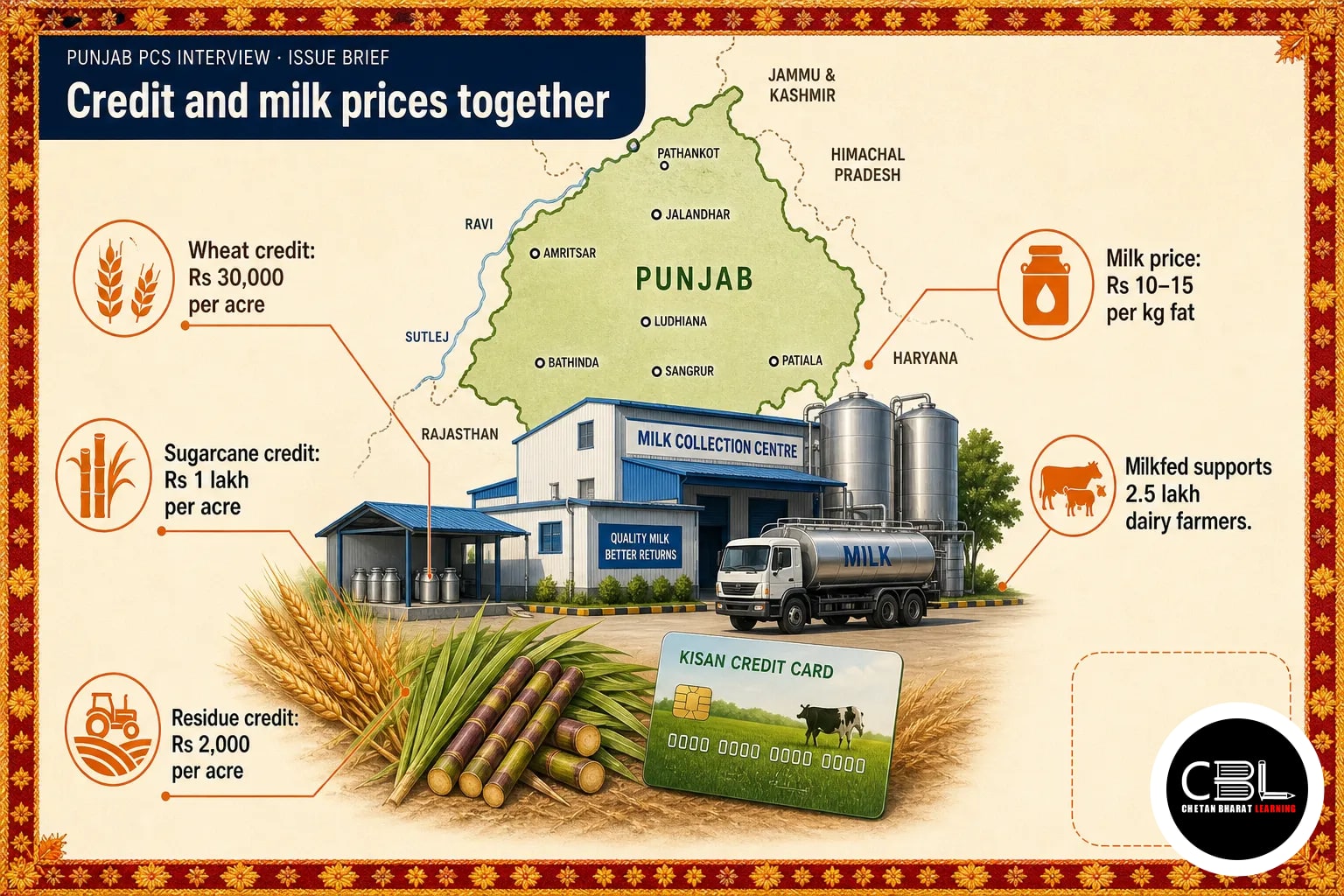
In April 2026, Milkfed Punjab raised milk procurement prices by Rs 10–15 per kg of fat, benefiting about 2.5 lakh dairy farmers. In June, Punjab announced revised Kisan Credit Card (KCC) limits of Rs 30,000 per acre for wheat and Rs 1 lakh for sugarcane, plus Rs 2,000 per acre separately for crop residue management. Together, these measures address farm credit, dairy returns and residue handling. Their impact depends on access and implementation.
Timeline: credit and returns in five stops
- 1998national schemeCredit card
The Kisan Credit Card scheme began in 1998.
- 1 Apr2026Milk revision
Milkfed raised procurement prices by Rs 10–15 per kg fat.
- 2 Jun2026Credit limits
Punjab announced wheat and sugarcane limits of Rs 30,000 and Rs 1 lakh per acre.
- 2 Jun2026Residue support
The announcement included a separate Rs 2,000 per acre for crop residue management.
- 1 Oct2026Price context
The Union Cabinet raised wheat minimum support price to Rs 2,610 per quintal for rabi 2027–28.
What connects farm credit and dairy support?
The Kisan Credit Card scheme provides a framework for institutional farm credit. The National Bank for Agriculture and Rural Development (NABARD) is associated with the scheme, and interest subvention can reduce borrowing costs.
Cooperative dairying pools producers to procure and market milk. Punjab farmers may combine crop cultivation with dairy work, making both credit access and milk returns relevant to household finances.
The two sides
Case for support
- Revised crop limits can improve access to formal credit for cultivation.
- A separate residue-management amount recognises a specific farm need.
- Higher procurement prices can improve returns for dairy farmers supplying Milkfed.
Implementation concerns
- A higher credit limit is still debt and must be repaid.
- Farmers’ access can depend on eligibility, documentation and bank processing.
- A price rise per kg of fat is not the same as a fixed increase per litre.
Key data
| Point | Details |
|---|---|
| KCC origin | Scheme launched in 1998. |
| Wheat credit | Announced limit of Rs 30,000 per acre. |
| Sugarcane credit | Announced limit of Rs 1 lakh per acre. |
| Crop residue | Separate announced amount of Rs 2,000 per acre. |
| Milk procurement | Increase of Rs 10–15 per kg fat, benefiting about 2.5 lakh dairy farmers. |
| Wheat price context | Minimum support price of Rs 2,610 per quintal for rabi 2027–28, announced in October 2026. |
Way forward
- Access: Help eligible farmers understand documentation and application procedures.
- Responsible lending: Explain repayment obligations and applicable interest terms before credit is sanctioned.
- Residue management: Connect credit support with practical guidance on managing crop residue.
- Milk transparency: Explain fat testing and procurement rates clearly to dairy suppliers.
- Review: Coordinate with banks and cooperatives to identify access gaps and resolve grievances.
Likely interview questions
What is the Kisan Credit Card, and what changed in Punjab in June 2026?
Answer pointers:
- It is a framework for institutional farm credit, launched in 1998.
- Punjab announced revised wheat and sugarcane limits and a separate residue-management amount.
- Distinguish an announced limit from credit actually accessed.
Do you think higher credit limits are an adequate response to farm debt?
Answer pointers:
- Formal credit can help farmers meet cultivation needs.
- Borrowing also creates repayment obligations and does not itself remove debt.
- Combine access with clear terms, financial guidance and grievance redress.
Do you think the Milkfed price increase will improve dairy farmers’ incomes?
Answer pointers:
- Higher procurement rates can improve returns for suppliers.
- The increase is per kg of fat, while costs and milk characteristics affect individual outcomes.
- Support transparent testing and assess returns alongside costs.
As Sub-Divisional Magistrate in Moga, how would you help farmers access these measures?
Answer pointers:
- Coordinate information sessions with banks and cooperative officials.
- Explain eligibility, credit terms, residue support and milk-fat pricing.
- Record grievances, refer them to the competent agency and review their resolution.
How would you link residue-management credit with Punjab’s air-quality challenge?
Answer pointers:
- Residue management offers an alternative to burning crop residue.
- Credit may help, but repayment and practical access remain important.
- Pair finance with technical guidance and local coordination.
Separate credit from a grant and a milk-fat price from a per-litre price. Discuss benefits and implementation risks without treating either measure as a complete solution.
Prelims Practice Corner
Q1. In which year was the Kisan Credit Card scheme launched?
(a) 1988 (b) 1998 (c) 2008 (d) 2018
Show answer
Answer: (b) because the scheme began in 1998.
Q2. What wheat credit limit per acre did Punjab announce in June 2026?
(a) Rs 2,000 (b) Rs 10,000 (c) Rs 30,000 (d) Rs 1 lakh
Show answer
Answer: (c) because the announced wheat limit was Rs 30,000 per acre.
Q3. Milkfed’s April 2026 procurement price increase was expressed per:
(a) litre of milk (b) kg of fat (c) dairy animal (d) acre
Show answer
Answer: (b) because the increase was Rs 10–15 per kg of fat.
Frequently Asked Questions
What is Punjab’s announced KCC limit for wheat in 2026?
The announced limit is Rs 30,000 per acre. It was part of the revision announced on 2 June 2026.
How much did Milkfed increase milk procurement prices in 2026?
Milkfed raised prices by Rs 10–15 per kg of fat. The increase took effect on 1 April 2026 and benefited about 2.5 lakh dairy farmers.
Is the crop residue amount a separate credit provision?
Yes, Punjab announced a separate Rs 2,000 per acre for crop residue management. It accompanied the revised crop credit limits.
Sources: GKToday: June 2026, GKToday: April 2026, GKToday: October 2026
Related Current Affairs
More Punjab interview issues
Preparing for UPSC, PCS or HCS?
Talk to a mentor at Chetan Bharat Learning, Chandigarh. Free guidance on choosing the right exam and building a study plan.
Chat on WhatsAppCall 97793 53345UPSC / IAS / PCS coaching in Chandigarh · Trusted by aspirants across Punjab & Haryana


Leave a Reply
You must be logged in to post a comment.