

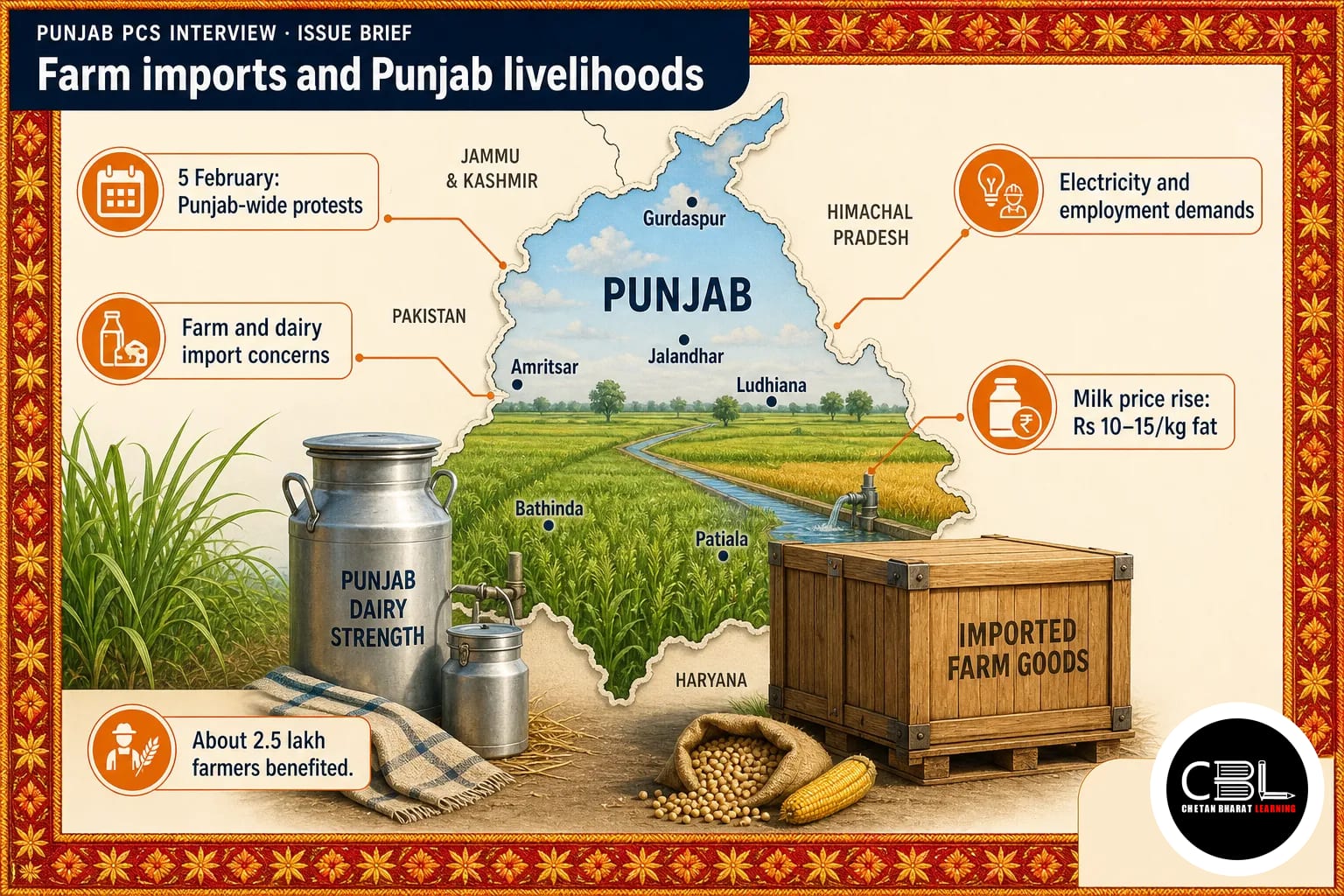
On 5 February 2026, farmer and worker unions protested across Punjab against the India–United States (US) trade deal and over other demands. They feared cheaper farm and dairy imports could depress local prices. The government said sensitive sectors were protected. The protests also covered electricity, rural employment and compensation. From 1 April 2026, Milkfed/Verka raised milk procurement prices by Rs 10–15 per kg fat, benefiting about 2.5 lakh farmers.
Timeline: trade, livelihoods and protest
- 1995global tradeTrade rules
The World Trade Organization and its Agreement on Agriculture came into force in 1995.
- 2005rural workEmployment law
The rural employment guarantee law was enacted in 2005.
- 5 Feb2026Protests
Farmer and worker unions protested across Punjab against the trade deal and over other demands.
- 1 Apr2026Milk prices
Milkfed/Verka raised procurement prices by Rs 10–15 per kg fat.
Why does a trade deal matter to Punjab farmers?
Trade rules influence the conditions under which agricultural goods can enter a market. The World Trade Organization (WTO) Agreement on Agriculture provides a framework for agricultural trade. Farmers worry that cheaper imports could affect the prices they receive.
Dairy is an important livelihood for small farmers. Minimum support price (MSP) is a benchmark announced for procurement of specified crops; it does not automatically guarantee every farmer a sale. A tariff-rate quota applies a lower tariff to imports within a specified quantity and usually a higher tariff beyond it.
The two sides
Farmers and worker unions
- Cheaper US farm and dairy imports could reduce prices for Punjab producers.
- Small farmers depend on dairy income as well as crops.
- Protesters also raised electricity, rural employment and compensation demands.
Government and policy considerations
- The government says sensitive sectors are protected.
- Trade policy must consider consumers and market access as well as producers.
- Specific tariff and quota provisions matter when assessing import risks.
Key data
| Point | Details |
|---|---|
| Protest date | 5 February 2026; protests took place across Punjab. |
| Protest locations | They included sites outside ministers’ and Members of Legislative Assembly’s residences. |
| Other demands | Opposition to the Electricity Amendment Bill, smart prepaid meters and changes to the Mahatma Gandhi National Rural Employment Guarantee Act (MGNREGA); compensation was also sought. |
| Dairy procurement | From 1 April 2026, Milkfed/Verka raised prices by Rs 10–15 per kg fat, benefiting about 2.5 lakh farmers. |
| Trade framework | The WTO Agreement on Agriculture came into force in 1995. |
| Constitutional hook | Article 19 protects peaceful assembly, subject to reasonable restrictions. |
Way forward
- Transparent terms: Explain relevant tariff, quota and safeguard provisions in accessible language.
- Regular dialogue: Consult farmer, dairy, worker and consumer representatives on likely effects.
- Market monitoring: Track import volumes and local prices to identify emerging pressures.
- Livelihood support: Strengthen dairy services and help small producers improve productivity and market access.
- Separate grievances: Address electricity, employment and compensation demands through their respective administrative channels.
Likely interview questions
What were the main issues raised in the February 2026 protests?
Answer pointers:
- Farmers feared cheaper US farm and dairy imports.
- Unions also raised electricity, rural employment and compensation demands.
- Distinguish trade concerns from other grievances before suggesting dialogue.
Do you think farmers’ concerns about the trade deal are justified?
Answer pointers:
- Import competition can matter for farm prices and dairy livelihoods.
- The government says sensitive sectors are protected; actual provisions matter.
- Seek transparent terms and monitor market outcomes.
Do you think protecting farmers should take priority over opening agricultural trade?
Answer pointers:
- Protection can help vulnerable producers manage adjustment.
- Trade can also affect consumer choices and market access.
- Balance both through calibrated rules and livelihood support.
As Sub-Divisional Magistrate in Bathinda, how would you handle a protest over the deal?
Answer pointers:
- Listen to representatives and record their demands.
- Facilitate peaceful assembly while maintaining safety and essential access.
- Send grievances to the competent authorities and communicate follow-up.
How would you link this protest to the constitutional right to peaceful assembly?
Answer pointers:
- Article 19 protects peaceful assembly, subject to reasonable restrictions.
- Administration must protect rights while safeguarding public order.
- Use proportionate measures and sustained communication.
Acknowledge both livelihood concerns and the government’s position. Avoid assuming specific deal terms or treating every protest demand as a trade issue.
Prelims Practice Corner
Q1. When did the farmer and worker unions protest across Punjab?
(a) 5 February 2026 (b) 1 April 2026 (c) 5 February 2025 (d) 1 April 2025
Show answer
Answer: (a) because the protests took place on 5 February 2026.
Q2. What does a tariff-rate quota generally provide?
(a) A ban on all imports (b) A lower tariff within a specified quantity (c) An MSP for every import (d) Free electricity for exporters
Show answer
Answer: (b) because imports within the specified quantity generally face a lower tariff.
Q3. Which constitutional provision protects peaceful assembly, subject to reasonable restrictions?
(a) Article 19 (b) Article 262 (c) Article 280 (d) Article 324
Show answer
Answer: (a) because Article 19 protects the right to assemble peacefully and without arms.
Frequently Asked Questions
Why did Punjab farmers protest against the India-US trade deal?
They feared cheaper US farm and dairy imports could hurt local prices. The government said sensitive sectors were protected.
What other demands were raised in the Punjab protests?
Unions raised electricity, rural employment and compensation issues. They also sought support for families of farmers who died during protests.
How much did Milkfed/Verka raise milk procurement prices in 2026?
It raised them by Rs 10–15 per kg fat from 1 April 2026. The increase benefited about 2.5 lakh farmers.
Sources: GKToday: February 2026, GKToday: April 2026
Related Current Affairs
More Punjab interview issues
Preparing for UPSC, PCS or HCS?
Talk to a mentor at Chetan Bharat Learning, Chandigarh. Free guidance on choosing the right exam and building a study plan.
Chat on WhatsAppCall 97793 53345UPSC / IAS / PCS coaching in Chandigarh · Trusted by aspirants across Punjab & Haryana


Leave a Reply
You must be logged in to post a comment.