
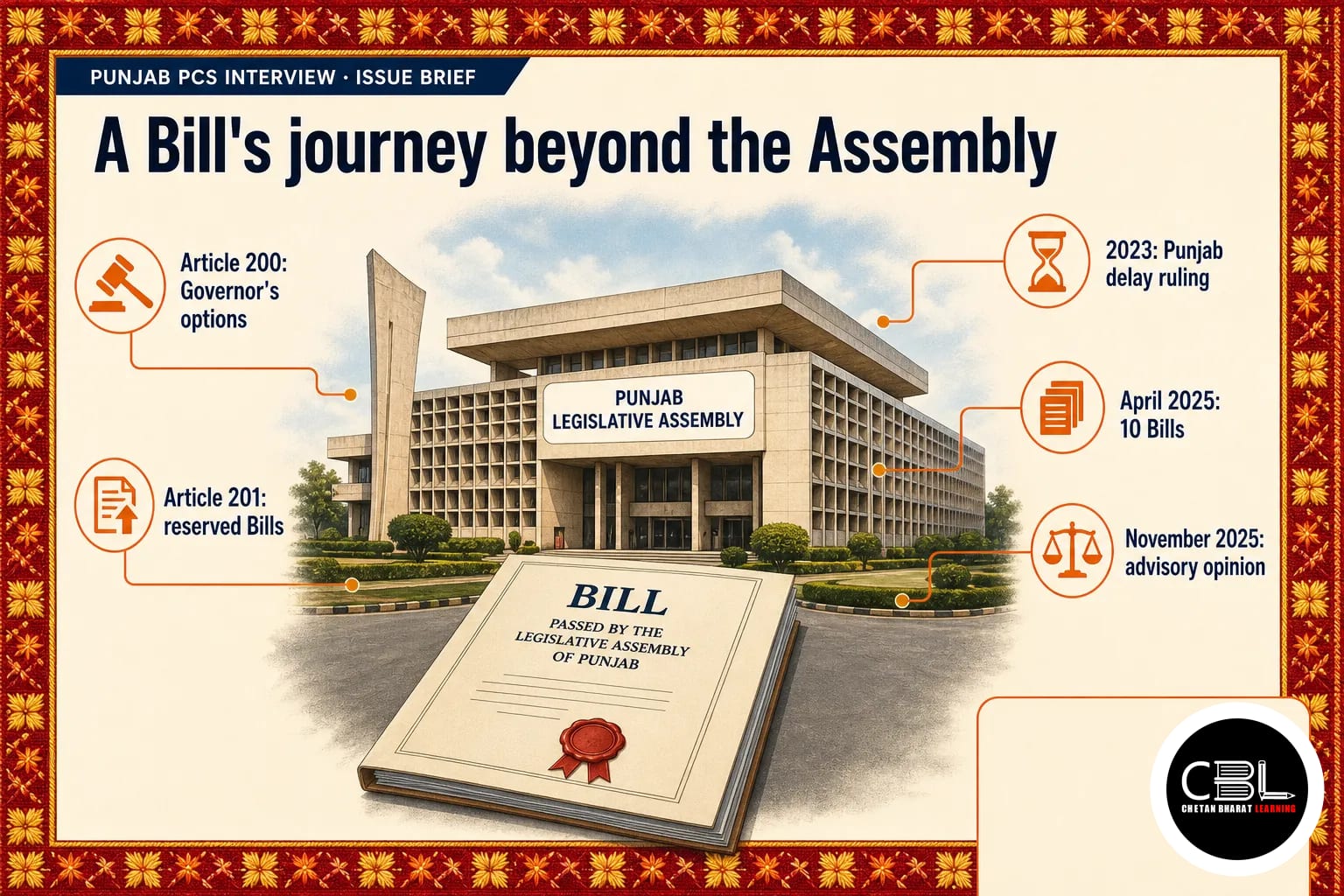
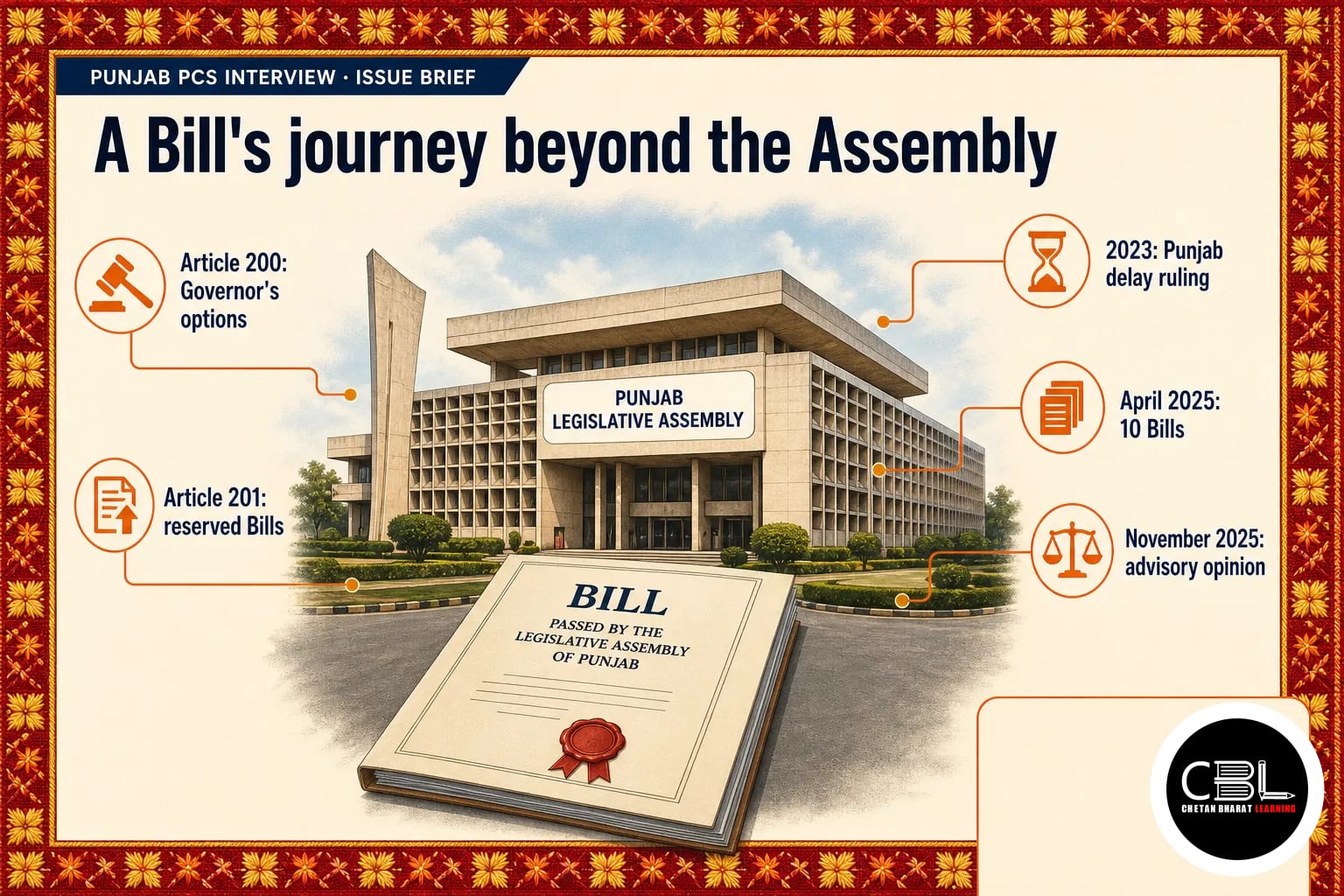
Punjab’s disputes over assent to Bills raise questions about the Governor’s role and the elected Assembly’s authority. In 2023, the Supreme Court said the Governor could not sit indefinitely on Bills. In April 2025, a Tamil Nadu judgment set timelines and deemed 10 Bills assented. On 20 November 2025, the Court opined that the Constitution fixes no timelines and permits no deemed assent, but Governors cannot indefinitely delay action.
Timeline: from assent to advisory opinion
- 1950ConstitutionFramework
Articles 200 and 201 provide the framework for action on state Bills.
- Nov2023Punjab ruling
The Supreme Court said Punjab’s Governor could not sit indefinitely on Assembly Bills.
- Apr2025Timelines
In the Tamil Nadu case, the Court set timelines and deemed 10 Bills assented.
- 20 Nov2025Opinion
The Court said there are no constitutionally fixed timelines or deemed assent; indefinite delay remains impermissible.
What happens after the Assembly passes a Bill?
Under Article 200, the Governor may assent, withhold assent, return a non-money Bill for reconsideration, or reserve a Bill for the President. Article 201 deals with Bills reserved for the President.
Article 163 concerns the Governor’s aid and advice from the Council of Ministers, subject to constitutional discretion. The Sarkaria and Punchhi Commissions examined the Governor’s role in Centre–state relations.
The two sides
Elected government’s perspective
- The Assembly represents voters and passes Bills through a legislative process.
- Prolonged delay can hold up policies approved by elected representatives.
- Timely decisions allow the government to respond through constitutional channels.
Governor’s constitutional role
- Article 200 provides options beyond immediate assent, including reservation for the President.
- Constitutional scrutiny can protect the legislative process and the wider constitutional framework.
- The 2025 opinion rejects fixed constitutional timelines and deemed assent, while rejecting indefinite delay.
Key data
| Point | Details |
|---|---|
| Governor’s options | Article 200: assent, withhold, return a non-money Bill, or reserve it for the President. |
| Reserved Bills | Article 201 deals with the President’s action on reserved Bills. |
| Aid and advice | Article 163 addresses the Governor’s relationship with the Council of Ministers. |
| Punjab ruling | In November 2023, the Supreme Court directed a decision on Bills from the June session. |
| Tamil Nadu judgment | In April 2025, the Court used Article 142 to deem 10 Bills assented. |
| Advisory opinion | On 20 November 2025, the Court gave its opinion under Article 143. |
| Punjab’s later plea | The challenge concerning two reserved Bills was closed after refusal of assent to one and queries on the other. |
Way forward
- Timely communication: The government and Governor’s office should exchange reasons and clarifications promptly.
- Better drafting: Departments should examine constitutional and legal issues before introducing Bills.
- Track proposals: Maintain a shared record of Bills, queries and responses without treating a tracking target as a constitutional deadline.
- Use dialogue: Resolve concerns through institutional consultation while respecting each office’s constitutional role.
- Follow the law: Act consistently with the Supreme Court’s opinion and avoid indefinite delay.
Likely interview questions
What options does Article 200 give the Governor after a Bill is passed?
Answer pointers:
- Assent, withhold assent or reserve the Bill for the President.
- Return a non-money Bill for reconsideration.
- Explain these options alongside the duty to avoid indefinite delay.
Do you think a Governor should have a fixed deadline to act on Bills?
Answer pointers:
- Timely action supports legislative accountability.
- Some Bills require constitutional scrutiny and consultation.
- Note the 2025 opinion: no constitutionally fixed timeline, but no indefinite delay.
Do you think reserving a state Bill for the President weakens federalism?
Answer pointers:
- Excessive delay may affect an elected Assembly’s work.
- Reservation is an option provided by the Constitution.
- Support reasoned, timely communication and respect for constitutional roles.
As a sub-divisional magistrate, how would you address public concerns about a delayed state Bill?
Answer pointers:
- Explain that assent is a constitutional process outside your office’s authority.
- Share verified public information without predicting the outcome.
- Record concerns and direct people to appropriate official channels.
How does the assent debate relate to Article 163 and cooperative federalism?
Answer pointers:
- Article 163 concerns aid and advice, subject to constitutional discretion.
- The Governor and elected government have distinct constitutional responsibilities.
- Encourage dialogue and timely action within the constitutional framework.
Distinguish the April 2025 judgment from the November advisory opinion. Avoid personal or partisan criticism; focus on constitutional roles and timely action.
Prelims Practice Corner
Q1. Which Article deals with the Governor’s options on a state Bill?
(a) Article 163 (b) Article 200 (c) Article 201 (d) Article 143
Show answer
Answer: (b) because Article 200 sets out the Governor’s options on a Bill.
Q2. Under which Article did the Supreme Court give its November 2025 advisory opinion?
(a) Article 142 (b) Article 163 (c) Article 143 (d) Article 200
Show answer
Answer: (c) because Special Reference No. 1 of 2025 invoked Article 143.
Q3. What did the November 2025 opinion say about action on Bills?
(a) Assent is automatic after three months (b) Governors may delay indefinitely (c) Every Bill must be reserved (d) No fixed constitutional timeline applies, but indefinite delay is impermissible
Show answer
Answer: (d) because the opinion rejected fixed timelines and deemed assent while disallowing indefinite delay.
Frequently Asked Questions
Can the Punjab Governor delay assent indefinitely?
No. The Supreme Court has said Governors cannot sit on Bills indefinitely, although the Constitution prescribes no fixed timeline.
What is the President’s role in a reserved state Bill?
Article 201 governs the President’s action on a Bill reserved by the Governor. Reservation is one of the options under Article 200.
What happened to Punjab’s challenge over two reserved Bills?
The plea was closed after Punjab was told assent had been refused to one Bill and queries sent on the other. The challenge concerned the Governor’s decision to reserve both Bills for the President.
Sources: Tribune, LiveLaw, Supreme Court
Related Current Affairs
More Punjab interview issues
Preparing for UPSC, PCS or HCS?
Talk to a mentor at Chetan Bharat Learning, Chandigarh. Free guidance on choosing the right exam and building a study plan.
Chat on WhatsAppCall 97793 53345UPSC / IAS / PCS coaching in Chandigarh · Trusted by aspirants across Punjab & Haryana


Leave a Reply
You must be logged in to post a comment.