
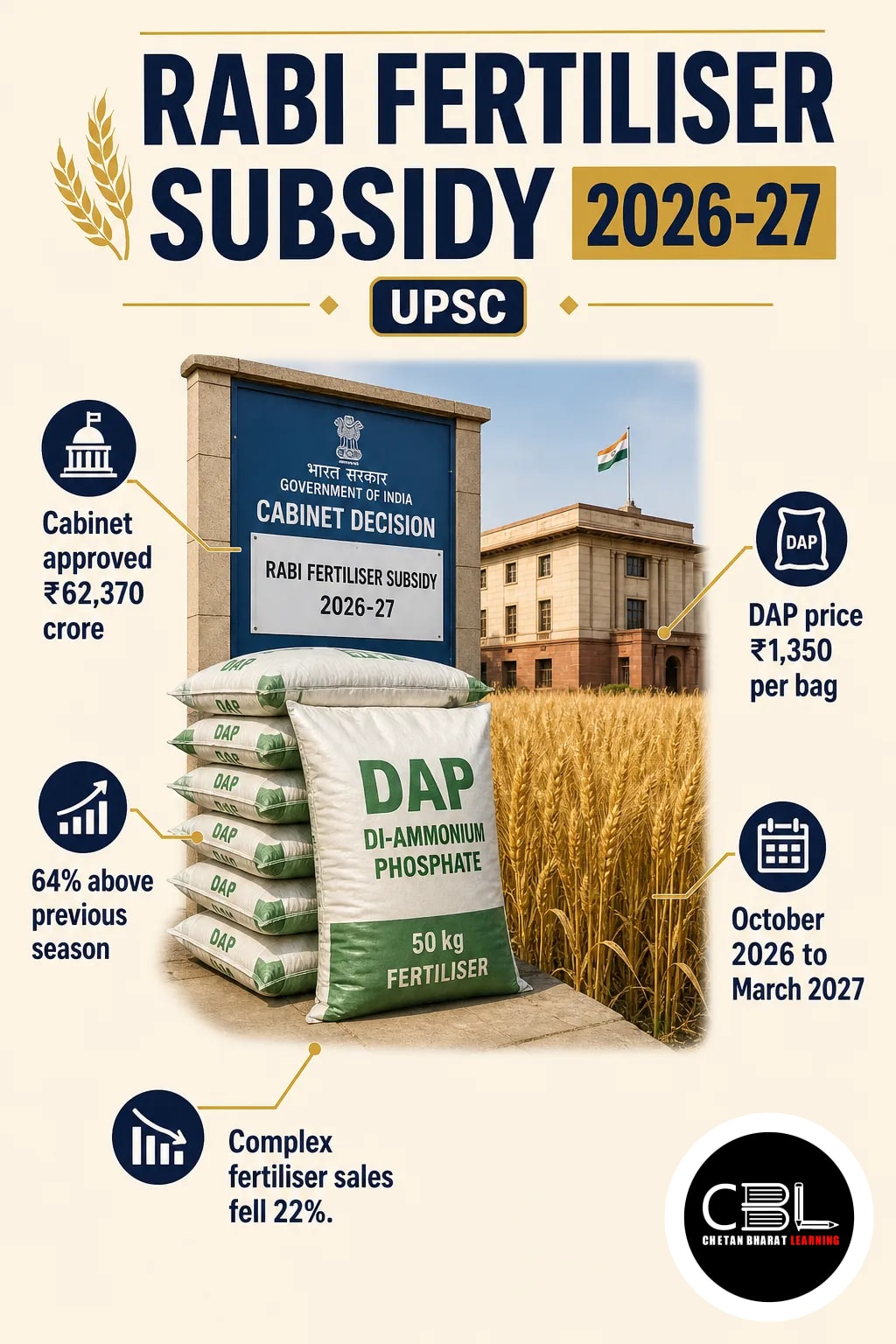
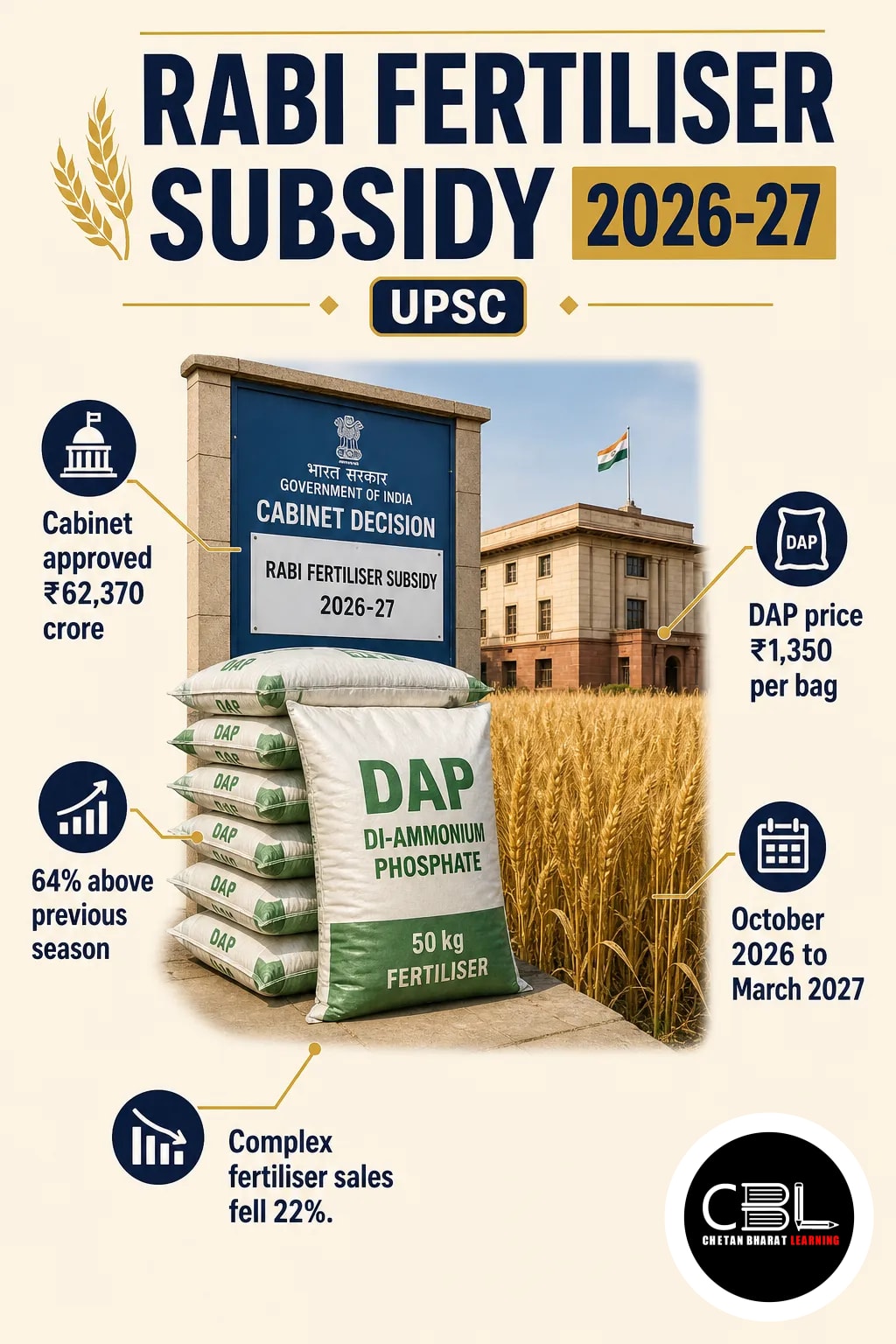
The rabi fertiliser subsidy for 2026-27 has received Union Cabinet approval of ₹62,370 crore. For related coverage, explore CBL’s economy current affairs.
Quick answer: On 11 November 2026, the Union Cabinet approved ₹62,370 crore for the rabi fertiliser subsidy, 64% above the previous season’s allocation. The rates for phosphatic and potassic fertilisers apply from 1 October 2026 to 31 March 2027. Additionally, the government will continue the special provision for di-ammonium phosphate at ₹1,350 per bag.
What did the Cabinet approve?
The Cabinet approved ₹62,370 crore for fertiliser subsidy during the 2026-27 rabi season. This compares with ₹37,952 crore for the previous season. Additionally, the government will continue its special provision to keep di-ammonium phosphate (DAP) at ₹1,350 per bag for farmers.
| Item | Key fact |
|---|---|
| 2026-27 rabi allocation | ₹62,370 crore |
| Previous rabi allocation | ₹37,952 crore |
| Phosphatic and potassic subsidy period | 1 October 2026 to 31 March 2027 |
| DAP price for farmers | ₹1,350 per bag |
The rabi fertiliser subsidy decision covers phosphatic and potassic fertilisers, including DAP. For the supply-side context, see CBL’s coverage of sulphur risks in phosphatic fertilisers.
Which nutrients are relevant?
The nutrient-based approach refers to nitrogen, phosphorus, potassium and sulphur in fertilisers. Complex fertilisers contain these nutrients in different ratios. DAP, meanwhile, supplies nitrogen and phosphorus.
For Prelims, distinguish the fertiliser product from its nutrient components. Also, the fixed DAP price is a special provision; it is not a price stated for every fertiliser.
How much has the Centre spent?
The Centre spent about ₹1.19 lakh crore on fertiliser subsidies in April–September 2026. This was nearly 70% of the full-year Budget estimate of ₹1.71 lakh crore.
According to the Controller General of Accounts, first-half spending included ₹33,664 crore on nutrient-based fertiliser subsidy. Meanwhile, urea subsidy spending stood at ₹85,586 crore. Their respective full-year Budget allocations were ₹54,000 crore and ₹1.17 lakh crore.
These figures cover the financial year, whereas the new approval concerns the rabi season. Therefore, candidates should not treat the two amounts as identical measures.
Why does the subsidy matter?
The rabi fertiliser subsidy supports fertiliser availability and the fixed DAP price for farmers. Meanwhile, the West Asia war, the energy shock and closure of the Strait of Hormuz raised global fertiliser prices, according to the source.
Domestic demand also changed: poor rainfall contributed to lower sales in the first half of 2026-27. Complex fertiliser sales fell 22%, while urea and DAP sales fell 4% and 0.6%, respectively. For further context, read CBL’s analysis of India’s fertiliser supply pressures.
Source: Indian Express Business, 12 November 2026
- Phosphatic Fertiliser Security: India’s Sulphur Risk (23 Sep 2026)
- Fertiliser Crisis: Why India Avoided It | UPSC Analysis (10 Aug 2026)
Punjab PCS and Haryana HCS may test the subsidy alongside rabi crops and agricultural inputs. For example, candidates should connect fertiliser availability with wheat cultivation in both states.
Prelims Practice Corner
Mains Practice Questions
Frequently Asked Questions
How much is the rabi fertiliser subsidy for 2026-27?
The allocation is ₹62,370 crore. This is 64% above the previous rabi season’s ₹37,952 crore.
What is the DAP price for farmers?
The fixed price is ₹1,350 per bag. The government will therefore continue the special provision supporting this price.
What is the subsidy period for phosphatic and potassic fertilisers?
The period runs from 1 October 2026 to 31 March 2027. It therefore covers the 2026-27 rabi season.
Related Current Affairs
Preparing for UPSC, PCS or HCS?
Talk to a mentor at Chetan Bharat Learning, Chandigarh. Free guidance on choosing the right exam and building a study plan.
Chat on WhatsAppCall 97793 53345UPSC / IAS / PCS coaching in Chandigarh · Trusted by aspirants across Punjab & Haryana









Leave a Reply
You must be logged in to post a comment.