
Barrier-less tolling faces an enforcement challenge as unidentified vehicles pass highway plazas without paying user fees. The issue links infrastructure financing and economic governance with digital identification and inter-agency coordination.
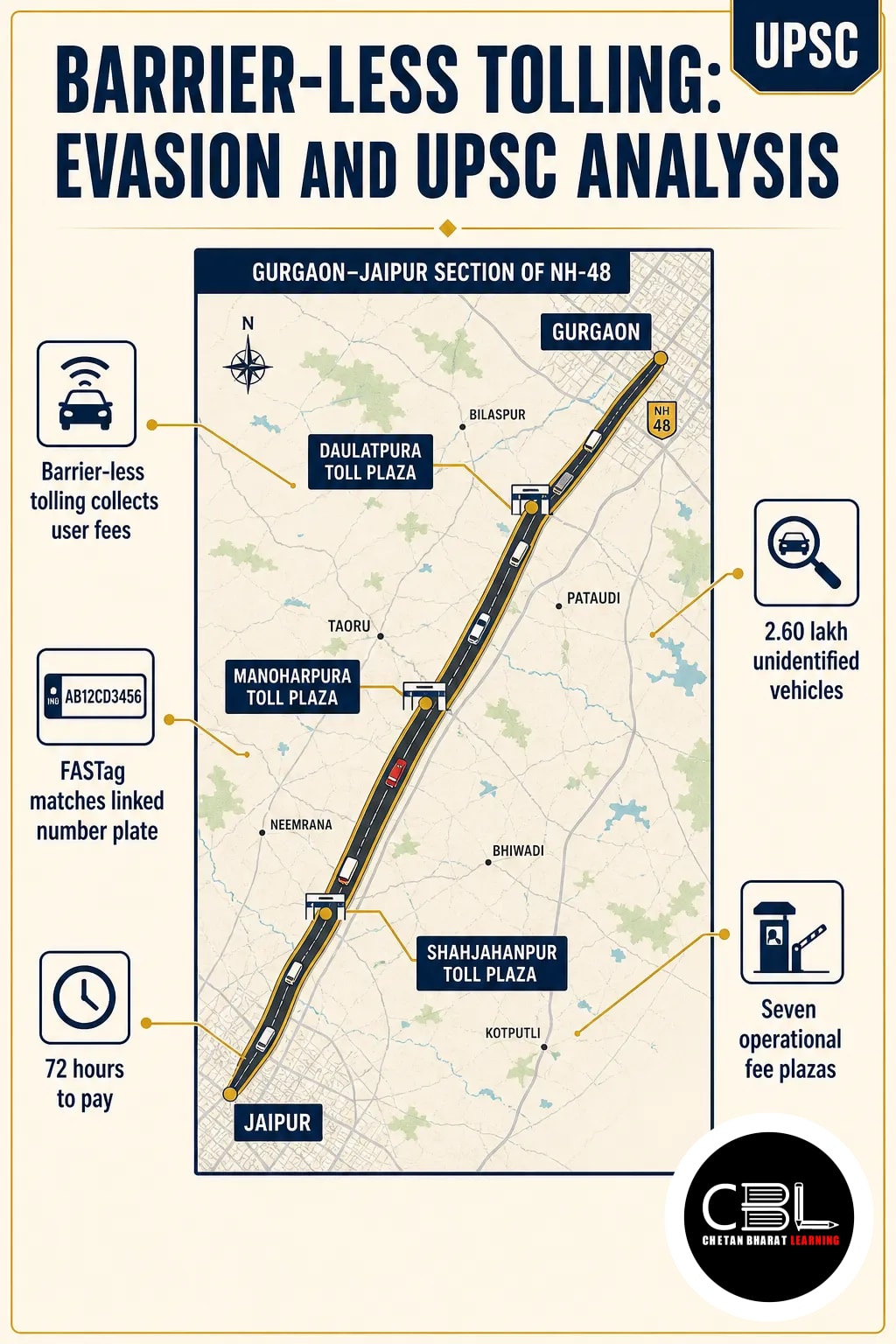
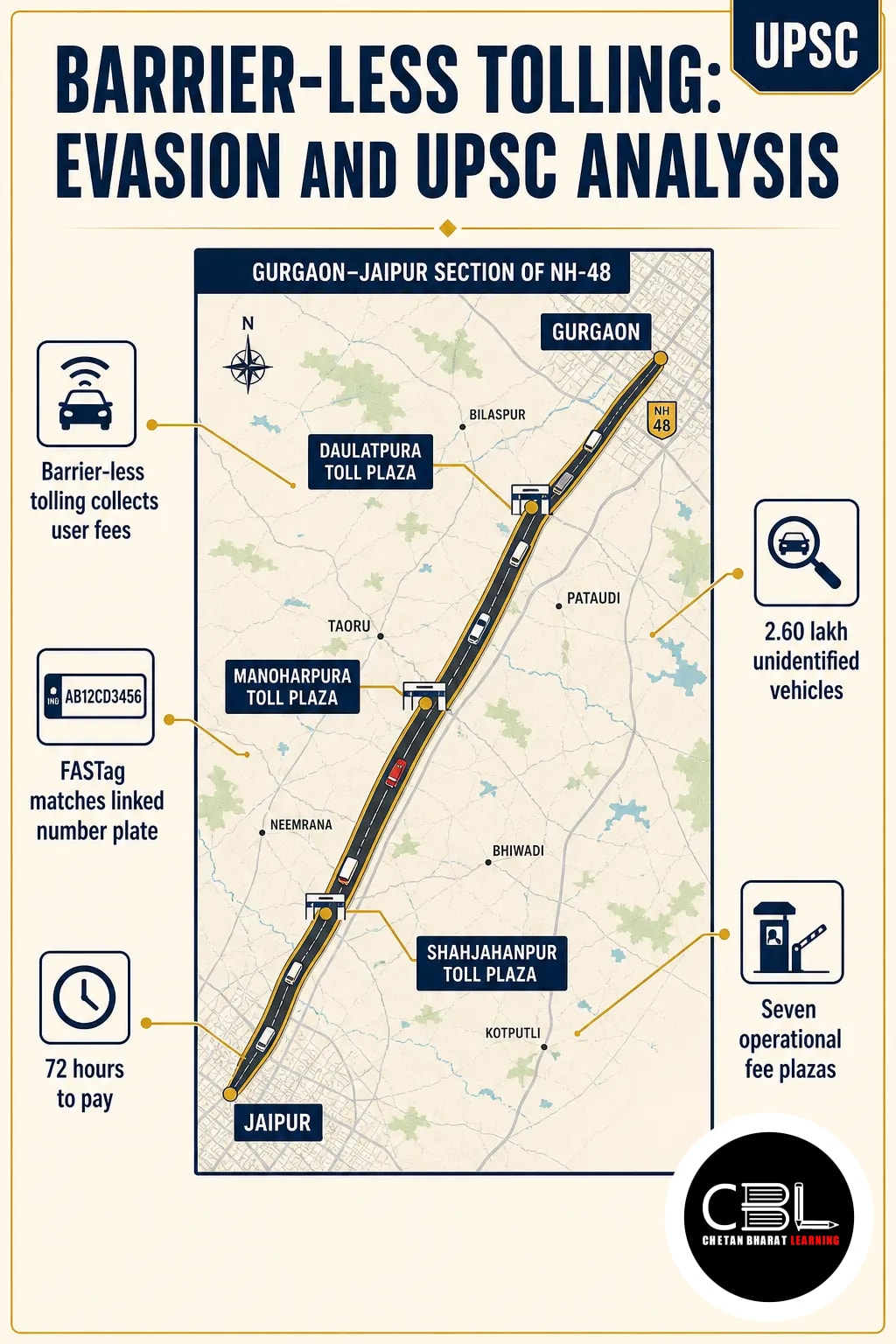
Quick answer: Barrier-less tolling lets vehicles pass without stopping, but identification gaps prevent fee recovery. At Rajasthan’s Shahjahanpur plaza, 2.60 lakh of around 24 lakh vehicles were unidentified. Consequently, the road transport ministry is discussing identification and enforcement measures with investigating agencies and Goods and Services Tax authorities.
What is barrier-less tolling?
Barrier-less tolling collects highway user fees without requiring vehicles to stop at a toll barrier. The Multi-Lane Free Flow (MLFF) system aims to reduce congestion and enable continuous passage through toll plazas.
Under MLFF, the system deducts the fee when a vehicle’s FASTag matches its linked number plate. If the FASTag has insufficient funds, the system issues an electronic notice and gives the commuter 72 hours to pay. For background, see CBL’s guide to the MLFF toll system.
In contrast, an unidentified vehicle cannot be readily linked to a recoverable toll account. The category includes vehicles whose plates or FASTags are obscured or not visible, and those with fake or impersonated plates. Thus, insufficient balance and failed identification are distinct problems.
Why are unidentified vehicles in the news?
Large numbers of vehicles are passing MLFF plazas without identification or payment, particularly on National Highway 48 (NH-48). The Ministry of Road Transport and Highways (MoRTH) has therefore initiated discussions with investigating agencies and Goods and Services Tax (GST) authorities.
| Plaza | Reported identification gap |
|---|---|
| Shahjahanpur, Rajasthan | 2.60 lakh unidentified among around 24 lakh vehicles; MLFF began on 1 August. |
| Manoharpura, Rajasthan | Over 99,500 unidentified among 31.74 lakh vehicles by 21 October; MLFF began on 1 July. |
| Mundka-Bakkarwala, Delhi | Around 2% of vehicles could not be identified. |
| Paranur, Tamil Nadu | Over 500 vehicles were unidentified in the first 20 days after the 1 October launch. |
The problem is especially consequential on the Gurgaon–Jaipur section of NH-48. All three plazas there—Daulatpura, Manoharpura and Shahjahanpur—use MLFF. Therefore, an unidentified vehicle can traverse the entire section without paying a toll.
How far has MLFF been rolled out?
MLFF is operational at seven fee plazas, beginning with Choryasi in Gujarat’s Surat. The National Highways Authority of India (NHAI) launched the system in May.
Besides the three Rajasthan plazas and Choryasi, the operational sites are Mundka in Delhi, Gharaunda in Haryana and Paranur in Tamil Nadu. Indian Highways Management Company Ltd (IHMCL), NHAI’s tolling implementation agency, has also awarded contracts for 10 more plazas and invited bids for another 104.
According to the Economic Survey 2025–26, MLFF is projected across all four-lane and wider national highways and expressways by March 2029. However, that projection is a future rollout goal, not evidence that coverage already exists.
What are the governance and economic concerns?
The main challenge is to preserve seamless travel while ensuring that users pay and enforcement remains accountable.
- Revenue recovery: NHAI and banks face revenue losses because no mechanism currently recovers the fee when a vehicle cannot be identified. Consequently, expanding the network without addressing identification can widen the recovery gap.
- Corridor-wide evasion: A fully barrier-less stretch offers no intervening boom-barrier transaction for cross-checking. Thus, enforcement must follow the journey across plazas rather than treat each crossing in isolation.
- Possible wider offences: Officials are concerned about smuggling, illegal sand mining and GST evasion; the e-way bill system is linked to FASTag. However, an unidentified crossing alone does not establish any such offence.
- Reliability and fairness: Identification depends on both tag and plate information. Therefore, an enforcement process must distinguish deliberate impersonation from an unreadable plate, a data mismatch or another identification failure.
- Data governance: Linking toll transactions with registration and enforcement records can aid recovery. Nevertheless, greater data sharing also calls for safeguards against errors, unnecessary access and misuse.
What measures are under consideration?
Authorities are considering coordinated identification, data sharing and stronger penalties, but the reported measures are not final decisions.
A dedicated internal portal is being developed to identify vehicles and share data with relevant departments. In addition, officials are reviewing the matter every 15 days and awarding MLFF projects in stages. The latter approach can allow checks against information from remaining boom-barrier plazas.
Officials propose matching vehicle model and colour details from the VAHAN registration database with FASTag transactions at those plazas. They also plan to use artificial intelligence (AI) to integrate datasets within a 10-minute window. However, the report describes this as an intended identification method, not a proven system operating everywhere.
Other options under consideration include a penalty exceeding twice the toll and registration of a First Information Report (FIR). Therefore, these measures should not be treated as penalties already notified for every unidentified vehicle.
What is the way forward?
A credible rollout needs accurate identification, proportionate enforcement and an accessible means to contest errors.
First, agencies could verify suspected mismatches before imposing penalties and provide vehicle owners a clear correction and appeal process. Second, controlled data access, retention limits and audit trails could reduce misuse while allowing authorised investigation.
Finally, monitoring recovery rates alongside traffic flow would show whether the system delivers both efficiency and compliance. Staged deployment can continue, but corridor-level checks must remain effective when all plazas on a route become barrier-less.
Source: The Indian Express, 10 November 2026
- MLFF Toll System: Highway Tolling for UPSC (31 Oct 2026)
Gharaunda on NH-44 in Haryana is among the seven operational MLFF plazas. Therefore, Haryana HCS and Punjab PCS aspirants can connect highway tolling with digital service delivery, enforcement coordination and state-level transport administration.
Prelims Practice Corner
Mains Practice Questions
Frequently Asked Questions
What happens if a FASTag has insufficient balance at an MLFF plaza?
The commuter receives an electronic notice and has 72 hours to pay. This differs from an unidentified vehicle, because identification is needed to link a crossing to an account.
Which was India’s first MLFF toll plaza?
Choryasi in Surat, Gujarat, was the first. NHAI launched MLFF there in May, and the system is now operational at seven plazas.
Has a higher penalty for unidentified vehicles been finalised?
No, a penalty exceeding twice the toll is still under consideration. Authorities are also considering FIR registration, but the report does not describe either measure as a final decision.
Related Current Affairs
Preparing for UPSC, PCS or HCS?
Talk to a mentor at Chetan Bharat Learning, Chandigarh. Free guidance on choosing the right exam and building a study plan.
Chat on WhatsAppCall 97793 53345UPSC / IAS / PCS coaching in Chandigarh · Trusted by aspirants across Punjab & Haryana









Leave a Reply
You must be logged in to post a comment.