
UPSC Mapping
Quick Facts
| Developer | DRDO-GTRE |
|---|---|
| Thrust Class | 350 kg |
| Type | Expendable Turbojet Engine |
| Applications | Cruise Missiles & UAVs |
Article
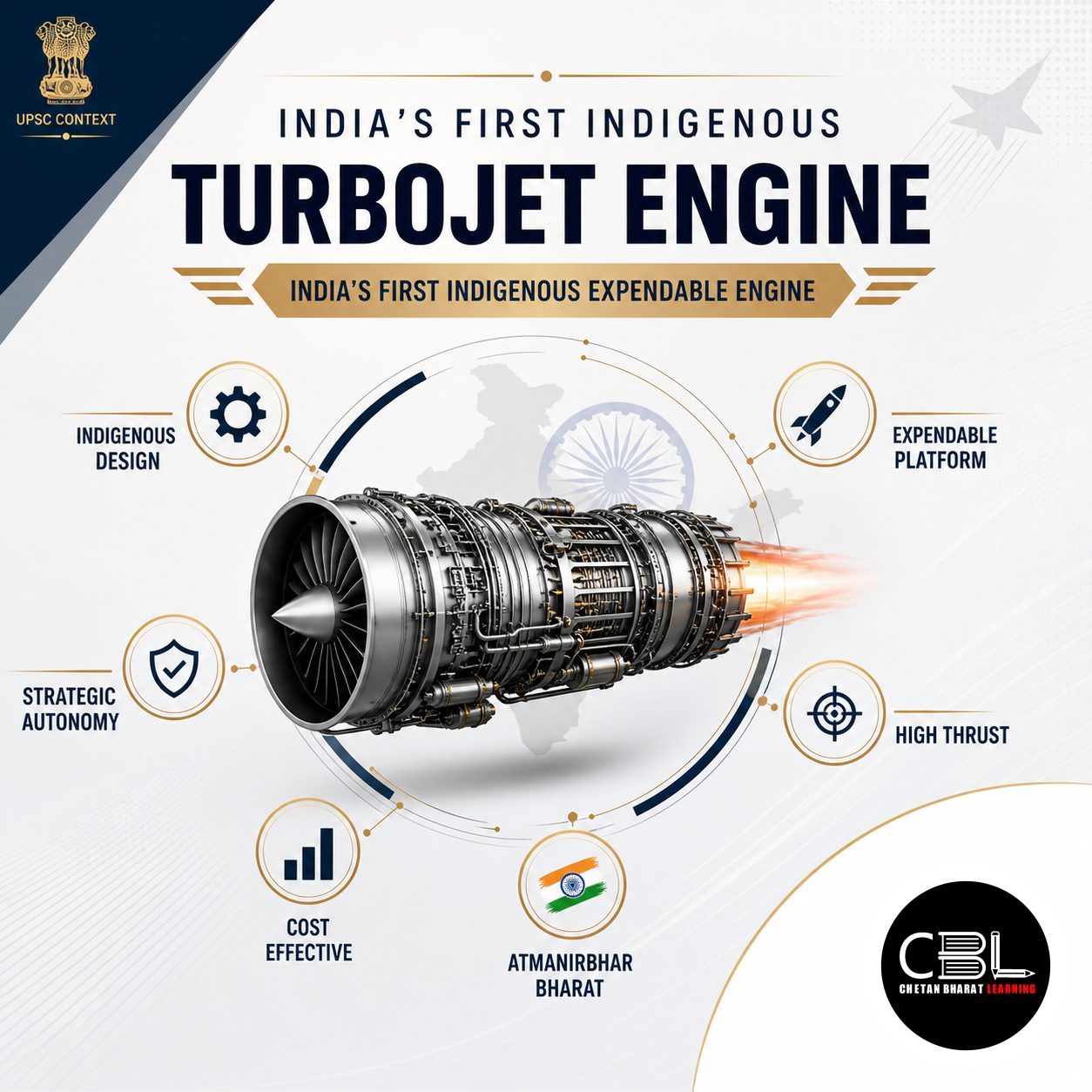
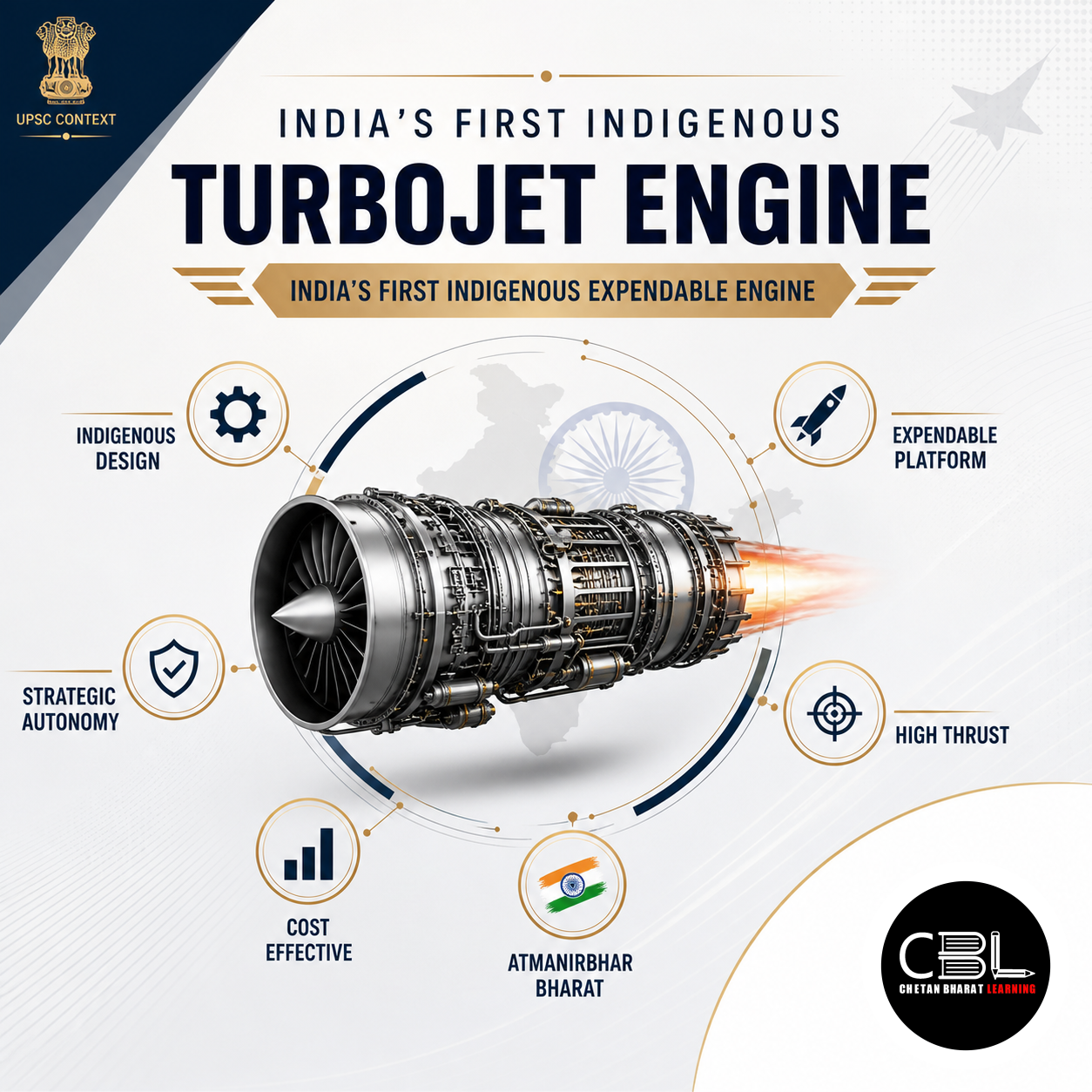
Turbojet Engine technology has achieved a major milestone with the development of India’s first indigenous expendable turbojet engine by the Gas Turbine Research Establishment (GTRE) under the Defence Research and Development Organisation (DRDO). The achievement strengthens India’s self-reliance in advanced aerospace propulsion technologies. Read more science and technology updates in the daily current affairs archive.
What is Turbojet Engine?
A Turbojet Engine is a type of air-breathing jet engine that generates thrust by compressing atmospheric air, mixing it with fuel, igniting the mixture and expelling high-speed exhaust gases through a nozzle. Unlike rockets, turbojet engines carry only fuel while using atmospheric air as the working fluid.
Turbojet engines are widely used in cruise missiles, certain unmanned aerial vehicles (UAVs), target drones and military aircraft requiring high-speed propulsion.
Why is Turbojet Engine in News?
Turbojet Engine technology is in the news because the Defence Research and Development Organisation (DRDO), through its Gas Turbine Research Establishment (GTRE), has successfully developed India’s first indigenous expendable turbojet engine in the 350 kg thrust class.
The engine is intended to power cruise missiles, unmanned aerial vehicles (UAVs), drones and other defence platforms requiring compact jet propulsion. Official updates are available through the Defence Research and Development Organisation.
Key Features of India’s Indigenous Turbojet Engine
- Indigenous development: Designed and developed by DRDO’s Gas Turbine Research Establishment (GTRE).
- 350 kg thrust class: Suitable for compact, high-speed defence platforms.
- Expendable design: Optimised for one-time operational use in systems such as cruise missiles.
- Multiple applications: Can power cruise missiles, UAVs, drones and other air-breathing platforms.
- Advanced propulsion: Demonstrates India’s growing expertise in complex aerospace engine technologies.
How Does a Turbojet Engine Work?
A turbojet engine operates through four basic stages.
- Air intake: Atmospheric air enters the engine through the intake.
- Compression: Compressors increase the pressure of incoming air.
- Combustion: Fuel is injected and ignited, producing high-temperature gases.
- Exhaust: Expanding gases exit through the nozzle at high speed, generating thrust according to Newton’s Third Law of Motion.
Significance of the Development
The indigenous turbojet engine strengthens India’s defence manufacturing ecosystem.
- Strategic self-reliance: Reduces dependence on imported propulsion technologies.
- Defence preparedness: Enhances indigenous capability for advanced missile and UAV programmes.
- Technological advancement: Demonstrates expertise in one of the world’s most sophisticated engineering fields.
- Atmanirbhar Bharat: Supports domestic defence production and technological innovation.
- Export potential: Strengthens India’s long-term position in defence manufacturing.
Challenges
Developing jet engine technology remains a complex engineering challenge.
- Extreme temperatures: Engines operate under very high thermal stress.
- Advanced materials: High-performance alloys and precision manufacturing are essential.
- Complex testing: Extensive validation is required before operational deployment.
- Technological barriers: Only a few countries possess complete jet engine design capabilities.
- Long development cycles: Engine development requires sustained investment and research.
Way Forward
Continued investment in propulsion research, advanced materials, testing infrastructure and indigenous manufacturing will strengthen India’s aerospace capabilities. Collaboration among research institutions, industry and the armed forces can accelerate future engine development.
Building expertise in advanced propulsion technologies will contribute to defence self-reliance, strengthen strategic capabilities and support India’s long-term technological competitiveness. Additional information is available through the GTRE.
Prelims Package
Mains Package
FAQs
What is a turbojet engine?
A turbojet engine is an air-breathing propulsion system that compresses atmospheric air, burns fuel and expels exhaust gases at high speed to generate thrust.
What is special about India’s indigenous expendable turbojet engine?
It is India’s first indigenous expendable turbojet engine in the 350 kg thrust class, developed by DRDO-GTRE for cruise missiles, UAVs and drones.
Why is turbojet engine technology important for UPSC?
It is relevant for GS Paper III under defence technology, indigenisation, aerospace engineering and strategic self-reliance.
Related Current Affairs
Preparing for UPSC, PCS or HCS?
Talk to a mentor at Chetan Bharat Learning, Chandigarh. Free guidance on choosing the right exam and building a study plan.
Chat on WhatsAppCall 97793 53345UPSC / IAS / PCS coaching in Chandigarh · Trusted by aspirants across Punjab & Haryana
Leave a Reply
You must be logged in to post a comment.