
The Jammu and Kashmir flag demand has returned to the political debate after a statement by minister Mir Saifullah. The issue connects regional identity with Indian constitutional and federal arrangements.
Quick answer: On 9 November 2026, National Conference minister Mir Saifullah called for the return of the Jammu and Kashmir flag and the pre-1953 position. Speaking in Kupwara, he also sought statehood and the restoration of Articles 370 and 35A. These are political demands, not changes in the present legal position.
What did the minister demand?
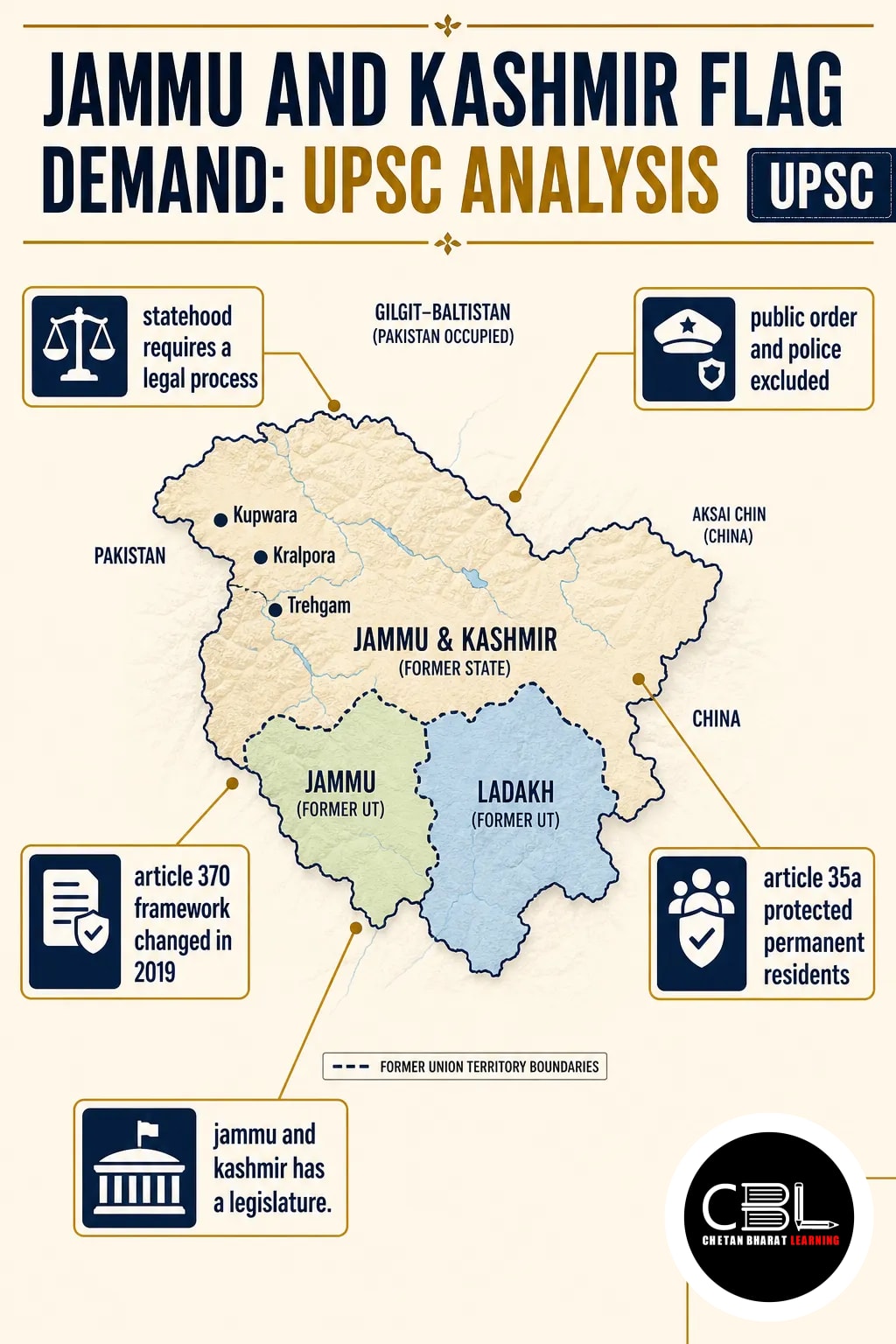
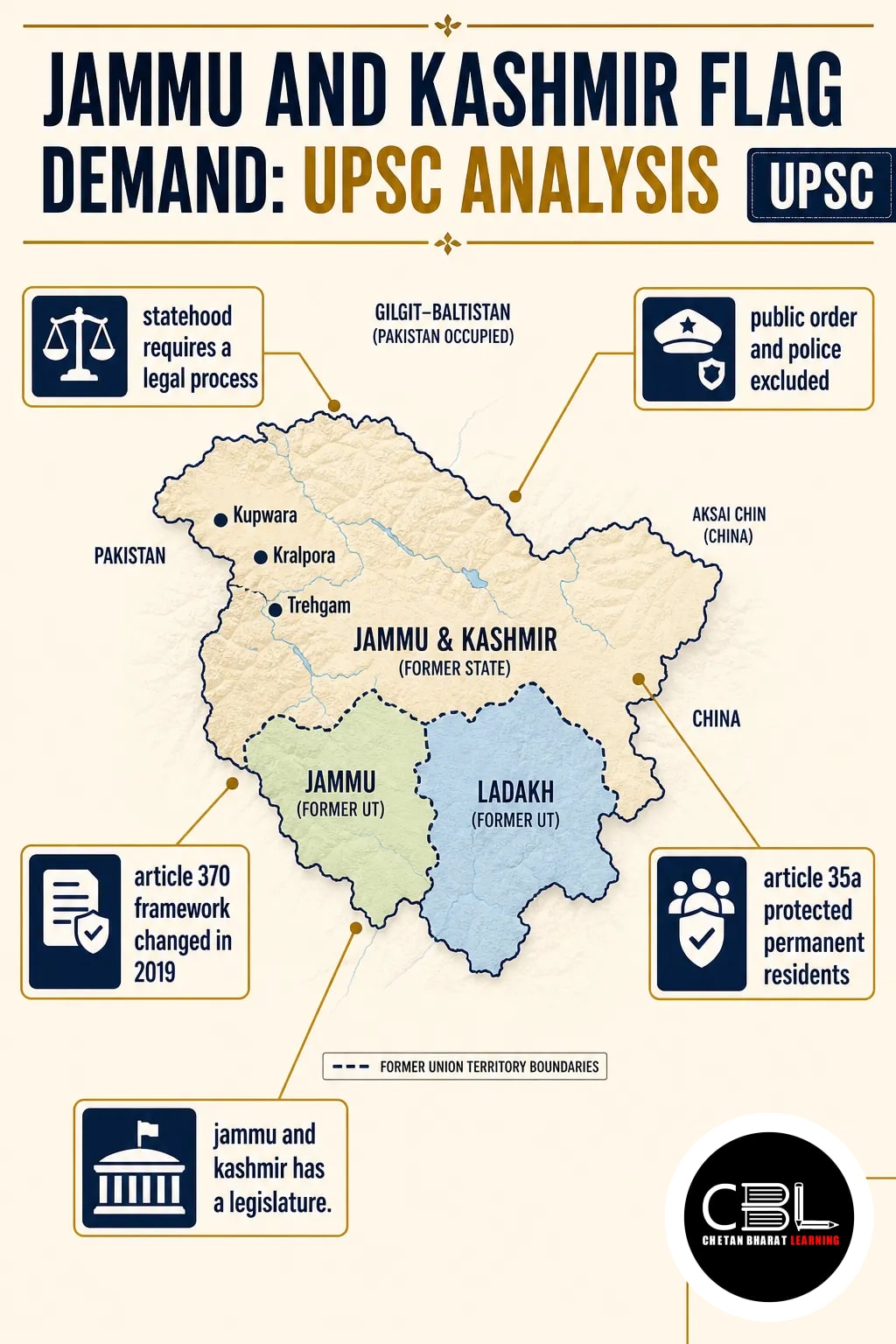
Saifullah called for the return of the former special status, separate flag and statehood of Jammu and Kashmir. At a rally in Kralpora in the Trehgam constituency, he asked other parties to join the effort.
He represents Kupwara district and joined Chief Minister Omar Abdullah’s Cabinet on 27 October 2026. His party, the National Conference (NC), also seeks the restoration of Article 35A. However, the statement announced a political objective; it did not itself alter any law.
What does the pre-1953 demand mean?
The pre-1953 demand refers broadly to an earlier arrangement of greater constitutional autonomy for the former state. However, the source does not set out a detailed legal blueprint for restoring it.
Historically, Jammu and Kashmir had its own Constitution and a state flag under that Constitution. Its flag was red, with a white plough and three white vertical stripes. Therefore, the flag demand concerns a former state symbol, not a replacement for India’s national flag.
The term pre-1953 position should not be treated as synonymous with statehood alone. It invokes a wider question about the former relationship between the Union and Jammu and Kashmir. For comparison, read about the debate on recognition of the Kannada flag.
Which constitutional provisions are relevant?
Articles 370 and 35A, Article 3 and the 2019 reorganisation law address different parts of the demand.
| Provision or law | Relevance |
|---|---|
| Article 370 | Provided the framework for applying provisions of the Indian Constitution to the former state. The 2019 changes made the Constitution applicable without the earlier special arrangement. |
| Article 35A | Previously protected specified state laws concerning permanent residents and their special rights. It was introduced through a 1954 constitutional order, rather than an ordinary parliamentary amendment. |
| Jammu and Kashmir Reorganisation Act, 2019 | Reorganised the former state into the Union Territories of Jammu and Kashmir, and Ladakh. Jammu and Kashmir has a legislature; Ladakh does not. |
| Article 3 | Empowers Parliament to make laws on the formation of states and changes to their areas, boundaries or names, subject to the prescribed procedure. |
Article 35A was part of the earlier constitutional arrangement and no longer operates as it did before 2019. Similarly, the former Jammu and Kashmir Constitution and its flag provision no longer have their earlier operative status.
Under Article 3, a bill requires the President’s recommendation. Where a state’s area, boundary or name is affected, the President refers the bill to that state’s legislature for its views; those views do not bind Parliament. For the wider procedure, see states reorganisation in India.
How do statehood, autonomy and the flag differ?
Statehood concerns territorial status, while autonomy and the flag concern distinct powers and institutional arrangements.
- Statehood: Changing the Union Territory’s status requires a legal process; a minister’s announcement cannot accomplish it.
- Legislative autonomy: The present Jammu and Kashmir legislature has powers under the reorganisation law, but public order and police are outside its legislative field. Moreover, Parliament retains legislative authority.
- Special provisions: Restoring the earlier position of Articles 370 and 35A would raise separate constitutional questions. Therefore, statehood alone would not automatically restore those provisions.
- Flag: The former flag derived its status from the erstwhile state Constitution. Consequently, its political restoration demand should be analysed separately from the status of the national flag.
These distinctions matter for federalism because territorial status and the distribution of powers are not identical. The J&K water tax verdict offers another entry point into questions of governmental authority.
What are the implications and concerns?
The demand brings representation, regional identity and constitutional authority into the same debate.
- Democratic representation: An elected legislature can articulate regional preferences. However, its powers remain subject to the constitutional and statutory framework.
- Federal balance: Greater local decision-making can strengthen accountability to residents. At the same time, proposals must specify the respective roles of the Union and regional institutions.
- Legal clarity: A political pledge does not identify the precise changes needed for each demand. Therefore, public debate must distinguish legislation from constitutional measures.
- Rights and inclusion: Any proposal concerning permanent-resident protections would require scrutiny of its effects on equality and affected groups. Moreover, its precise design would matter.
A constructive way forward is to specify each proposed change, its legal route and its consequences for representation and rights. In addition, dialogue among elected representatives, the Union and affected communities can clarify competing expectations without treating a political claim as an accomplished fact.
Source: The Hindu, 10 November 2026
- Hydel Water Tax Verdict: J&K High Court on UPSC (30 Oct 2026)
Asked in UPSC: Previous Year Questions
- UPSC CSE Mains 2025 (GS Paper II): Discuss the nature of the Jammu and Kashmir Legislative Assembly after the 2019 Reorganisation Act. Briefly describe its powers and functions.
UPSC connects J&K’s constitutional status with the powers of its legislature, so revise both together.
Punjab PCS and Haryana HCS may test Article 3, Union Territories and the distribution of legislative powers. In addition, candidates should distinguish a state’s territorial status from demands for special constitutional arrangements.
Prelims Practice Corner
Mains Practice Questions
Frequently Asked Questions
What is the Jammu and Kashmir flag demand?
It is a political demand to restore the former state’s separate flag. In addition, minister Mir Saifullah called for the return of the earlier special status and statehood.
What was Article 35A?
Article 35A protected specified Jammu and Kashmir laws on permanent residents and their special rights. It entered the constitutional framework through a 1954 order; however, it no longer operates as before 2019.
Would statehood automatically restore the former special status?
No, because statehood and special constitutional provisions are distinct legal matters. Therefore, a change in territorial status alone would not automatically restore the earlier arrangement.
Does Jammu and Kashmir have a legislature?
Yes, Jammu and Kashmir has a legislature under the 2019 reorganisation framework. However, public order and police lie outside its legislative field.
Related Current Affairs
Preparing for UPSC, PCS or HCS?
Talk to a mentor at Chetan Bharat Learning, Chandigarh. Free guidance on choosing the right exam and building a study plan.
Chat on WhatsAppCall 97793 53345UPSC / IAS / PCS coaching in Chandigarh · Trusted by aspirants across Punjab & Haryana

 Ananya RanaIAS · AIR 60
 Aditya SharmaIAS · AIR 70
 Ria Kaur SethiIPS · AIR 89
 Aman AloonIRS · AIR 295
 Sumer Singh VirkIRS · AIR 335
 Shivani PanchalIAS

Leave a Reply
You must be logged in to post a comment.