
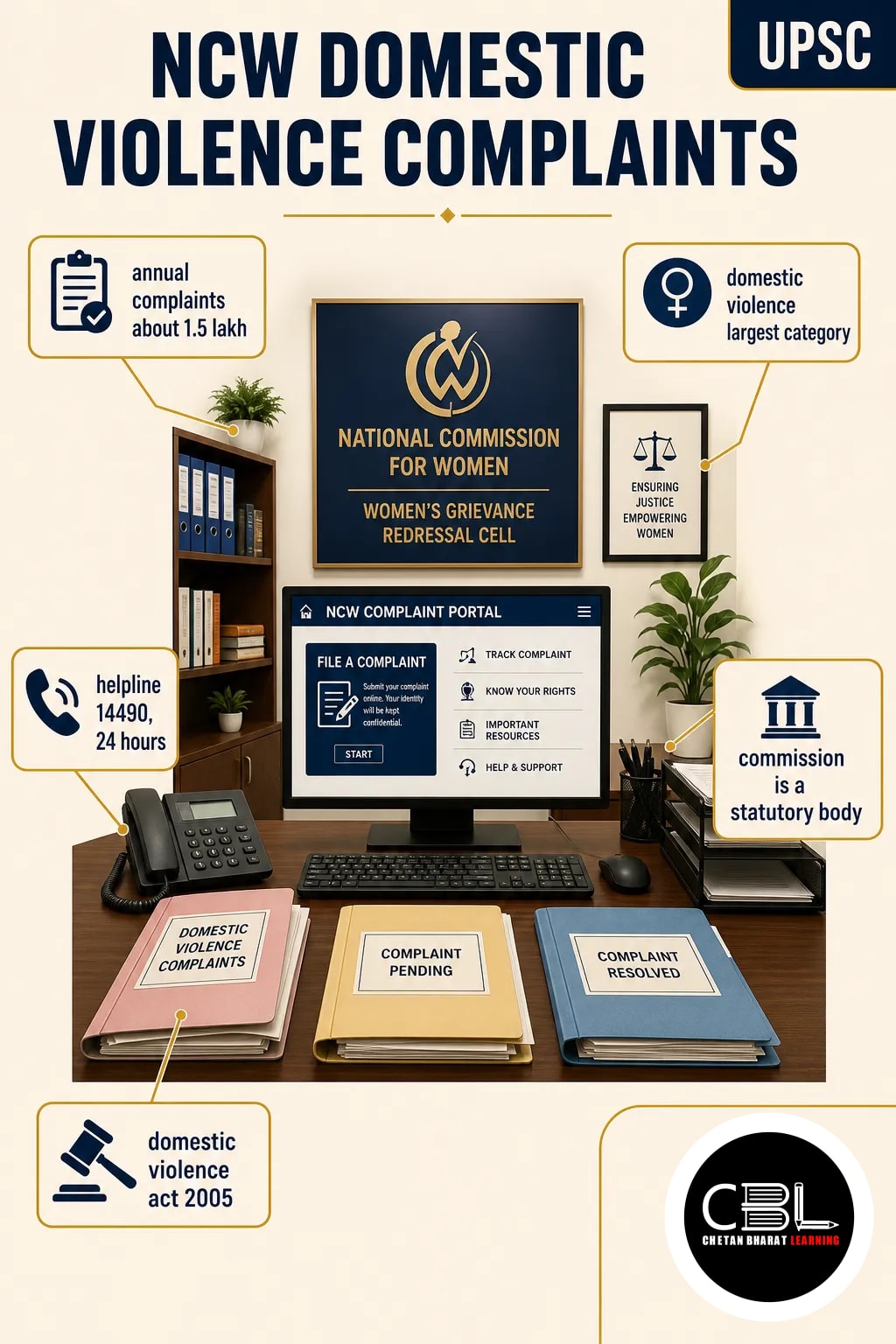
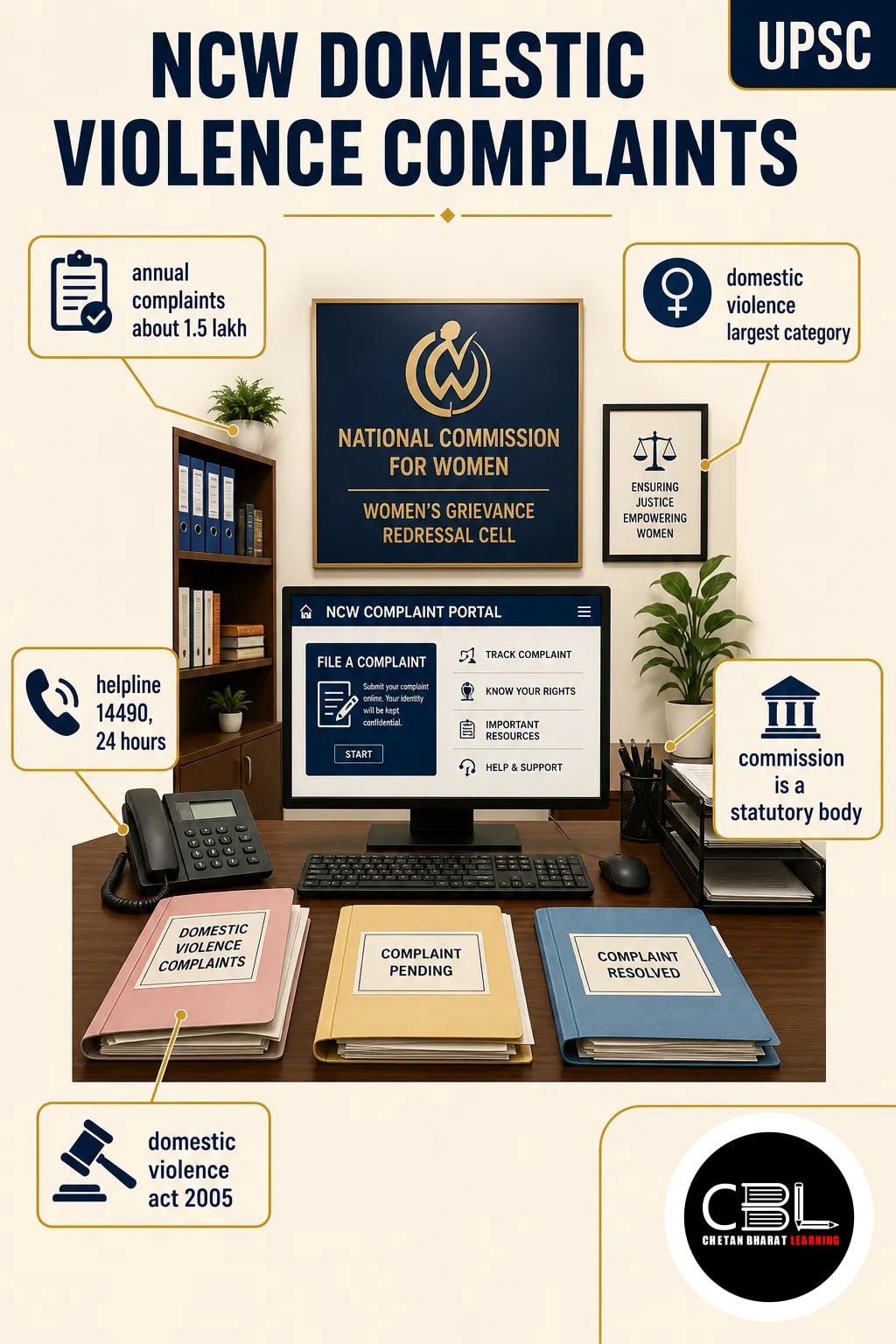
NCW domestic violence complaints form the largest category within the commission’s mandate, according to its chairperson. The figures raise questions about access to justice and grievance redressal, central themes in social issues for UPSC.
Quick answer: The National Commission for Women (NCW) receives about 1.5 lakh complaints annually, chairperson Vijaya Rahatkar said. Among complaints within its mandate, domestic violence is the largest category. Women can approach the commission through its online system, email, in person or its 24-hour helpline, 14490.
What does the complaint data show?
The NCW receives roughly 1.5 lakh complaints a year, with domestic violence leading categories within its mandate. However, the source does not give a separate number or percentage for domestic violence.
Rahatkar emphasised that lack of knowledge about filing should not prevent women from seeking help. In addition, she described public hearings and legal-rights awareness programmes as ways to reach women.
| Indicator | Reported fact |
|---|---|
| Annual complaint volume | Around 1.5 lakh |
| Leading category | Domestic violence, among cases within the mandate |
| Public hearings | More than 200 in person over the past 1.5 years, according to Rahatkar |
| Outreach initiative | Rashtriya Mahila Aayog Aapke Dwar |
These are complaint figures, not estimates of all incidents or proven cases. Therefore, they cannot establish the prevalence of domestic violence or the proportion of complaints resolved.
What is the National Commission for Women?
The NCW is a statutory body established under the National Commission for Women Act, 1990. It is not a constitutional body.
The Act assigns it functions including reviewing safeguards for women, examining complaints and taking up specified matters with authorities. In addition, it can study problems affecting women and recommend measures.
While investigating certain matters, the commission has specified powers of a civil court, including summoning persons and requiring documents. However, it does not replace a court that decides a domestic violence case.
How can women approach the commission?
Women can contact the NCW through online, telephone, email and in-person channels. The commission’s online portal uses a Management Information System (MIS), while its helpline operates round the clock at 14490.
Under Rashtriya Mahila Aayog Aapke Dwar, the commission holds public hearings in states. Rahatkar said it had conducted more than 200 in-person hearings in villages and other locations over the preceding 1.5 years. Thus, outreach can provide an alternative to travelling to the commission or navigating an online system.
What legal protections address domestic violence?
The Protection of Women from Domestic Violence Act, 2005 provides civil remedies for women facing domestic violence. In addition, constitutional guarantees establish a wider framework for equality and dignity.
| Provision | Relevance |
|---|---|
| Article 14 | Guarantees equality before law and equal protection of laws. |
| Article 15(3) | Permits the state to make special provisions for women and children. |
| Article 21 | Protects life and personal liberty, subject to procedure established by law. |
| Domestic Violence Act, 2005 | Provides for remedies including protection, residence and monetary relief orders. |
The Act covers physical, sexual, verbal, emotional and economic abuse within its definition of domestic violence. A magistrate may grant relief under the Act; therefore, filing with the NCW and obtaining a judicial order are distinct processes.
What are the governance challenges?
The main challenge is to translate accessible complaint channels into timely protection and effective remedies.
- Access and awareness: A woman may not know where or how to complain; therefore, multiple channels and local outreach matter.
- Safety and confidentiality: Disclosing abuse can create risks within a shared household; hence, complaint handling must protect privacy.
- Coordination: The commission, protection officers, police and courts have different roles; consequently, referrals and follow-up matter.
- Evidence gaps: The available figure lacks category-wise counts and outcomes; therefore, it cannot measure disposal or effectiveness.
A large complaint volume also needs careful interpretation. For example, an increase could reflect easier reporting, a change in incidents, or both; the available figures cannot distinguish these explanations.
What is the way forward?
The priority is to connect accessible reporting with safe, accountable follow-up. First, clear information in accessible formats can explain complaint channels and legal remedies.
Second, public hearings should link complainants with appropriate local services and legal authorities. In addition, privacy safeguards and consent-sensitive referrals can reduce the risks associated with disclosure.
Finally, category-wise data on receipt, referral and disposal, with personal information protected, would enable better assessment. Such measures should track outcomes rather than treat complaint registration alone as success.
Source: The Hindu, 10 November 2026
Asked in UPSC: Previous Year Questions
- UPSC CSE Mains 2020 (GS Paper II): What steps are needed to constitutionalise a commission? Would constitutional status for the National Commission for Women ensure greater gender justice and empowerment? Give reasons.
- UPSC CSE Mains 2017 (GS Paper II): Can the National Commission for Women strategise and tackle women’s problems in public and private spheres? Give reasons.
UPSC tests both the commission’s institutional status and its effectiveness in addressing women’s concerns.
Punjab PCS and Haryana HCS can test the NCW’s statutory status and remedies under the domestic violence law. In addition, prepare the role of state authorities in protection, referral and grievance redressal.
Prelims Practice Corner
Mains Practice Questions
Frequently Asked Questions
How many complaints does the NCW receive annually?
Around 1.5 lakh, according to chairperson Vijaya Rahatkar. Among cases within the commission’s mandate, domestic violence is the largest category.
What is the NCW complaint helpline number?
The helpline number is 14490, and it operates 24 hours a day. In addition, women can contact the commission online, by email or in person.
Is the National Commission for Women a constitutional body?
No, because it is a statutory body. The National Commission for Women Act, 1990 establishes it.
What is Rashtriya Mahila Aayog Aapke Dwar?
It is the NCW’s public-hearing outreach initiative. Through it, the commission reaches women in different states who may find it difficult to approach it.
Related Current Affairs
Preparing for UPSC, PCS or HCS?
Talk to a mentor at Chetan Bharat Learning, Chandigarh. Free guidance on choosing the right exam and building a study plan.
Chat on WhatsAppCall 97793 53345UPSC / IAS / PCS coaching in Chandigarh · Trusted by aspirants across Punjab & Haryana









Leave a Reply
You must be logged in to post a comment.