
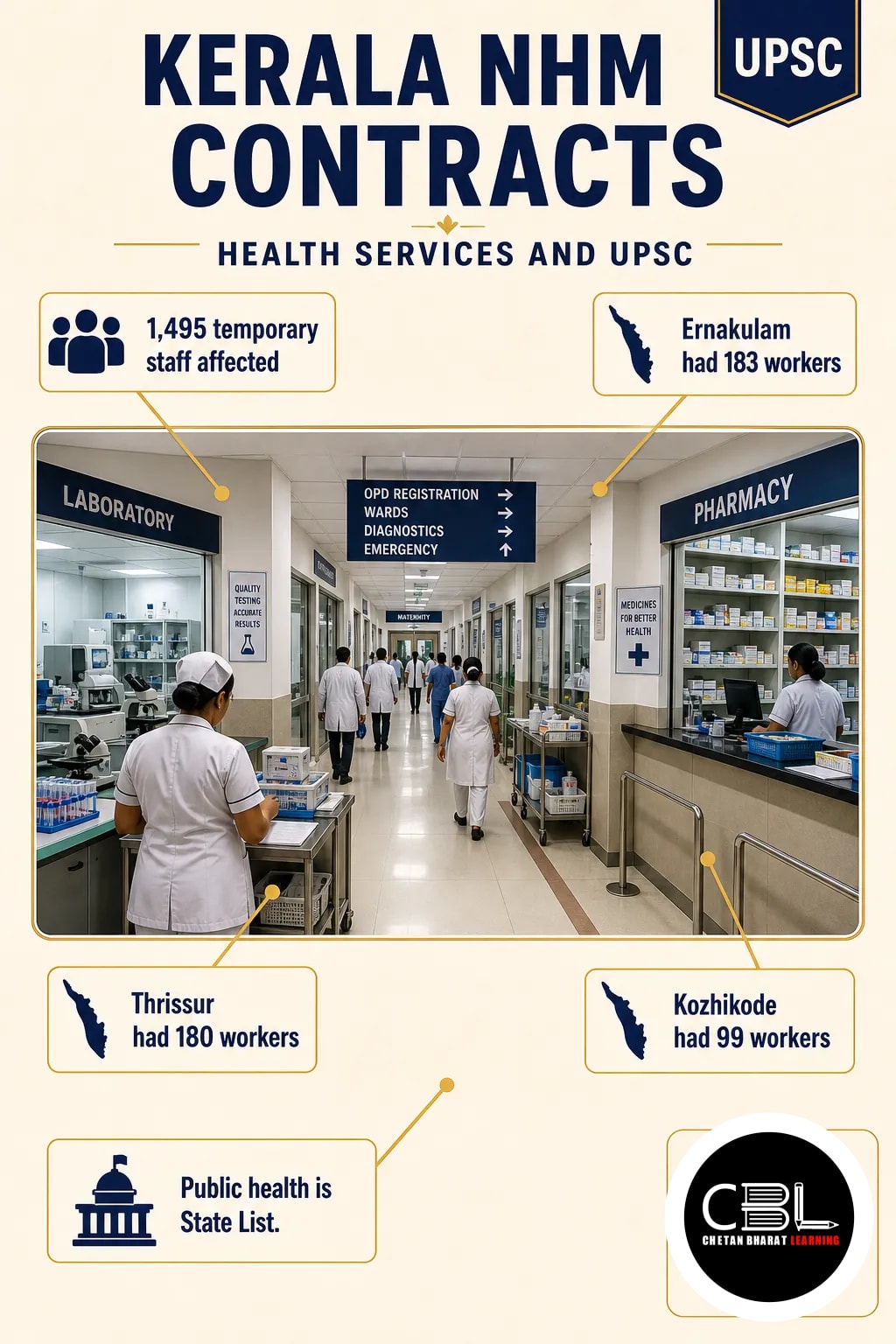

Kerala NHM contracts ended for 1,495 temporary workers from 31 October, raising concerns about continuity of care. The issue connects public health governance with workforce management and accountability.
Quick answer: Kerala NHM contracts for 1,495 temporary staff ended from 31 October 2026. According to the employees’ federation, Ernakulam and Thrissur accounted for 183 and 180 affected workers respectively. Doctors, nurses and other personnel were among those affected; consequently, government hospitals and health centres face potential service disruption.
What happened to Kerala NHM contracts?
The National Health Mission (NHM) contracts of 1,495 temporary staff ended from 31 October. According to the NHM Employees Federation, Ernakulam and Thrissur had the highest numbers affected. Moreover, 99 workers lost their jobs in Kozhikode.
The affected roles include doctors, nurses, pharmacists, accountants, physiotherapists and laboratory technicians. In addition, staff coordinating Accredited Social Health Activists (ASHAs) lost their jobs. The figures therefore reflect a mix of clinical, administrative and community-facing work.
The reported figures establish the scale of job losses, not the number of services already interrupted. However, the range of roles suggests that individual facilities should assess their staffing needs separately.
| District | Affected staff |
|---|---|
| Ernakulam | 183 |
| Thrissur | 180 |
| Kozhikode | 99 |
The federation supplied the Ernakulam and Thrissur figures; the report also gives the Kozhikode figure. These district counts are not a complete state-wide breakdown.
Why did the contracts end?
The federation says the terminations followed an October performance appraisal, after an earlier appraisal in May. State general secretary Meera Nimeesh says contracts normally run from April to March.
According to her, the government first extended the contracts until May because of the Assembly election model code of conduct. After the new government took office, it extended them twice more, until 31 October.
Nimeesh alleges that political alignment influenced the terminations and that some affected workers had nearly 20 years of experience. These are the federation’s allegations, not established findings. Meanwhile, The Hindu reports that the Health department has issued a notification to appoint new staff.
The report does not establish the government’s reasons for each termination or whether replacements will arrive before service gaps emerge. Therefore, an assessment requires both the appraisal criteria and facility-level staffing information.
Which health services could be affected?
Newborn care, specialised bleeding-disorder care and routine hospital support are among the services potentially at risk. However, the report describes likely effects rather than confirmed closures.
- Newborn care: Special newborn units in district hospitals may face staffing pressure, particularly where experienced clinical personnel leave.
- Ashadhara project: The digital and decentralised NHM initiative manages haemophilia and other rare genetic bleeding and coagulation disorders; its activities may suffer.
- Diagnostics and medicines: Laboratories and pharmacies in hospitals and other institutions may be affected because technicians and pharmacists are among those leaving.
- Community services: The federation identifies immunisation, maternal and child care, disease control and field activities as areas supported by NHM staff.
- Continuing care: Palliative care also depends on coordinated personnel; for context, see the discussion of palliative care in Mysuru.
A missing staff member can affect more than one step in a care pathway. For example, a consultation may still occur, but delayed laboratory work can postpone a clinical decision. The actual effect, however, depends on local staffing and replacement arrangements.
What does the issue reveal about health governance?
The case highlights the need to balance performance assessment with continuity of public services. It also raises questions about transparent decisions in contractual employment.
Workforce planning and accountability
Fixed-term contracts allow administrators to review staffing needs periodically. However, simultaneous exits across occupations can create gaps if recruitment and handovers do not match service requirements.
Repeated appraisals can help assess performance, but their legitimacy depends on clear criteria and consistent application. Moreover, a meaningful opportunity to seek reasons and challenge errors can improve trust without ruling out performance-based decisions.
Experience matters where staff understand local patients, referral pathways and programme records. Consequently, replacing a worker is not necessarily the same as immediately replacing that worker’s practical knowledge.
Constitutional context
Public health and hospitals fall principally under the State List in the Constitution’s Seventh Schedule. Therefore, state governments have a central role in organising public health services.
Article 47 directs the State to regard improving public health as a primary duty. In addition, Article 21 protects life and personal liberty, and the Supreme Court has interpreted its protection to include aspects of health. These provisions frame the policy debate; they do not by themselves establish the legality of any individual termination.
How can services and fair procedures be protected?
A practical response should protect urgent care while examining staffing decisions through fair procedures.
- Map critical gaps: First, district authorities should identify vacancies by facility, occupation and service, rather than relying only on aggregate totals.
- Prioritise continuity: Next, facilities should plan interim coverage for newborn units, laboratories, pharmacies and patients requiring regular follow-up.
- Publish appraisal rules: Clear criteria, recorded reasons and an accessible review process would help address concerns about consistency and political influence.
- Sequence recruitment: Replacement appointments should include timely induction and handovers; otherwise, recruitment alone may not prevent short-term disruption.
- Monitor outcomes: Finally, authorities should track service availability and unresolved staff grievances, while protecting patient confidentiality.
Overall, the Kerala NHM contracts issue is both a workforce question and a service-delivery test. Its evaluation should distinguish documented job losses from projected effects and contested claims.
Source: The Hindu, 3 November 2026
Punjab PCS and Haryana HCS may examine this case through public health administration and contractual staffing. In addition, revise the State List and Article 47 when analysing state responsibility for health services.
Prelims Practice Corner
Mains Practice Questions
Frequently Asked Questions
How many NHM staff lost their jobs in Kerala?
A total of 1,495 temporary staff lost their jobs as their contracts ended from 31 October 2026. The affected workers included clinical, technical and administrative personnel.
Which Kerala districts had the most affected NHM staff?
Ernakulam and Thrissur had the highest numbers, at 183 and 180 respectively, according to the employees’ federation. In addition, the report records 99 job losses in Kozhikode.
What is Kerala’s Ashadhara project?
Ashadhara is a digital and decentralised NHM healthcare initiative for haemophilia and other rare genetic bleeding and coagulation disorders. Its activities may be affected by the staff terminations.
Related Current Affairs
Preparing for UPSC, PCS or HCS?
Talk to a mentor at Chetan Bharat Learning, Chandigarh. Free guidance on choosing the right exam and building a study plan.
Chat on WhatsAppCall 97793 53345UPSC / IAS / PCS coaching in Chandigarh · Trusted by aspirants across Punjab & Haryana

 Ananya RanaIAS · AIR 60
 Aditya SharmaIAS · AIR 70
 Ria Kaur SethiIPS · AIR 89
 Aman AloonIRS · AIR 295
 Sumer Singh VirkIRS · AIR 335
 Shivani PanchalIAS

Leave a Reply
You must be logged in to post a comment.