
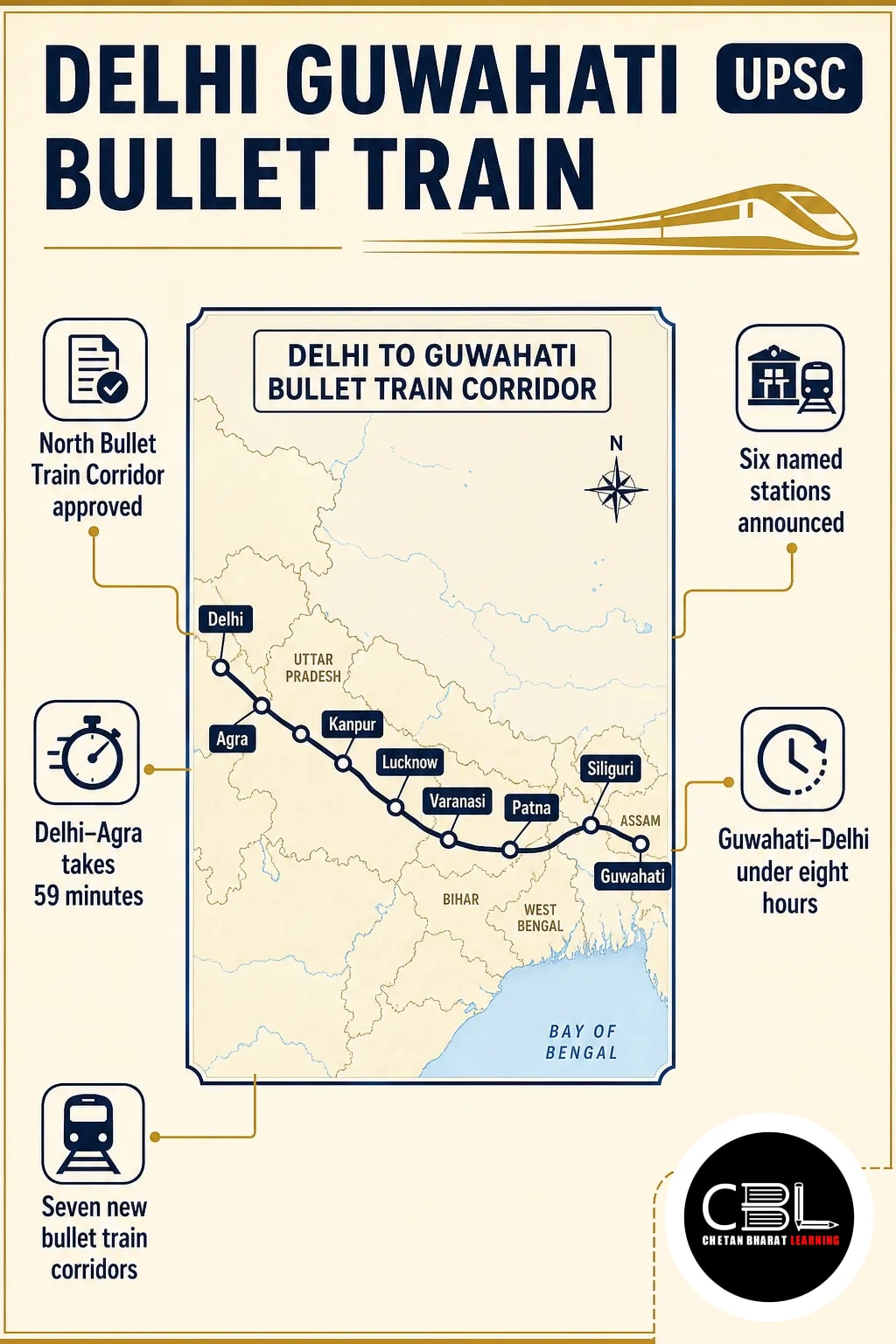

Delhi Guwahati bullet train plans received a boost after the government approved the North Bullet Train Corridor, according to Railway Minister Ashwini Vaishnaw. For more infrastructure updates, visit CBL’s economy current affairs section.
Quick answer: The Delhi Guwahati bullet train corridor is a proposed high-speed rail link between Delhi and Assam’s largest city. Vaishnaw announced its approval and named six stations. Assam Chief Minister Himanta Biswa Sarma said the route was initially planned to end at Siliguri and could connect Guwahati to Delhi in under eight hours.
What is the proposed route?
The Delhi Guwahati bullet train is planned as part of the North Bullet Train Corridor. The source names six stations: Agra, Kanpur, Lucknow, Varanasi, Patna and Siliguri. It also identifies Delhi and Guwahati as the connecting cities but does not clarify the total station count including the endpoints.
Sarma said the earlier plan ended at Siliguri. He added that the extension followed his written request and a meeting with Vaishnaw in July.
What journey times were announced?
Vaishnaw gave estimated journey times for six city pairs. These are proposed times, not an operating timetable.
| City pair | Estimated time |
|---|---|
| Delhi–Agra | 59 minutes |
| Delhi–Kanpur | About 1 hour 45 minutes |
| Delhi–Lucknow | 2 hours 12 minutes |
| Varanasi–Lucknow | 1 hour 21 minutes |
| Varanasi–Patna | About 1 hour |
| Varanasi–Delhi | About 3 hours 33 minutes |
Separately, Sarma estimated that Guwahati–Delhi travel could take less than eight hours. Vaishnaw also said bullet train fares would be lower than airfares, but the source does not specify fares.
How does it fit into India’s high-speed rail plans?
The proposed corridor forms part of a wider high-speed rail expansion. The Union Budget 2026–27 announced seven new bullet train corridors, according to the source.
Meanwhile, construction continues on the separate Mumbai–Ahmedabad corridor, which is 508 km long. The government has targeted August 2027 for operationalising its priority section; that target does not apply to the Delhi–Guwahati project. Vaishnaw also said the project would prioritise the spirit of Make in India.
Why does the corridor matter?
The extension proposes high-speed rail connectivity between the national capital and the Northeast. In addition, the named cities give aspirants a useful geography exercise: Agra, Kanpur, Lucknow and Varanasi are in Uttar Pradesh; Patna is in Bihar; Siliguri is in West Bengal; and Guwahati is in Assam.
However, approval is not the same as a running service. The source gives neither an opening date nor a corridor length for the proposed Delhi–Guwahati route.
Source: Indian Express, 1 November 2026
State PCS examinations can test the corridor’s named cities, their states and proposed travel times. They may also ask candidates to distinguish proposed projects from rail corridors under construction.
Prelims Practice Corner
Mains Practice Questions
Frequently Asked Questions
Which stations were named for the proposed corridor?
Agra, Kanpur, Lucknow, Varanasi, Patna and Siliguri were named. The source also identifies Delhi and Guwahati as connecting cities, but does not clarify the total station count including endpoints.
How long could a bullet train take from Delhi to Guwahati?
Less than eight hours, according to Assam Chief Minister Himanta Biswa Sarma’s estimate. However, this is not an operating timetable.
Has an opening date been announced for the Delhi–Guwahati corridor?
No opening date is given in the source. The August 2027 target instead concerns the priority section of the Mumbai–Ahmedabad corridor.
Related Current Affairs
Preparing for UPSC, PCS or HCS?
Talk to a mentor at Chetan Bharat Learning, Chandigarh. Free guidance on choosing the right exam and building a study plan.
Chat on WhatsAppCall 97793 53345UPSC / IAS / PCS coaching in Chandigarh · Trusted by aspirants across Punjab & Haryana

 Ananya RanaIAS · AIR 60
 Aditya SharmaIAS · AIR 70
 Ria Kaur SethiIPS · AIR 89
 Aman AloonIRS · AIR 295
 Sumer Singh VirkIRS · AIR 335
 Shivani PanchalIAS

Leave a Reply
You must be logged in to post a comment.