
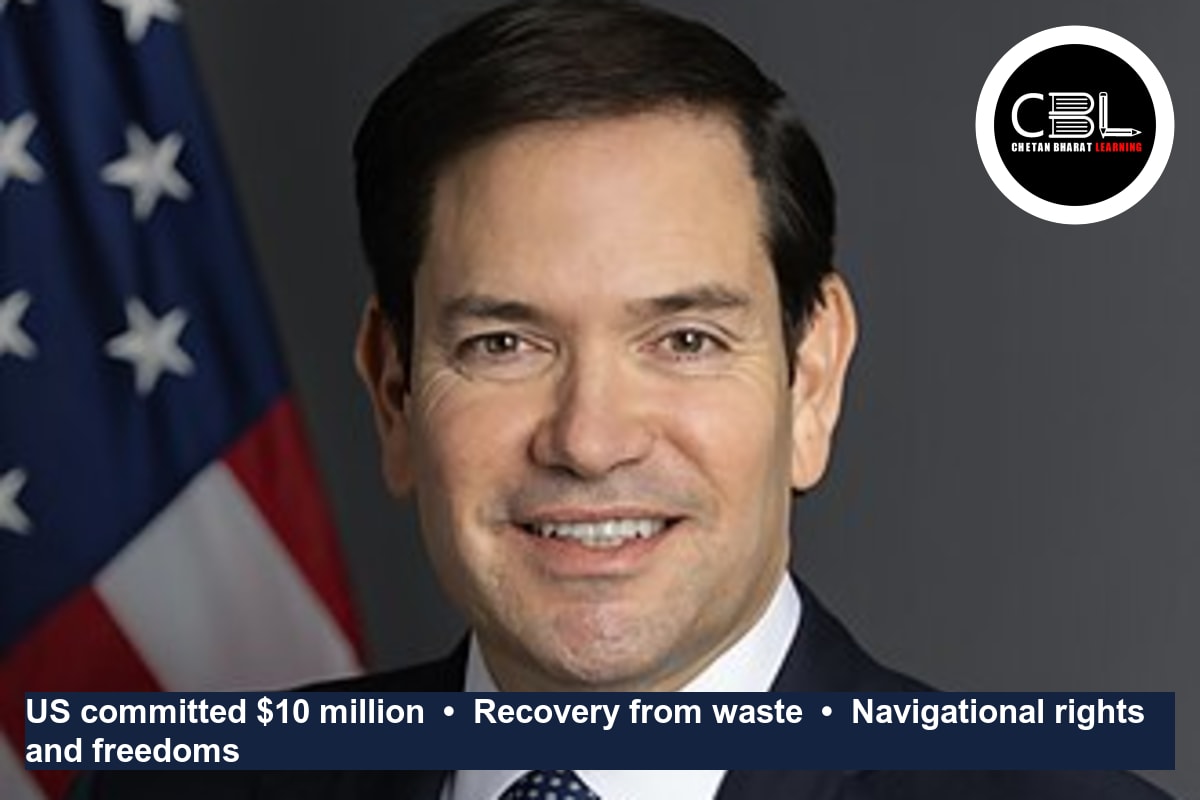

Photo: Marco Rubio, via Wikimedia Commons
Quad critical minerals cooperation took centre stage as foreign ministers of India, Australia, Japan and the United States met in Atlanta. Their discussions connected economic security with maritime routes, technology and Indo-Pacific cooperation.
Quick answer: At their meeting alongside the G20 foreign ministers’ gathering in Atlanta, Quad ministers backed open supply chains and critical mineral recovery. The United States committed $10 million to promote recovery facilities in India and Southeast Asia. They also discussed economic coercion, maritime access, energy security and technology cooperation.
What happened at the Quad meeting?
The four foreign ministers met alongside the Group of Twenty (G20) Foreign Ministers’ Meeting in Atlanta. It was their third meeting in less than six months, following New Delhi in May and Manila in July.
United States Secretary of State Marco Rubio met India’s External Affairs Minister S Jaishankar, Japan’s Foreign Minister Toshimitsu Motegi and Australia’s Foreign Minister Penny Wong. Rubio identified supply chains, critical minerals, next-generation technology and maritime cooperation as shared priorities. For the wider diplomatic setting, see the G20 foreign ministers’ meeting coverage.
The Quadrilateral Security Dialogue, or Quad, brings together India, Australia, Japan and the United States. Its discussions on economic security complement its wider Indo-Pacific cooperation; however, an announced priority is not the same as a completed project.
What were the key outcomes?
The ministers linked reliable supply chains to mineral recovery, technology, maritime access and energy security.
| Area | Announcement or position |
|---|---|
| Critical minerals | The US committed $10 million to promote infrastructure and facilities recovering minerals from waste in India and Association of Southeast Asian Nations (ASEAN) countries. |
| Technology | Ministers highlighted artificial intelligence (AI) and Pax Silica, and expressed intent to provide over $85 million in technical and financial assistance. |
| Maritime routes | They supported navigational rights and freedoms in the Strait of Hormuz, Red Sea and Bab el-Mandeb Strait. |
| Fuel security | The first Quad Fuel Security Forum met in September and discussed strategic petroleum reserves and stockholdings. |
| Business and cybercrime | Ministers announced the first Quad Business Leaders’ Forum and pledged action against transnational online and cyber scam operations. |
The $10 million commitment concerns recovery from waste, not a stated allocation solely for mining. Likewise, the joint statement records an intent to provide over $85 million; it does not establish completed disbursement.
Why do critical minerals matter for supply chains?
Critical minerals are materials whose economic importance and supply risks make reliable access a policy concern. Their supply chains extend beyond extraction to processing, manufacturing, recovery and transport.
Consequently, access to mineral deposits alone cannot guarantee reliable inputs. A disruption at a processing facility, an export restriction or an interruption along a shipping route can affect downstream production. Recovery from waste adds another potential source, although it also depends on collection and processing capacity.
The ministers expressed concern about economic coercion, including arbitrary export restrictions, and non-market policies that create overcapacity. The Quad critical minerals agenda therefore combines diversification with cooperation on infrastructure and technology. Yet open supply chains also require commercially viable projects and access for users beyond the four partners.
Why is maritime access part of economic security?
Maritime routes connect mineral and energy suppliers with processors, manufacturers and consumers. Therefore, a secure source can still face delivery risks if a major sea lane becomes unsafe.
The ministers stressed uninterrupted commerce, energy security and the safety of crews and vessels in the Strait of Hormuz, Red Sea and Bab el-Mandeb Strait. They invoked international law as reflected in the United Nations Convention on the Law of the Sea (UNCLOS). Separately, the BIMSTEC maritime security exercise illustrates another regional setting for maritime cooperation.
Fuel stockholdings can provide a buffer against disruption; however, they do not eliminate the need for safe shipping. The September forum thus connects reserve planning with the Quad’s wider supply-security agenda.
What does this mean for India?
India can use the cooperation to strengthen mineral recovery, industrial inputs and diplomatic partnerships. The proposed recovery support offers an opening to connect waste collection with processing and manufacturing needs.
First, diversified sources and recovery capacity could reduce exposure to a disruption at any single supply-chain stage. Second, technology and business cooperation could help identify investment opportunities. However, India must assess projects by their actual capacity, costs and environmental safeguards rather than announcements alone.
The agenda also gives India space to pursue economic security with multiple partners. In parallel, maritime cooperation supports the movement of commerce and energy. The Quad critical minerals discussion should therefore be viewed as one part of a broader strategy, not as a guarantee of self-sufficiency.
What are the challenges and the way forward?
The main challenge is translating shared commitments into reliable and environmentally sound capacity.
- Implementation: Partners should identify facilities, timelines and measurable outputs; otherwise, funding pledges may not improve supply security.
- Commercial viability: Recovery projects need predictable supplies of waste and buyers for recovered materials. Therefore, public support should encourage workable business models.
- Environmental safeguards: Processing and waste recovery require careful handling of residues. Clear standards and monitoring can limit local costs.
- Openness: Diversification should reduce concentration without creating unnecessary barriers to other suppliers. Consequently, transparent rules and wider regional participation matter.
- Whole-chain resilience: Partners should assess processing, transport and fuel security together. In addition, they should review whether projects actually reduce disruption risks.
Overall, the test of Quad critical minerals cooperation will be durable capacity and reliable access, not the size of pledges alone.
Source: The Indian Express, 1 November 2026
- G20 Foreign Ministers Meeting: India’s UPSC Angle (30 Oct 2026)
Asked in UPSC: Previous Year Questions
- UPSC CSE Prelims 2025 (GS Paper I): Which statements on India’s Minerals Security Partnership membership, critical-mineral resources and the 2023 mining-law amendments are correct?
- UPSC CSE Mains 2020 (GS Paper II): Discuss the claim that the Quad is transforming from a military alliance into a trade bloc.
UPSC examines both critical-mineral governance and the changing dimensions of Quad cooperation.
Punjab PCS and Haryana HCS may test Quad membership, mineral recovery and major maritime routes in General Studies. In addition, mains answers can connect supply-chain resilience with industrial policy and waste management.
Prelims Practice Corner
Mains Practice Questions
Frequently Asked Questions
Which countries are members of the Quad?
India, Australia, Japan and the United States are its four members. Together, they discuss Indo-Pacific issues including maritime and economic security.
What is the US commitment for critical-mineral recovery?
The commitment is $10 million. It will promote infrastructure and facilities that recover critical minerals from waste in India and ASEAN countries.
Why did the Quad discuss maritime routes?
The ministers linked safe navigation to commerce and energy security. Accordingly, they highlighted the Strait of Hormuz, Red Sea and Bab el-Mandeb Strait.
Has the Quad already disbursed over $85 million in assistance?
The statement records an intent to provide over $85 million, not completed disbursement. It also highlights AI and Pax Silica in the context of future economic growth.
Related Current Affairs
Preparing for UPSC, PCS or HCS?
Talk to a mentor at Chetan Bharat Learning, Chandigarh. Free guidance on choosing the right exam and building a study plan.
Chat on WhatsAppCall 97793 53345UPSC / IAS / PCS coaching in Chandigarh · Trusted by aspirants across Punjab & Haryana

 Ananya RanaIAS · AIR 60
 Aditya SharmaIAS · AIR 70
 Ria Kaur SethiIPS · AIR 89
 Aman AloonIRS · AIR 295
 Sumer Singh VirkIRS · AIR 335
 Shivani PanchalIAS

Leave a Reply
You must be logged in to post a comment.