
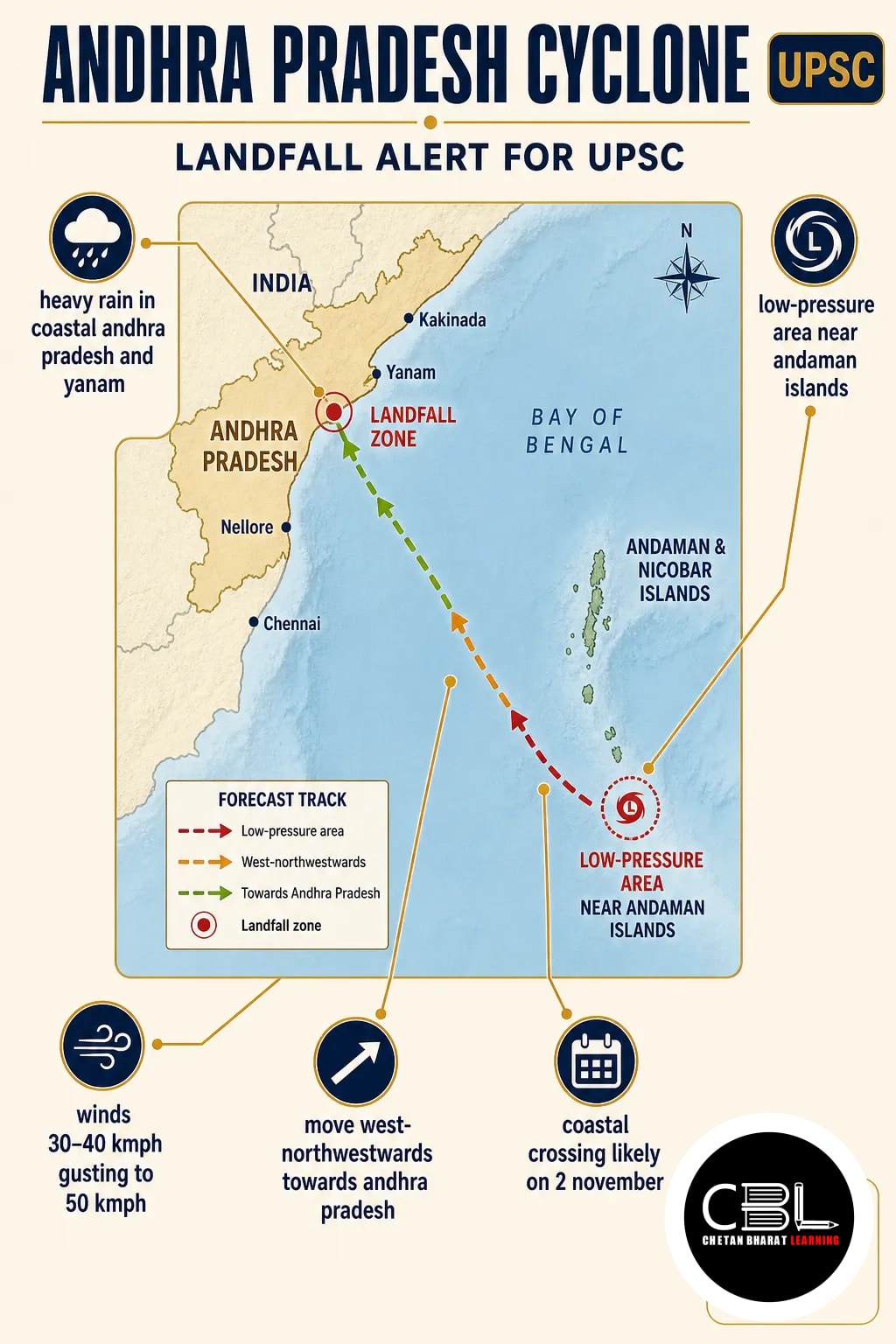

Andhra Pradesh cyclone landfall is likely on 2 November, according to the India Meteorological Department (IMD). The alert adds to geography and disaster management current affairs for UPSC.
Quick answer: On 31 October 2026, IMD said a low-pressure system near the Andaman and Nicobar Islands could become a cyclone by 1 November. It forecast an Andhra Pradesh cyclone crossing on 2 November, with heavy rain in coastal Andhra Pradesh and Yanam. If the storm forms, it will be named Murasu.
Where is the weather system located?
The well-marked low-pressure area developed over the southeast Bay of Bengal, near the Andaman and Nicobar Islands. IMD expected it to move west-northwestwards towards Andhra Pradesh.
| Feature | Forecast or location |
|---|---|
| Initial system | Well-marked low-pressure area near the Andaman and Nicobar Islands |
| Depression | Expected by 31 October evening |
| Cyclonic storm | Expected by 1 November |
| Coastal crossing | Andhra Pradesh coast, likely on 2 November |
These stages are forecasts, not confirmation of a completed landfall. For context, see the earlier account of Cyclone Arnab’s Andhra landfall.
What rainfall and wind warnings did IMD issue?
IMD forecast heavy rain in coastal Andhra Pradesh and Yanam as the system approaches.
- Wind: Speeds of 30–40 kmph, gusting to 50 kmph, are likely until 1 November over coastal Andhra Pradesh, Yanam and Rayalaseema.
- Sea conditions: IMD also warned of rough seas along the Andhra Pradesh coast.
- Other rainfall: Heavy rain is forecast in Tamil Nadu, Puducherry and Karaikal until 5 November. Meanwhile, Kerala and Mahe are likely to receive rain until 4 November.
Yanam and Karaikal are parts of the Union Territory of Puducherry. For comparison, read about the Odisha evacuations during Cyclone Arnab.
What would the cyclone be named?
The storm would be named Murasu if it develops into a cyclone. India proposed the name, which means ‘drum’ in Tamil. The name is therefore conditional on the system reaching cyclonic-storm intensity.
Why does the alert matter?
The warning follows Cyclone Arnab’s impact on the Andhra Pradesh coast less than a week earlier. Consequently, the forecast is relevant to coastal preparedness and monitoring of rainfall and sea conditions.
For prelims, distinguish the forecast stages from observed events. Also revise how warm ocean waters and atmospheric circulation support tropical cyclone formation.
Source: The Indian Express, 31 October 2026
- Cyclone Arnab: Andhra Landfall and UPSC Facts (28 Oct 2026)
- Evacuations in Odisha as Cyclone Arnab Advances (28 Oct 2026)
- Cyclone Arnab 2026: IMD Alert, Formation & UPSC (28 Oct 2026)
Asked in UPSC: Previous Year Questions
- UPSC CSE Mains 2024 (GS Paper I): What is sea surface temperature rise? How does it affect the formation of tropical cyclones?
- UPSC CSE Mains 2022 (GS Paper I): Discuss the meaning of colour-coded weather warnings for cyclone-prone areas given by India Meteorological Department.
UPSC tests both cyclone formation and the interpretation of weather warnings.
State PCS General Studies can test cyclone formation, the Bay of Bengal and IMD warnings. Also revise how forecasts support disaster preparedness.
Prelims Practice Corner
Mains Practice Questions
Frequently Asked Questions
When is the cyclone expected to cross Andhra Pradesh?
2 November 2026 is the forecast date. However, the crossing had not occurred when IMD issued the alert.
What is the possible name of the storm?
Murasu is the proposed name if the system becomes a cyclonic storm. India proposed it, and the word means ‘drum’ in Tamil.
Where did the low-pressure area develop?
It developed over the southeast Bay of Bengal near the Andaman and Nicobar Islands. IMD also expected it to move west-northwestwards.
Related Current Affairs
Preparing for UPSC, PCS or HCS?
Talk to a mentor at Chetan Bharat Learning, Chandigarh. Free guidance on choosing the right exam and building a study plan.
Chat on WhatsAppCall 97793 53345UPSC / IAS / PCS coaching in Chandigarh · Trusted by aspirants across Punjab & Haryana

 Ananya RanaIAS · AIR 60
 Aditya SharmaIAS · AIR 70
 Ria Kaur SethiIPS · AIR 89
 Aman AloonIRS · AIR 295
 Sumer Singh VirkIRS · AIR 335
 Shivani PanchalIAS

Leave a Reply
You must be logged in to post a comment.