
SIR voter roll appeals in West Bengal have raised a new question: which officials could challenge voters’ restoration? The issue adds to the electoral governance debate and CBL’s earlier coverage of constitutional rules concerning the Chief Election Commissioner.
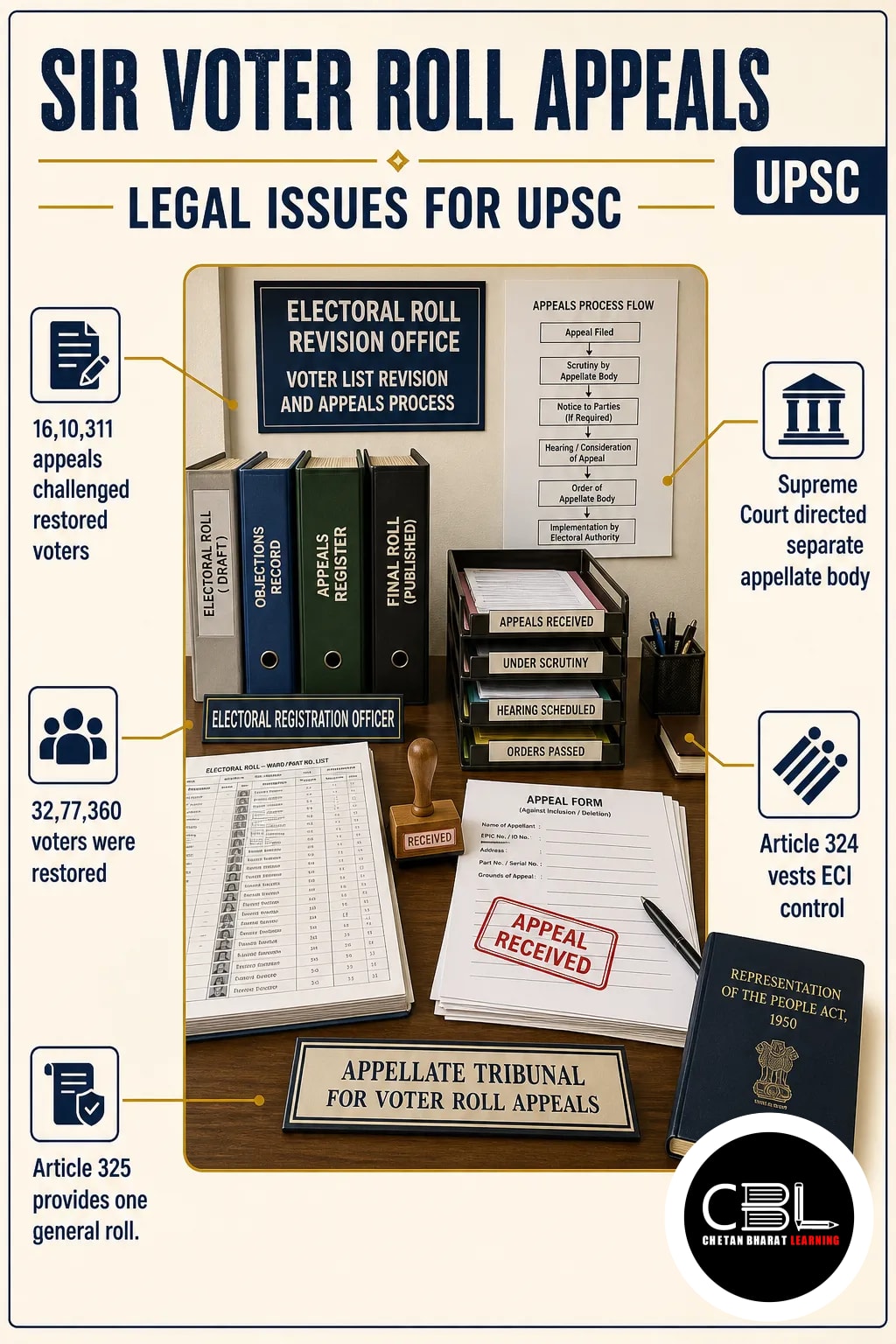
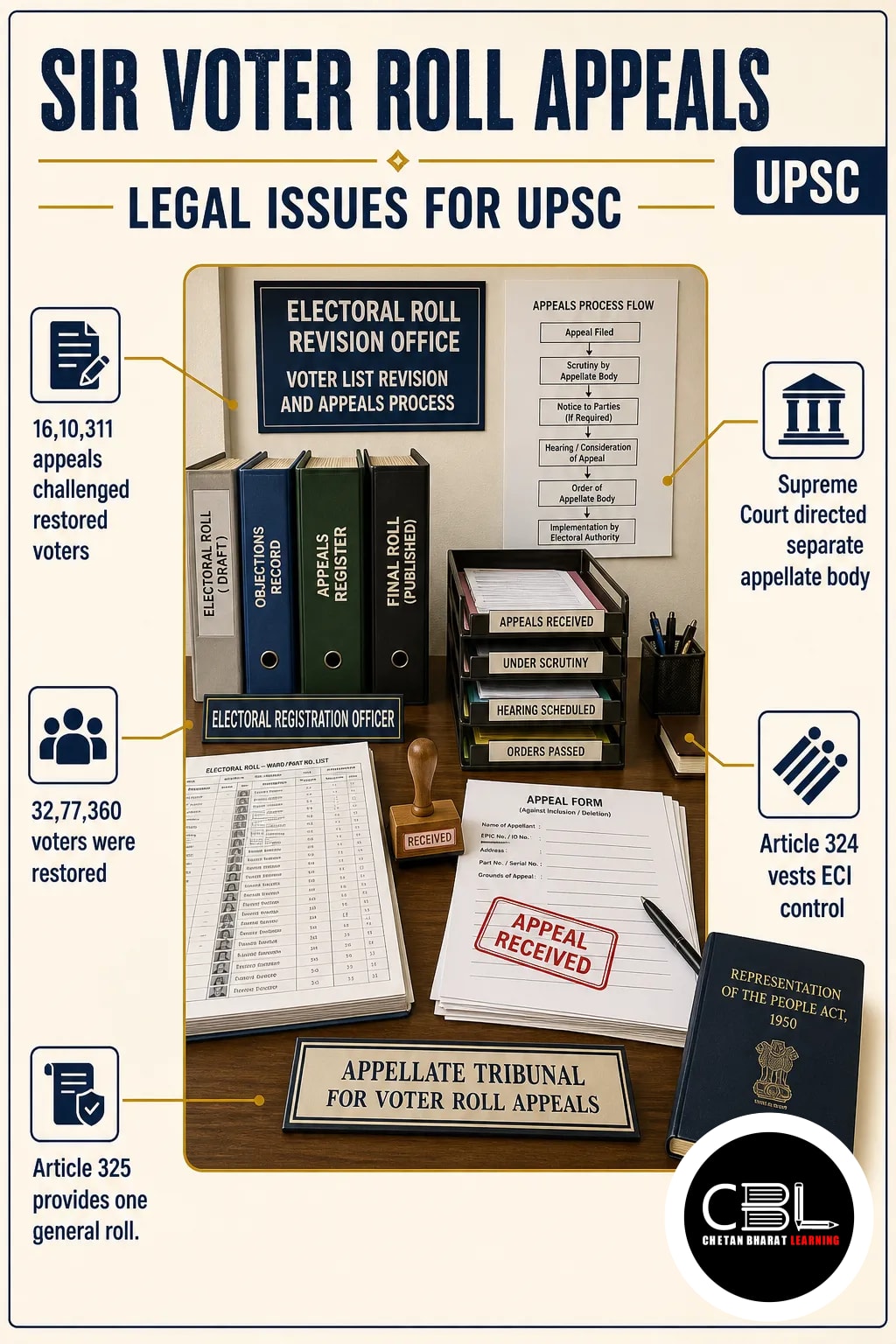
Quick answer: In West Bengal, 16,10,311 SIR voter roll appeals challenged entries restored by judicial officers. In its 26 October 2026 affidavit, the Election Commission said officials had authority under Supreme Court orders. However, the affidavit did not categorically identify the filers as the electoral-roll authorities recognised under the Representation of the People Act.
What is the legal question?
The dispute concerns whether the officials who challenged restored entries had authority to file those appeals. It arose during the Special Intensive Revision (SIR) of West Bengal’s electoral rolls. However, the source does not establish a final judicial ruling on the officials’ authority.
In its affidavit, the Election Commission of India (ECI) said a 22 October communication from the state’s Chief Electoral Officer described the filers as authorities under the Act. The ECI also said the officers had authority under Supreme Court orders. However, its affidavit referred to them as officers of the Chief Electoral Officer’s office without categorically identifying them as the recognised roll authorities.
Therefore, two issues need separate examination: the filers’ statutory designation and the scope of the Supreme Court’s directions. An officer’s association with an electoral office does not, by itself, settle either question.
How did the appeals arise?
The appeals followed judicial scrutiny of roughly 60 lakh doubtful and pending cases. The Supreme Court directed a separate appellate body so that people could challenge judicial officers’ decisions.
| Date or stage | Development |
|---|---|
| 10 March 2026 | Supreme Court directed a separate appellate body. |
| 21 March 2026 | ECI constituted appellate tribunals for West Bengal. |
| Around 13 April | Tribunals began functioning. |
| 16 April | Court ordered successful appellants’ inclusion through a supplementary list. |
| 26 October | ECI filed its affidavit before the Supreme Court. |
Some 700 judicial officers restored 32,77,360 voters; they rejected the remaining approximately 27.23 lakh cases. Of those rejected, 22 lakh appealed. Separately, 16,10,311 bulk appeals challenged decisions to include restored voters, taking the tribunal caseload to over 38 lakh.
The two appeal categories have opposite objectives: one seeks inclusion after rejection, while the other challenges inclusion. Consequently, the filing of an appeal against an entry should not be confused with a final order deleting it.
Which constitutional and legal provisions matter?
The Constitution and the Representation of the People Act, 1950 provide the core framework for electoral rolls. However, the authority to appeal before these particular tribunals also depends on the relevant court directions.
| Provision | Relevance |
|---|---|
| Article 324 | Vests superintendence, direction and control of electoral rolls and specified elections in the ECI. |
| Article 325 | Provides for one general electoral roll and bars exclusion solely on specified grounds, including religion and sex. |
| Article 326 | Provides for adult suffrage in Lok Sabha and State Assembly elections, subject to constitutional and legal conditions. |
| 1950 Act: electoral-roll officers | Establishes roles for Chief Electoral Officers, District Election Officers, Electoral Registration Officers and Assistant Electoral Registration Officers. |
The officer designations are commonly abbreviated as Chief Electoral Officer (CEO), District Election Officer (DEO), Electoral Registration Officer (ERO) and Assistant Electoral Registration Officer (AERO). Their roll-related functions must be distinguished from a specific authority to file an appeal.
Why do SIR voter roll appeals matter?
The dispute tests how roll accuracy, fair procedure and institutional accountability operate together. It also highlights the difference between reviewing eligibility and establishing who may initiate that review.
- Electoral inclusion: Reopening restored entries can create uncertainty for affected electors; therefore, clear notice and an opportunity to respond matter.
- Legal authority: An appeal process needs an identifiable legal basis; otherwise, its validity may remain contested.
- Administrative accountability: A record of the filing officer, authorisation and grounds would allow meaningful scrutiny.
- Tribunal capacity: More than 38 lakh pending cases can strain adjudication; consequently, orderly case management matters.
Election Commissioners S. S. Sandhu and Vivek Joshi raised the appeals issue in file notings. Meanwhile, opposition parties sought cancellation and a judicial probe. On 29 October, the Congress also requested an information technology (IT) audit of the filing process.
What safeguards could address the dispute?
A transparent, case-specific process can protect both roll integrity and electors’ procedural interests. The following measures are analytical options, not claims about orders already issued.
- Clarify authority: Identify each filing official’s designation and the statutory provision or court direction relied upon.
- Disclose reasons: Provide affected electors with the grounds for each appeal and an effective chance to respond.
- Audit filings: Verify timestamps, authorisations and filing methods, while protecting personal information.
- Track outcomes: Publish aggregate appeal and disposal figures; in addition, communicate individual decisions to affected electors.
Ultimately, an accurate roll and a fair hearing are complementary goals. Therefore, the resolution should address both the merits of individual entries and the authority behind the appeals.
Source: The Hindu, 31 October 2026
Asked in UPSC: Previous Year Questions
- UPSC CSE Mains 2026 (GS Paper II): Discuss the Election Commission’s position in electoral roll revision. Can it also examine voters’ citizenship?
UPSC connects electoral-roll revision with the Election Commission’s powers and the limits of its examination.
Punjab PCS and Haryana HCS can test the roles of electoral-roll officers and the ECI in General Studies. Aspirants should also distinguish Assembly electoral rolls from local-body election administration.
Prelims Practice Corner
Mains Practice Questions
Frequently Asked Questions
How many restored entries faced appeals in West Bengal?
A total of 16,10,311 appeals challenged decisions to include restored voters. These were separate from appeals by people whose cases judicial officers rejected.
Did the Supreme Court rule that the appeals were invalid?
The source does not establish such a final ruling. However, it records a dispute over the filers’ authority and the ECI’s explanation to the Court.
Which constitutional article gives the ECI control over electoral rolls?
Article 324 vests electoral superintendence, direction and control in the ECI. It also covers the preparation of electoral rolls for specified elections.
Does an appeal against inclusion automatically delete a voter’s name?
No; filing an appeal is distinct from a final decision on the entry. Therefore, the appeal count alone does not establish how many entries were ultimately deleted.
Related Current Affairs
Preparing for UPSC, PCS or HCS?
Talk to a mentor at Chetan Bharat Learning, Chandigarh. Free guidance on choosing the right exam and building a study plan.
Chat on WhatsAppCall 97793 53345UPSC / IAS / PCS coaching in Chandigarh · Trusted by aspirants across Punjab & Haryana

 Ananya RanaIAS · AIR 60
 Aditya SharmaIAS · AIR 70
 Ria Kaur SethiIPS · AIR 89
 Aman AloonIRS · AIR 295
 Sumer Singh VirkIRS · AIR 335
 Shivani PanchalIAS

Leave a Reply
You must be logged in to post a comment.