
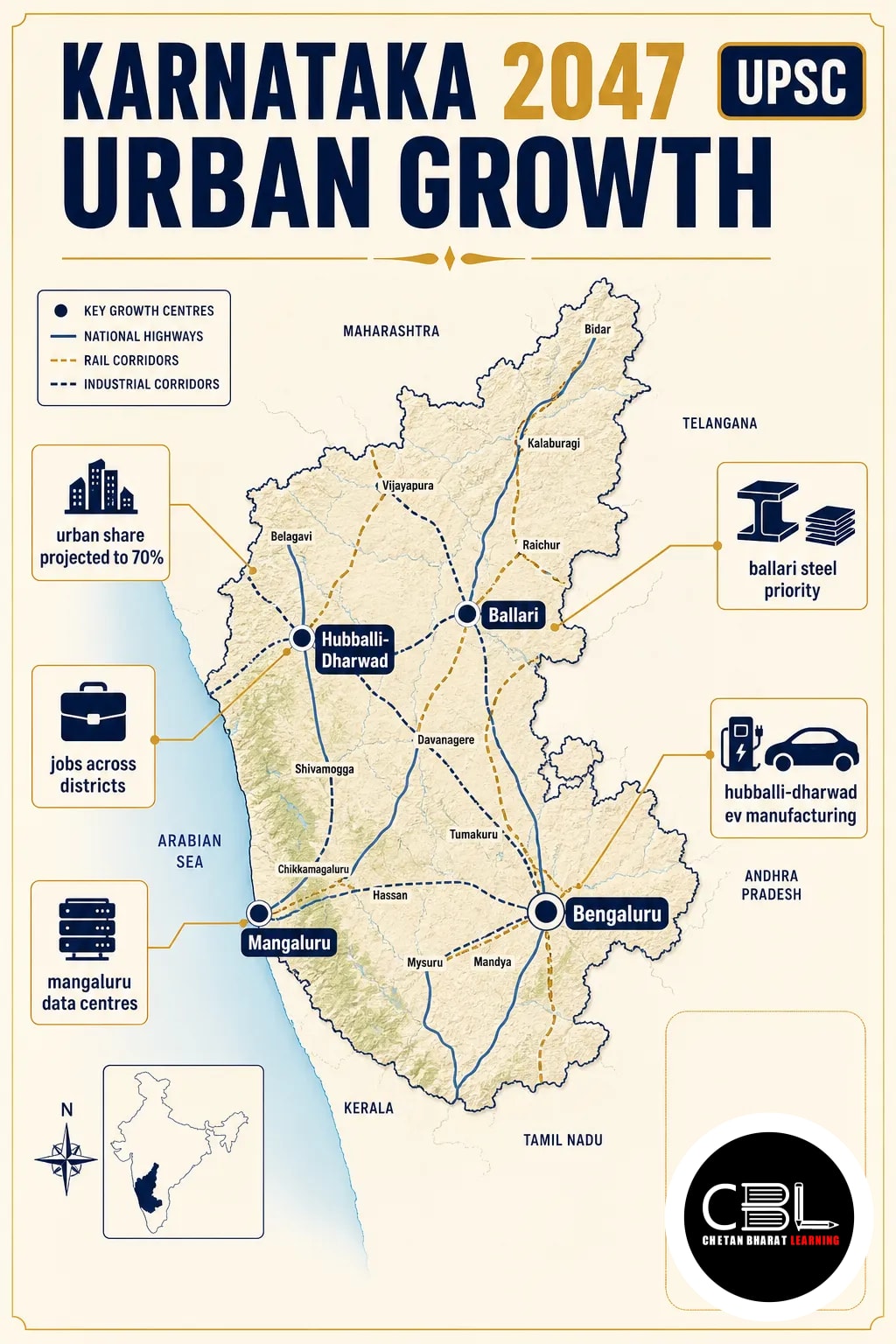
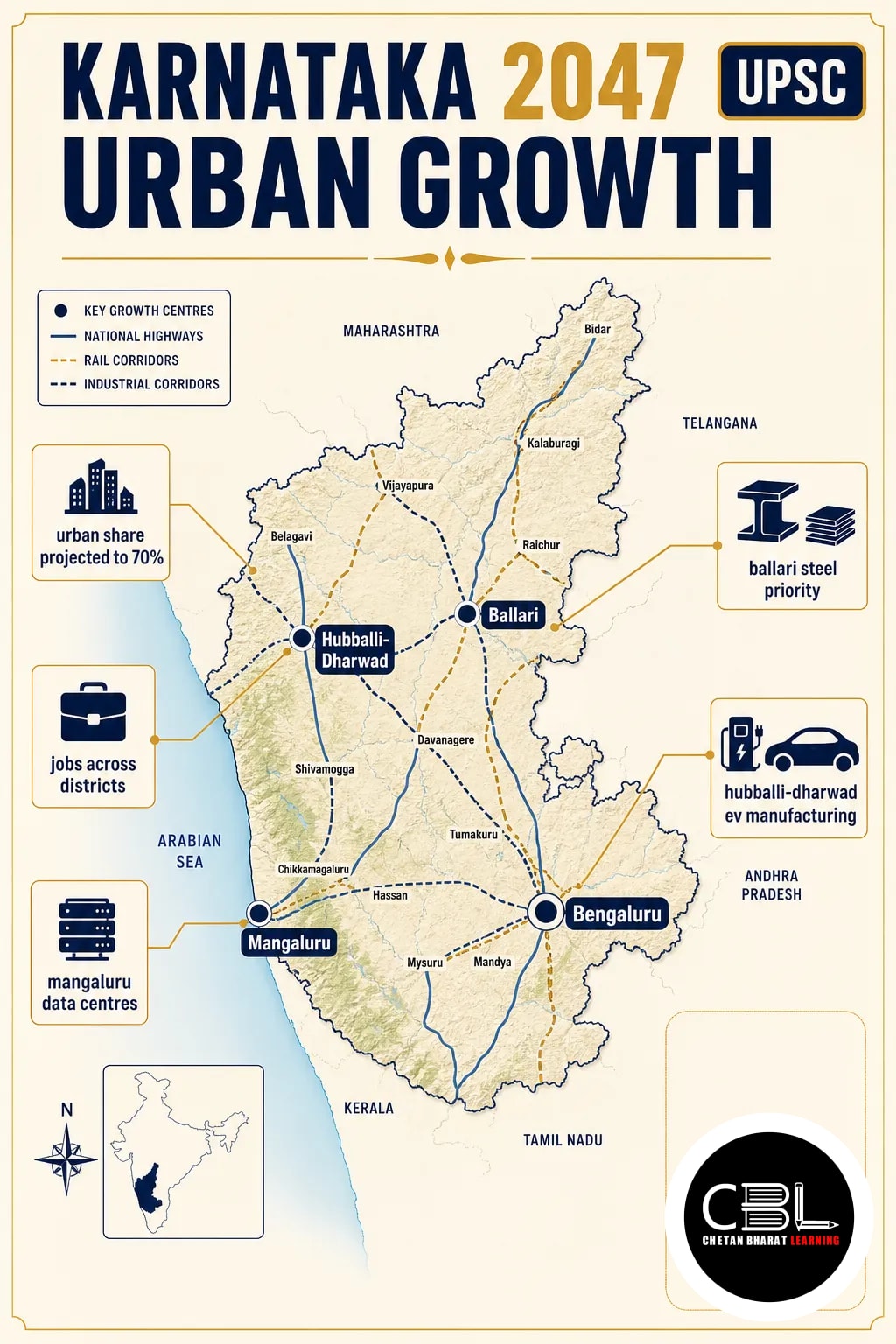
Karnataka urban growth 2047 has gained policy attention as the state plans for a larger urban population beyond Bengaluru. The proposal offers a case study in urban governance and regional development.
Quick answer: Karnataka urban growth 2047 centres on the Karnataka State Regional Urbanisation Plan, 2047. The state expects its urban population share to rise from 46% to 70% by 2047. Therefore, it seeks jobs, infrastructure and public transport across districts to reduce excessive concentration in Bengaluru.
What is the regional urbanisation plan?
The Karnataka State Regional Urbanisation Plan, 2047 seeks to prepare cities and towns for demographic change. D.K. Shivakumar unveiled its report and outlined a development agenda extending beyond Bengaluru.
The approach links district-level employment with infrastructure, public transport and environmental protection. It also emphasises human resource development, inclusive growth and digital governance. Together, these priorities aim to connect urban expansion with livelihoods in towns and villages.
However, the available report does not specify funding allocations, implementation deadlines or legally binding targets. The urbanisation figure is a projection, not a measured future outcome.
Why is Karnataka planning beyond Bengaluru?
Karnataka expects urban growth to place greater demands on infrastructure, while Bengaluru already faces a gap between growth and infrastructure expansion.
| Indicator | Estimate or projection |
|---|---|
| Karnataka urban population share | 46% currently; 70% projected by 2047 |
| Karnataka population | About 6.9 crore currently; 7.7–7.8 crore projected by 2047 |
| Bengaluru population | Nearly 1.4 crore currently; previously about 70 lakh |
| Bengaluru vehicles | Around 1.35 crore |
The projected urban share represents a rise of 24 percentage points. Moreover, population growth means the number of urban residents could rise even faster than the share alone suggests.
Education and employment draw people from villages to cities, according to the announcement. Therefore, jobs in towns, taluks and districts could give residents more choices about where to work. Decentralisation, however, requires viable local economies rather than infrastructure alone.
Which regional priorities has Karnataka identified?
The state proposes to build industries around regional strengths and is considering ring roads for cities and towns.
- Ballari: The government identified steel as a regional industrial priority.
- Hubballi-Dharwad: It identified electric vehicle manufacturing as a potential focus.
- Mangaluru: It identified data centres as a regional opportunity.
- Transport: In addition to public transport, the government is considering ring roads to ease congestion and improve commutes.
These are identified priorities and measures under consideration, not evidence that projects have been completed. Moreover, their success would depend on workforce skills, reliable services and connections between firms and surrounding settlements.
Infrastructure choices also require attention to maintenance and local capacity. For context, see CBL’s coverage of underground cables in Kalaburagi and street-light infrastructure in Vellore.
What are the main governance and planning challenges?
The central challenge is to spread economic opportunities without reproducing infrastructure and environmental pressures in smaller cities.
Jobs, services and land
New industries need skilled workers, housing, water, power and transport. If investment arrives before services, workers may face high commuting costs or inadequate living conditions. Similarly, land conversion can create disputes unless planning protects existing livelihoods and provides transparent procedures.
Ring roads may divert traffic from crowded centres. However, roads alone may encourage dispersed development and longer journeys. Public transport and coordinated land use therefore matter alongside road capacity.
Municipal capacity and the environment
Urban local bodies must plan and maintain services as settlements grow. Yet their ability to deliver depends on finances, personnel and coordination with state agencies. Moreover, expanding built-up areas can put pressure on water sources, drainage and urban green spaces.
The 74th Constitutional Amendment gave constitutional recognition to municipalities. The Twelfth Schedule lists functions including urban planning, water supply and public health. Actual devolution, however, depends on state law and implementation.
What should a balanced urbanisation strategy include?
A balanced strategy should align district employment plans with municipal services, ecological safeguards and accountable financing.
- Regional planning: First, map employment centres and surrounding settlements together, so transport and housing follow expected demand.
- Local capacity: Strengthen municipal staffing and finances; also assign clear responsibilities across local bodies and state agencies.
- Inclusive access: Link industrial development with affordable housing, skills and public transport, so benefits reach workers and nearby communities.
- Environmental safeguards: Assess water availability, drainage and land impacts before approving major expansion. Similarly, the Central Ridge restoration discussion highlights the importance of urban ecological assets.
- Measurable delivery: Finally, publish district-level milestones for service coverage and employment, alongside progress reviews and public consultation.
For Karnataka urban growth 2047, the test is not simply the number of new projects. Rather, it is whether more places can offer livelihoods and dependable services while protecting local resources.
Source: The Hindu, 30 October 2026
- Central Ridge Restoration: SC Clears Invasive Trees (28 Oct 2026)
Punjab PCS and Haryana HCS candidates can use this case to examine urban local bodies, regional employment and infrastructure planning. Moreover, state General Studies questions may connect municipal finance and public transport with balanced growth.
Prelims Practice Corner
Mains Practice Questions
Frequently Asked Questions
What is Karnataka’s projected urban population share by 2047?
It is 70%, compared with 46% currently. Therefore, the projected increase is 24 percentage points.
Why does Karnataka want urban growth beyond Bengaluru?
It wants to spread jobs and infrastructure across districts and prepare for urban growth. Moreover, Bengaluru’s infrastructure has not expanded as quickly as its population and vehicles.
Which industries are identified for Karnataka’s regional centres?
Steel in Ballari, electric vehicle manufacturing in Hubballi-Dharwad and data centres in Mangaluru are identified priorities. However, identification does not establish that specific projects are complete.
Related Current Affairs
Preparing for UPSC, PCS or HCS?
Talk to a mentor at Chetan Bharat Learning, Chandigarh. Free guidance on choosing the right exam and building a study plan.
Chat on WhatsAppCall 97793 53345UPSC / IAS / PCS coaching in Chandigarh · Trusted by aspirants across Punjab & Haryana

 Ananya RanaIAS · AIR 60
 Aditya SharmaIAS · AIR 70
 Ria Kaur SethiIPS · AIR 89
 Aman AloonIRS · AIR 295
 Sumer Singh VirkIRS · AIR 335
 Shivani PanchalIAS

Leave a Reply
You must be logged in to post a comment.