
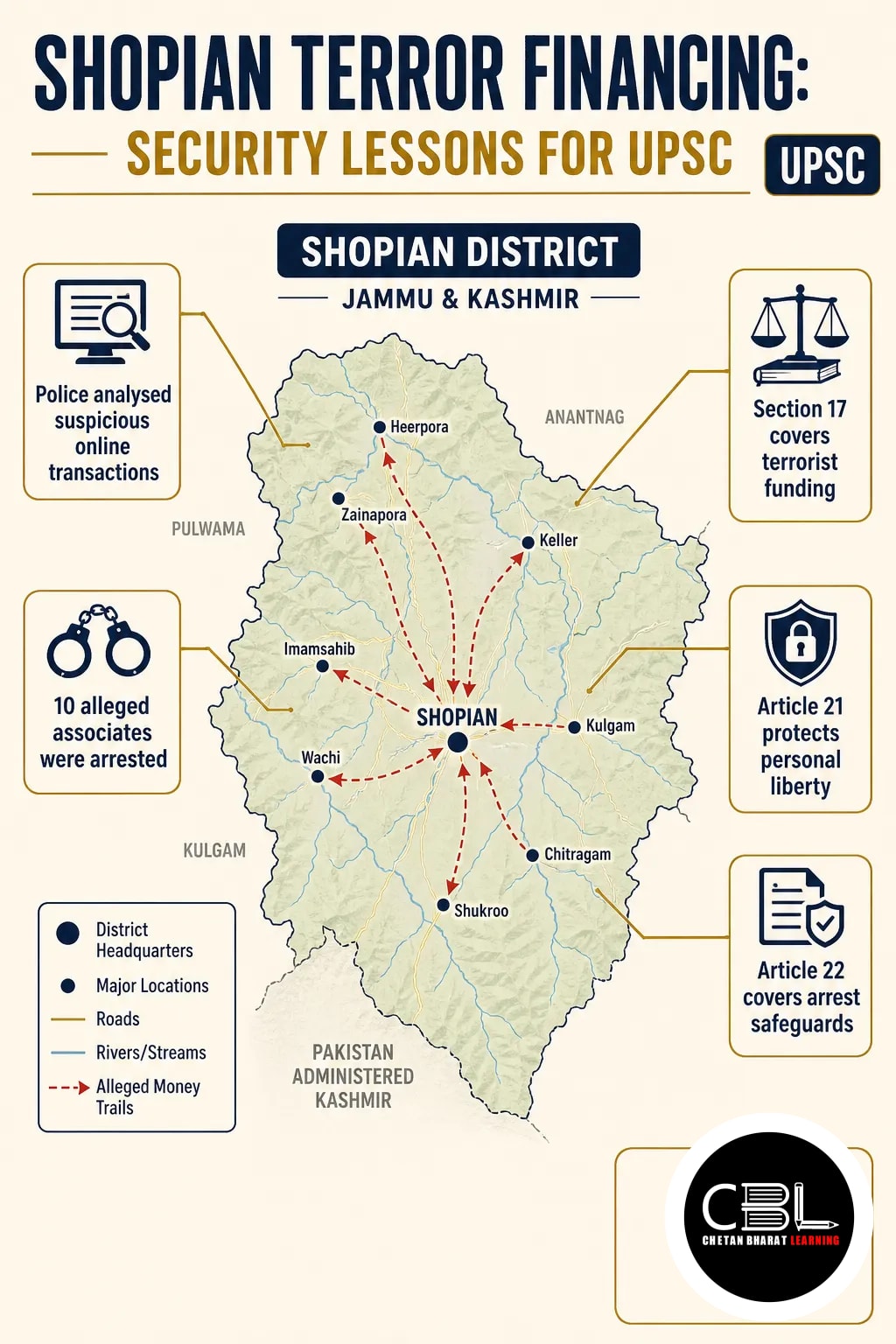
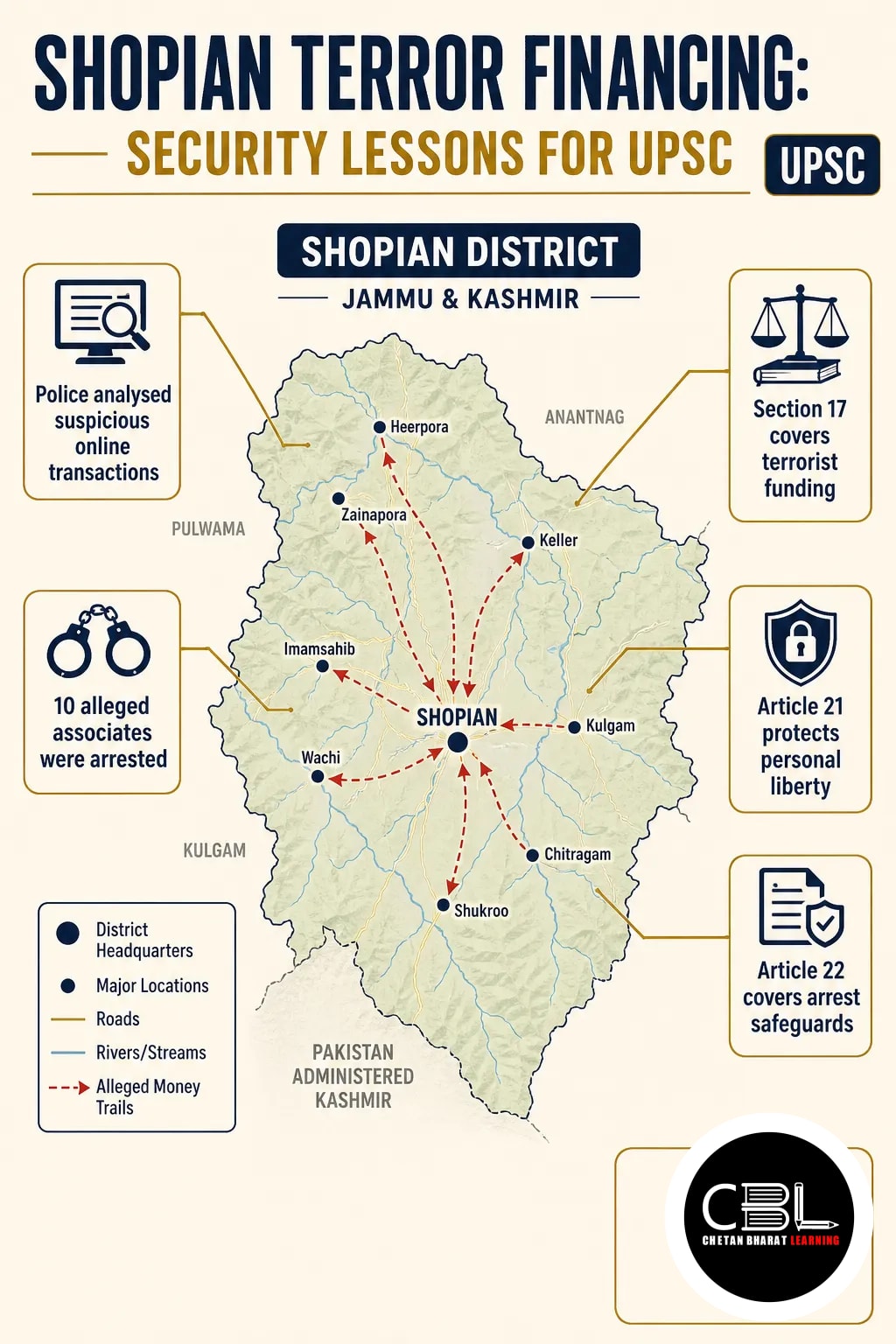
Shopian terror financing investigations led to the arrest of 10 alleged associates of terrorists in Jammu and Kashmir. The case adds a financial investigation dimension to internal security preparation for UPSC.
Quick answer: Shopian terror financing investigations uncovered an alleged network operating within Jammu and Kashmir, officials said on 30 October 2026. Police arrested 10 overground workers after analysing suspicious online transactions across payment platforms. The investigation also identified alleged links between the network and terrorists and associates lodged in different jails.
What is terror financing?
Terror financing involves providing or raising funds to support terrorist activity. Such support can sustain an organisation even when the people transferring money do not participate directly in an attack.
Investigators therefore examine who controlled funds, how money moved and what purpose the transfers served. However, a digital transaction alone does not establish terrorist intent or criminal liability.
Why is Shopian terror financing in the news?
Shopian police arrested 10 alleged overground workers after investigating a suspected financial network. Officials described it as a module operating within the Union Territory of Jammu and Kashmir.
Police analysed suspicious transactions across multiple payment platforms and followed money trails through several layers. Moreover, officials said the wider network had links with terrorists and their associates in different jails.
The source does not identify the platforms, transaction amounts or specific charges. Consequently, the allegations and arrests must not be treated as findings of guilt.
How can financial networks support terrorism?
Financial networks can connect people who raise, transfer and use funds for terrorist activity. Overground workers are people who support such networks without necessarily taking part in armed operations.
Money trails and intermediaries
A transfer through several accounts can make it harder to identify the original source or final beneficiary. Therefore, investigators must connect transaction records with account ownership, communications and other admissible evidence.
Digital payment records can provide leads across platforms. However, investigators must distinguish an innocent intermediary from someone who knowingly supports an unlawful purpose.
Links beyond the immediate transaction
Prison-related links in the Shopian case underline the need to examine alleged networks beyond the arrested individuals. Yet the source does not explain how those in jail communicated or participated.
For a related security context, see CBL’s explanation of cyber terrorism and digital threats. Digital terror financing and cyber terrorism are distinct concepts, even when investigations involve electronic evidence.
Which laws and safeguards are relevant?
India’s legal framework addresses terrorist funding while constitutional safeguards govern state action. The following provisions provide context; the source does not specify which charges police invoked in Shopian.
| Provision | Relevance |
|---|---|
| Unlawful Activities (Prevention) Act, 1967, Section 17 | Provides punishment for raising funds for a terrorist act, subject to the statutory conditions. |
| Prevention of Money-laundering Act, 2002 | Addresses money laundering involving proceeds of crime linked to scheduled offences; its application depends on legal conditions. |
| Constitution, Article 21 | Protects life and personal liberty, except according to procedure established by law. |
| Constitution, Article 22 | Provides safeguards concerning arrest and detention, subject to constitutional exceptions. |
Financial investigation and money-laundering prosecution are not interchangeable. In addition, authorities must establish the ingredients of each applicable offence rather than infer them from an arrest.
What are the main investigative challenges?
The central challenge is to turn a transaction trail into reliable evidence of an unlawful purpose.
- Multiple layers: Transfers across accounts and platforms can complicate attribution; therefore, investigators need a coherent chronology.
- Intent and knowledge: A payment may have a lawful explanation, so its context matters as much as its destination.
- Evidence preservation: Digital records require careful collection and documentation; otherwise, their reliability may be contested.
- Privacy and proportionality: Investigators handle sensitive financial information, so access and sharing need legal safeguards.
- Coordination: Police, financial institutions and prison authorities may hold different pieces of information; consequently, lawful information-sharing matters.
These are analytical challenges, not findings that each problem occurred in Shopian. For a broader governance perspective, see digital data protection and legal safeguards.
What should a proportionate response include?
A proportionate response should combine financial intelligence, evidence-led policing and safeguards for individual rights.
- Trace funds systematically: Map transactions across platforms and verify the identity and role of each participant.
- Corroborate digital leads: Combine financial records with independent evidence; moreover, document how investigators obtained and preserved each record.
- Coordinate lawfully: Create clear channels for police, payment providers and prison authorities to share relevant information.
- Protect legitimate users: Use targeted scrutiny and review mechanisms; consequently, suspicious patterns need not lead to indiscriminate restrictions.
- Build public trust: Explain lawful procedures and provide avenues for grievances, while protecting the integrity of investigations.
Overall, the Shopian terror financing case shows why internal security requires both network disruption and fair investigation. The test is not the number of suspicious transfers alone, but whether evidence establishes the alleged connection to terrorist activity.
Source: The Hindu, 30 October 2026
Asked in UPSC: Previous Year Questions
- UPSC CSE Mains 2019 (GS Paper III): Examine the role of overground workers in assisting terrorist organisations in insurgency-affected areas, and discuss measures to neutralise their influence.
UPSC links support networks to counter-insurgency measures; therefore, prepare both their functions and proportionate responses.
Punjab PCS and Haryana HCS may test terror financing under internal security and the role of police in financial investigations. Also revise constitutional safeguards alongside the distinction between allegations and proven offences.
Prelims Practice Corner
Mains Practice Questions
Frequently Asked Questions
How many people were arrested in the Shopian investigation?
Police arrested 10 alleged associates of terrorists. Officials also described them as overground workers linked to a suspected financial network.
How did police trace the alleged network?
Police analysed suspicious online transactions across multiple payment platforms. They also traced money trails through several layers, according to officials.
Does an arrest prove involvement in terror financing?
No, because an arrest is not a finding of guilt. Investigators and courts must assess evidence under the applicable legal process.
Which law addresses raising funds for a terrorist act?
Section 17 of the Unlawful Activities (Prevention) Act addresses raising funds for a terrorist act. However, the source does not specify the charges invoked in the Shopian case.
Related Current Affairs
Preparing for UPSC, PCS or HCS?
Talk to a mentor at Chetan Bharat Learning, Chandigarh. Free guidance on choosing the right exam and building a study plan.
Chat on WhatsAppCall 97793 53345UPSC / IAS / PCS coaching in Chandigarh · Trusted by aspirants across Punjab & Haryana
Leave a Reply
You must be logged in to post a comment.