
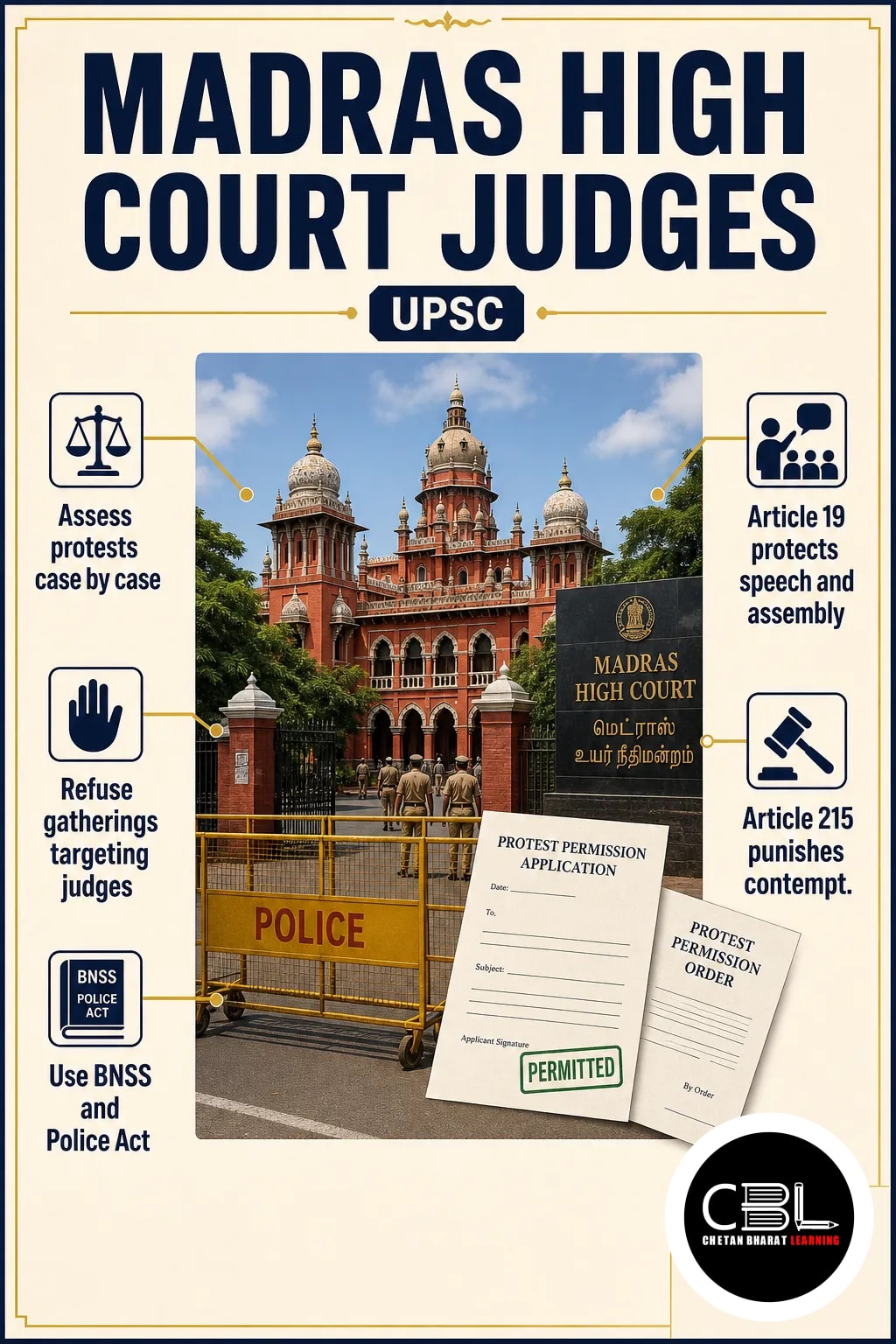
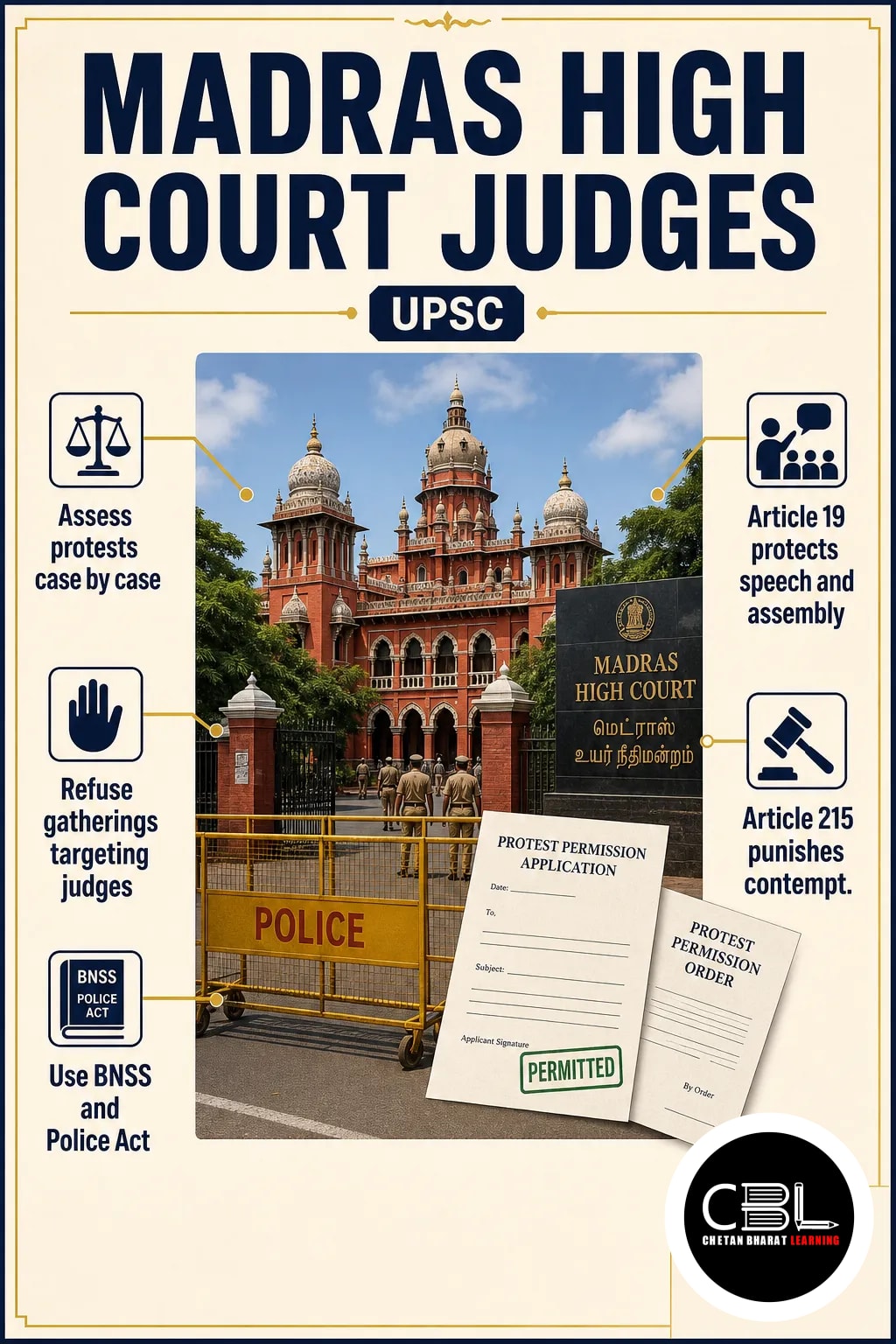
Madras High Court judges have directed Tamil Nadu authorities to refuse permission for gatherings intended to personally target or intimidate a sitting judge. The order raises questions about judicial independence and the right to protest, both central to Indian polity and governance.
Quick answer: On 30 October 2026, Madras High Court judges directed Tamil Nadu police and district authorities to scrutinise judicially related protest applications case by case. They must refuse gatherings aimed at personally targeting or intimidating a sitting judge. If a permitted event turns into a personal attack, officers must end it and take appropriate legal action.
What did the court direct?
The court directed authorities to assess protests concerning judicial matters individually and prevent gatherings aimed at personal targeting or intimidation of sitting judges. The First Division Bench comprised Chief Justice Sushrut Arvind Dharmadhikari and Justice G. Arul Murugan.
The Bench told state police and district administration to use their powers under the Bharatiya Nagarik Suraksha Sanhita (BNSS) and the local Police Act. In addition, officers must end a permitted assembly if it turns into a personal attack on judges and take appropriate legal action.
These directions concern the assessment and conduct of gatherings. They should not be read as a reported blanket prohibition on discussing or criticising judgments.
What was the background of the case?
Chennai resident R. Karthikeyan filed a public interest litigation (PIL) seeking action against those who scandalise the judiciary. The court disposed of the petition while issuing its directions.
The petitioner referred to protests by Tamil Nadu Thowheed Jamaath and Tamil Nadu Muslim Munnetra Kazhagam. The protests followed a ruling by a Bench led by Justice G.R. Swaminathan that converted Muslims were not entitled to reservations.
He sought preventive and penal measures against campaigns, gatherings, speeches and social media publications that intimidated or undermined the judiciary. He also requested criminal cases and investigation of cognisable offences, as well as guidelines for permissions. These were the petitioner’s requests; the reported directions should not be equated with every measure he sought.
Which constitutional provisions are relevant?
The order sits at the intersection of freedoms of expression and assembly, permissible restrictions, and the authority of High Courts.
| Provision | What it says |
|---|---|
| Article 19(1)(a) | Protects citizens’ freedom of speech and expression. |
| Article 19(1)(b) | Protects citizens’ right to assemble peacefully and without arms. |
| Article 19(2) | Permits reasonable legal restrictions on speech on specified grounds, including contempt of court and public order. |
| Article 19(3) | Permits reasonable legal restrictions on assembly in the interests of sovereignty and integrity of India or public order. |
| Article 215 | Makes every High Court a court of record with power to punish for contempt of itself. |
Importantly, a police decision on a gathering and a court’s exercise of contempt jurisdiction are distinct processes. Article 215 does not make every critical statement contempt. Similarly, the discussion of BNSS security bonds provides context on preventive powers, not a substitute for the specific powers applicable to an assembly.
Why does the order matter for judicial independence?
The order seeks to protect judges from personal intimidation while leaving room to examine how restrictions affect public debate.
- Independent adjudication: Threats directed at judges can place pressure on those deciding contentious disputes. Therefore, lawful protection supports decisions based on law rather than intimidation.
- Public accountability: Judicial reasoning affects citizens and remains open to fair discussion. Consequently, criticism of a judgment should not automatically be treated as a personal attack.
- Administrative responsibility: Police and district authorities must assess applications individually. Thus, the quality of their reasons and evidence matters to both safety and liberty.
- Institutional safeguards: Judicial independence also depends on appointment and tenure arrangements. For background, see the High Court judges’ appointment process.
What are the concerns and the way forward?
The central challenge is to distinguish genuine intimidation from peaceful disagreement without weakening protection for judges.
Concerns in implementation
Terms such as personal targeting require careful application to particular facts. Otherwise, broad interpretation could discourage citizens from discussing judicial decisions. Moreover, ending an ongoing assembly calls for prompt assessment of what participants actually say or do.
Permission decisions may also involve incomplete information about a planned event. Therefore, officials should not assume that opposition to a ruling necessarily implies an intention to threaten its author. Equally, a permitted event can change character, requiring a fresh assessment.
A rights-sensitive response
Authorities should record specific reasons for decisions and connect them to the applicable legal power. In addition, clear instructions to field officers can help distinguish criticism, personal abuse and intimidation. Any response should be proportionate to the circumstances and consistent with law.
Organisers should receive clear communication about conditions and decisions, while affected persons should be able to seek legal remedies. Finally, transparent review of disputed decisions can protect both judicial functioning and the space for peaceful protest. These are policy considerations, not additional directions attributed to the Bench.
Source: The Hindu, 30 October 2026
- HC Judges Appointment: Collegium System and Procedure (13 Aug 2026)
Asked in UPSC: Previous Year Questions
- UPSC CSE Mains 2025 (GS Paper II): Explain constitutional morality and its application to balance judicial independence and judicial accountability in India.
UPSC links judicial independence to accountability; therefore, prepare both institutional safeguards and limits on public authority.
State PCS General Studies can test the roles of police and district administration in regulating public assemblies. In addition, revise fundamental rights and the constitutional status of High Courts.
Prelims Practice Corner
Mains Practice Questions
Frequently Asked Questions
What did the Madras High Court direct police to do?
It directed police to refuse permission for gatherings aimed at personally targeting or intimidating a sitting judge. In addition, officers must end a permitted event if it becomes a personal attack and take appropriate legal action.
Does the reported order ban all criticism of judges?
No, the reported directions do not impose a blanket ban on criticism of judgments. Instead, they address personal targeting or intimidation and require case-by-case assessment of relevant gatherings.
Which constitutional article makes a High Court a court of record?
Article 215 makes every High Court a court of record. It also gives the High Court power to punish for contempt of itself.
Who filed the public interest litigation in this case?
R. Karthikeyan of Chennai filed the petition. He sought action against those who scandalise the judiciary and, in addition, requested guidelines on permissions for related gatherings.
Related Current Affairs
Preparing for UPSC, PCS or HCS?
Talk to a mentor at Chetan Bharat Learning, Chandigarh. Free guidance on choosing the right exam and building a study plan.
Chat on WhatsAppCall 97793 53345UPSC / IAS / PCS coaching in Chandigarh · Trusted by aspirants across Punjab & Haryana

 Ananya RanaIAS · AIR 60
 Aditya SharmaIAS · AIR 70
 Ria Kaur SethiIPS · AIR 89
 Aman AloonIRS · AIR 295
 Sumer Singh VirkIRS · AIR 335
 Shivani PanchalIAS

Leave a Reply
You must be logged in to post a comment.