
IDBI Bank strategic restructuring has prompted a government clarification on bidding, valuation and delegated decision-making. The case links economic policy with public asset management and banking regulation.
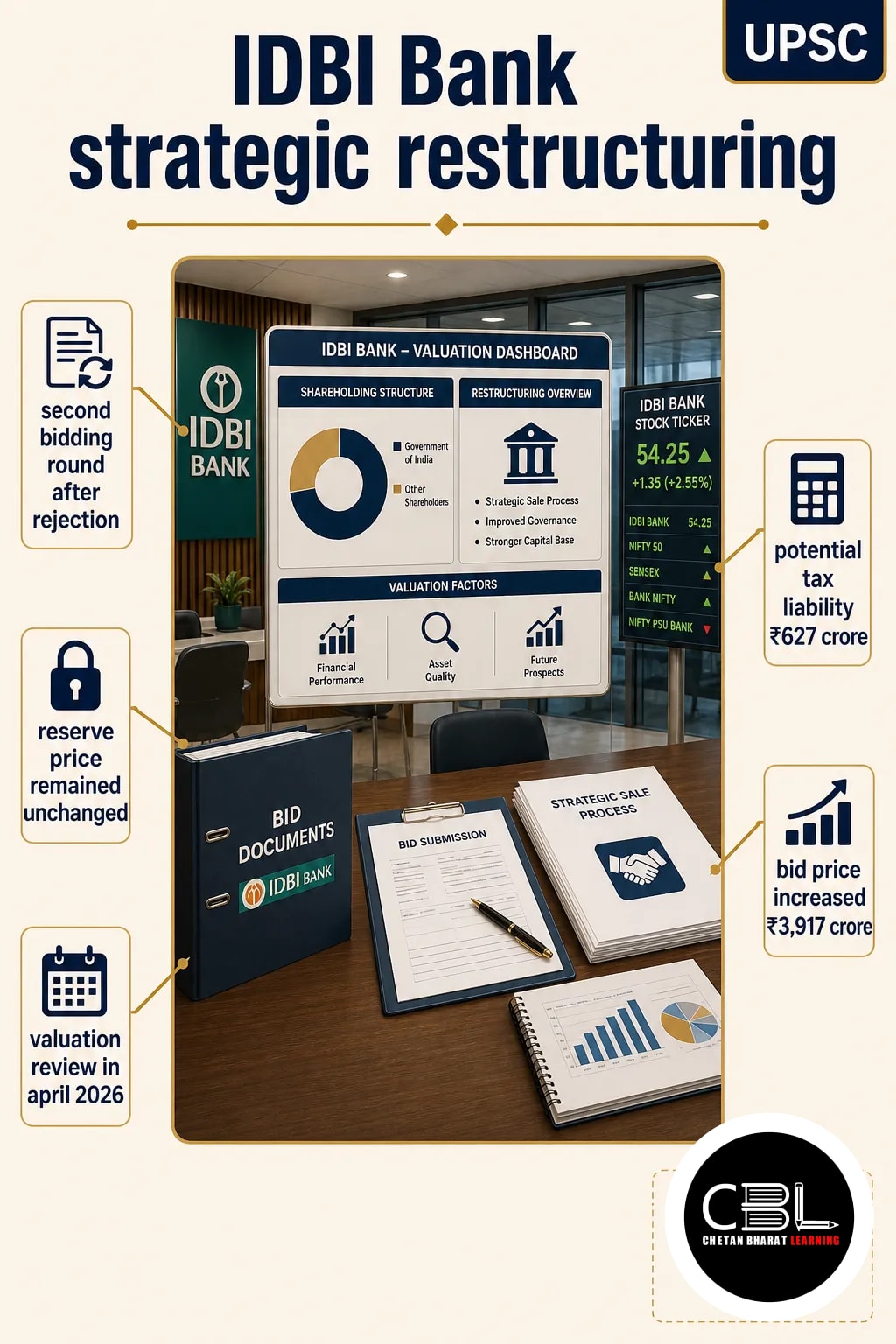
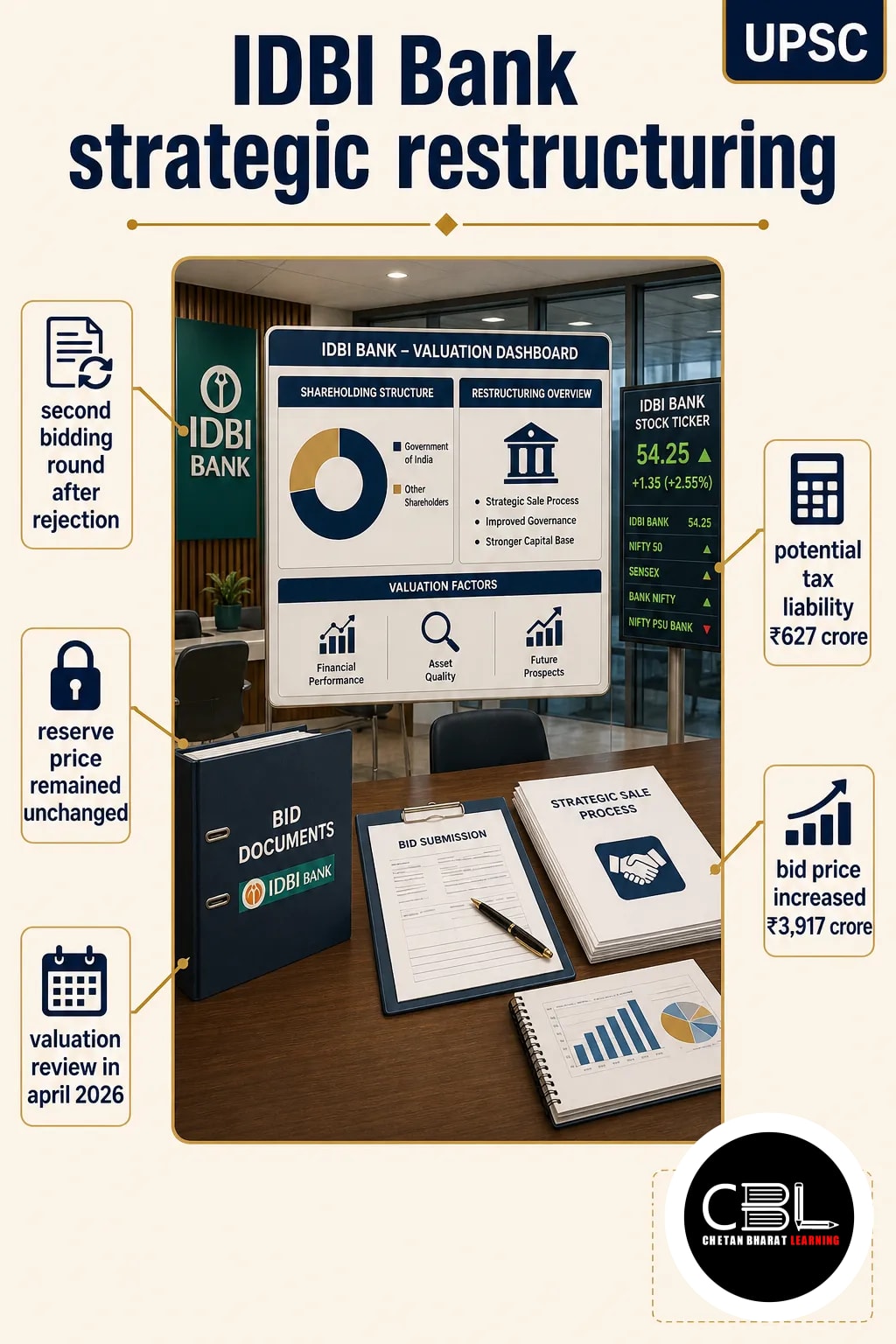
Quick answer: In its clarification on IDBI Bank strategic restructuring, the government explained why a second bidding round followed an unsuccessful initial round in 2025–26. It said the reserve price remained unchanged, while independent valuers revised their assessments. A tax-related provision carried a potential ₹627 crore liability, against a stated ₹3,917 crore increase in bid price.
What is IDBI Bank strategic restructuring?
The transaction concerns a strategic change in IDBI Bank’s ownership structure, with the government and Life Insurance Corporation of India (LIC) retaining residual shares. Strategic disinvestment generally involves the sale of a substantial government stake alongside a transfer of management control. However, the clarification does not specify the stake sold or identify a successful bidder.
For this case, the Department of Investment and Public Asset Management (DIPAM) organised the initial bidding process. The government says its internal procedural guidelines are indicative, rather than an inflexible legal framework. Therefore, authorised decision-makers can adapt the process to the transaction’s circumstances.
Why did the government clarify the bidding process?
The clarification explains the transition from an initial round in 2025–26 to a second, best-offer round. According to the government, the first round ended after the initial bids did not receive approval. Moreover, it says the reserve price was neither lowered nor raised.
Paragraph 5.3.6(iii) of the request for proposal (RFP) addresses a highest financial bid below the reserve price. In that situation, the Government of India decides the next action; the provision also limits subsequent challenges by qualified bidders to that decision. Thus, a bid below the reserve price does not automatically determine the outcome.
The reserve price and an independent valuation have different roles. The former is the transaction’s reference threshold, whereas the latter provides a benchmark for assessing bid reasonableness. Consequently, a revised valuation does not, by itself, establish that the reserve price changed.
Who authorised the second round?
The Core Group of Secretaries on Disinvestment (CGD) determined the second-round process under powers delegated by the Cabinet Committee on Economic Affairs (CCEA). On 16 August 2017, the CCEA empowered the group to resolve procedural difficulties and consider necessary deviations for implementing approved strategic disinvestment transactions.
According to the clarification, DIPAM had no prescribed internal procedure for the situation that arose. Therefore, the CGD used its delegated authority to design the best-offer round. This distinction matters: an indicative procedure allows flexibility, but the delegation remains the stated basis for the decision.
How did the valuation process work?
Two independent advisers used different methods to assess the bank, while bidders submitted their own confidential financial offers. The CGD reviewed the overall valuation methodology in April 2026. After accounts for the year ending 31 March 2026 became public in late April, independent agencies began revised valuations in May.
The government describes a double-confidentiality arrangement: bidders did not know the valuations, and valuers did not see the bids. Meanwhile, the CGD had access to both and compared them to judge bid reasonableness. This separation aims to reduce the risk that either exercise simply follows the other.
| Valuation element | Government’s explanation |
|---|---|
| Business valuation | The transaction adviser engaged specialists in market multiples. |
| Comparable companies | All listed public sector banks formed the comparison set. |
| Comparable transactions | The method was not used because suitable transactions were unavailable. |
| IDBI share price | The clarification cites limited trading and price volatility in explaining its exclusion. |
Market multiples compare an enterprise with similar listed companies using financial measures. However, the choice of peers affects the result. The government’s choice reflects IDBI’s ownership history: LIC acquired a majority stake in 2019, while the Reserve Bank of India (RBI) classified it as a private sector bank for regulatory purposes. The clarification says government and LIC ownership nevertheless remained predominant.
What was the disputed tax demand adjustment?
The asset valuer included an adjustment concerning disputed tax demands, responding to a common request from qualified bidders. According to the government, the provision increased the bid price by ₹3,917 crore, while the potential liability under this item was ₹627 crore.
The clarification calls the event unlikely and describes it as revenue-neutral for the government. It says only an additional tax demand actually paid would qualify for reimbursement. However, the bid increase and potential liability are different quantities; they should not be treated as a guaranteed net fiscal gain.
What are the policy implications and concerns?
The case illustrates the trade-off between transaction flexibility and accountability in strategic disinvestment.
- Price discovery: Independent bids and valuations offer separate signals; however, their divergence requires a reasoned decision.
- Procedural discretion: Delegated powers can prevent delays, but decisions to depart from an indicative process need clear records.
- Comparable firms: Listed public sector banks offer a benchmark; nevertheless, differences between banks can affect valuation.
- Contingent obligations: Tax-related reimbursement may influence bids, so its conditions and fiscal exposure need separate assessment.
- Residual ownership: The government and LIC retain shares and may benefit from future appreciation; equally, future value is uncertain.
What should guide future transactions?
Future transactions should combine documented discretion with independently assessed value and clear fiscal safeguards. First, decision records should explain procedural changes and their delegated authority. Second, disclosures after commercially sensitive stages should clarify valuation methods, comparable choices and contingent obligations without compromising live bids.
Finally, assessment should distinguish immediate proceeds from possible future gains on retained shares. This allows policymakers to evaluate both the transaction price and continuing public exposure.
Source: Press Information Bureau, 30 October 2026
Asked in State PCS: Previous Year Questions
- Punjab PCS Prelims 2021 (General Studies): Which of these are Union non-tax revenue receipts: disinvestment receipts, spectrum fees, public sector dividends and interest on loans?
State PCS questions distinguish disinvestment receipts from revenue receipts, so revise the classification of government receipts.
Punjab PCS and Haryana HCS General Studies can test strategic disinvestment, public asset valuation and the classification of government receipts. In addition, candidates should distinguish a capital receipt from non-tax revenue such as dividends.
Prelims Practice Corner
Mains Practice Questions
Frequently Asked Questions
Why was a second bidding round held for IDBI Bank?
The initial bids did not receive approval, so the first round ended. Subsequently, the CGD determined the best-offer round under delegated powers.
Did the government change the IDBI reserve price?
No, the government says it neither lowered nor raised the reserve price. However, independent agencies began revised valuations in May 2026.
Why were public sector banks used as valuation comparables?
They provided a listed-company comparison set when suitable comparable transactions were unavailable. Moreover, the government cited IDBI’s ownership history and predominant government and LIC ownership.
Related Current Affairs
Preparing for UPSC, PCS or HCS?
Talk to a mentor at Chetan Bharat Learning, Chandigarh. Free guidance on choosing the right exam and building a study plan.
Chat on WhatsAppCall 97793 53345UPSC / IAS / PCS coaching in Chandigarh · Trusted by aspirants across Punjab & Haryana
Leave a Reply
You must be logged in to post a comment.