
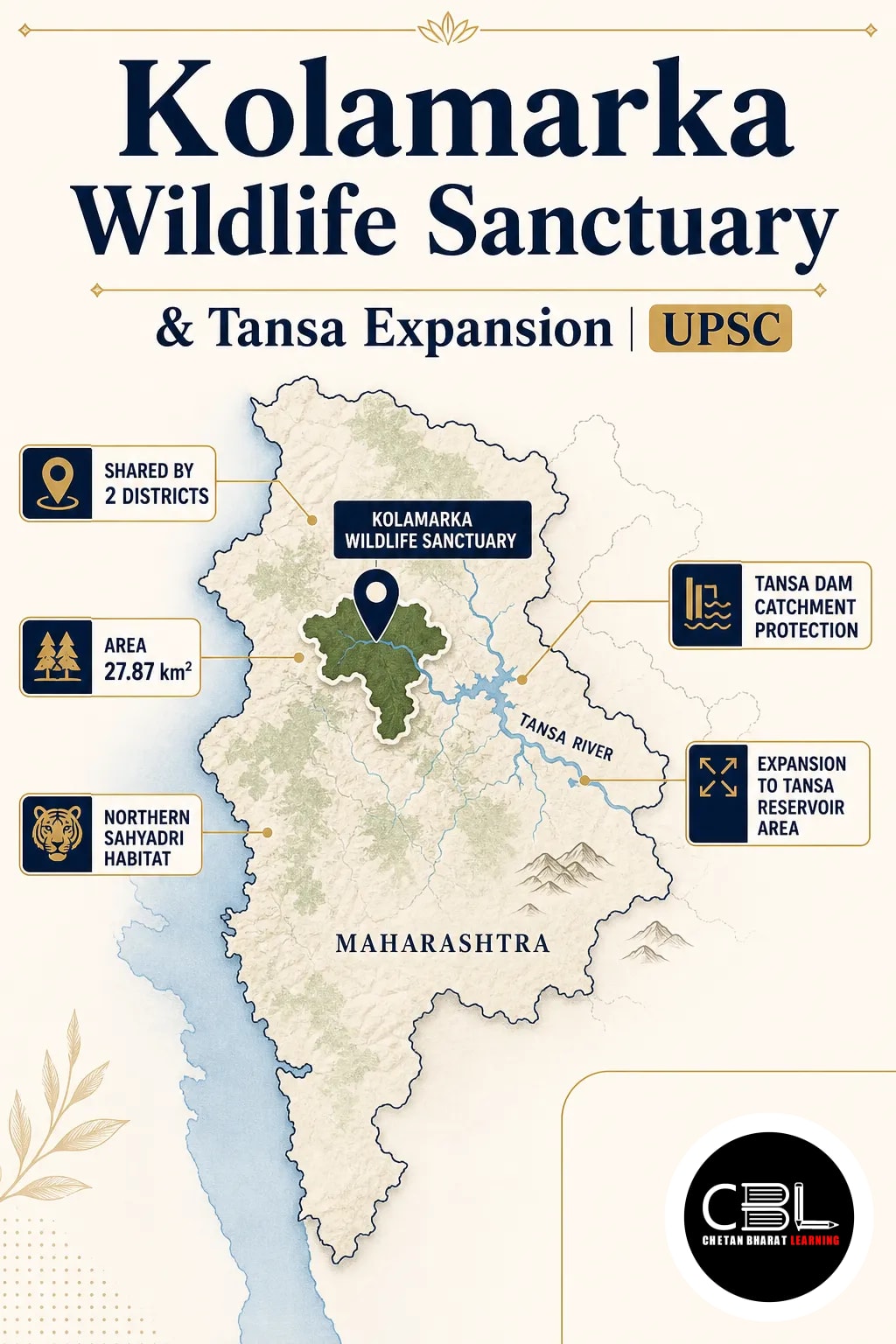
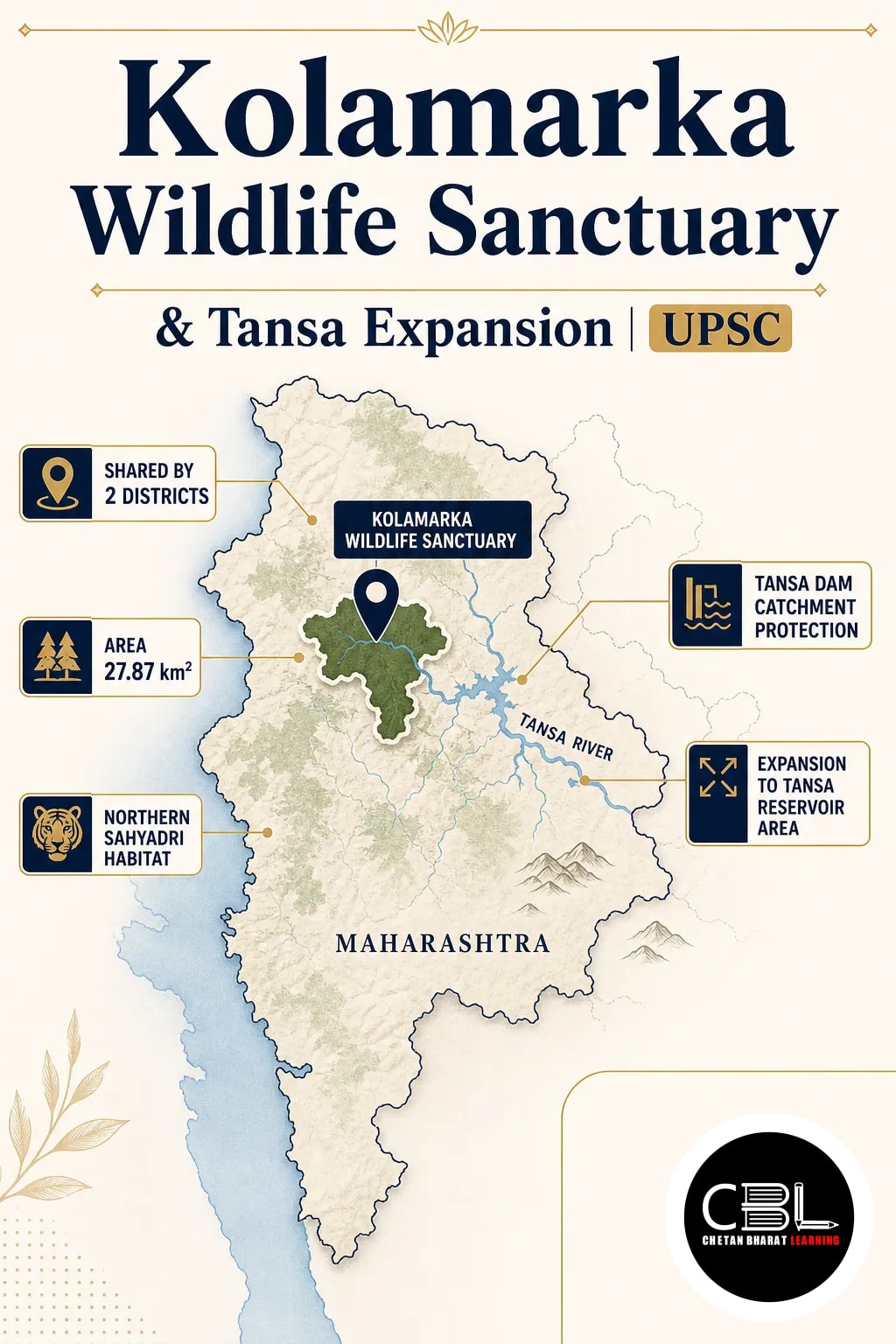
Kolamarka Wildlife Sanctuary has emerged as an important conservation development following the Maharashtra State Board for Wildlife’s approval of a proposal to upgrade the Kolamarka Conservation Reserve in Gadchiroli district to wildlife sanctuary status. At its 26th meeting on 26 October 2026, chaired by Chief Minister Devendra Fadnavis, the board also approved sanctuary status for an expanded area adjoining the existing Tansa Wildlife Sanctuary. Additionally, it cleared proposals for 14 conservation reserves across seven districts. These decisions are important for UPSC Environment, biodiversity conservation and protected-area mapping. Explore related topics in the daily current affairs archive.
The proposed changes aim to strengthen habitat protection, improve wildlife corridors and safeguard important ecosystems. The board’s approval is a key administrative step, while the applicable statutory notification process determines formal protected-area status.
Location and Key Features
The two protected areas lie in distinct ecological regions of Maharashtra. Kolamarka is situated in eastern Maharashtra, while Tansa occupies part of the Western Ghats landscape near the Mumbai Metropolitan Region.
Kolamarka Conservation Reserve
The Kolamarka Conservation Reserve is located in the Sironcha taluka of Gadchiroli district, close to Maharashtra’s borders with Telangana and Chhattisgarh. The region forms part of an important forest landscape supporting wildlife movement.
Kolamarka is particularly known for the endangered Asian wild water buffalo (Bubalus arnee). Its forests support habitat connectivity across adjoining central Indian landscapes.
The area contains dry deciduous forests, bamboo patches, grassland habitats and riverine ecological features. Its location near the Pranhita-Indravati river system makes it important for landscape-level conservation.
Tansa Wildlife Sanctuary
Tansa Wildlife Sanctuary lies within the Thane-Palghar region of Maharashtra, along the foothills of the Western Ghats. It includes forested catchment areas associated with Tansa, Vaitarna and Modak Sagar reservoirs.
The sanctuary supports moist deciduous forest ecosystems and wildlife including leopards, sloth bears, birds and smaller mammals. The landscape also contributes to water security for the Mumbai Metropolitan Region.
Its ecological significance extends beyond wildlife protection because forest cover helps regulate runoff, reduce erosion and preserve watershed functions.
Why in News?
On 26 October 2026, the Maharashtra State Board for Wildlife approved proposals to declare Kolamarka Conservation Reserve and the newly expanded Tansa area as wildlife sanctuaries.
The board also supported the inclusion of 588.767 hectares of revenue and private land from six villages in the Tansa expansion proposal. The villages include Ogda, Khodde, Tirmal, Pachghar, Phansad and Amle.
The expansion proposal is associated with efforts to address settlement-related pressures and strengthen habitat management. Any relocation or recognition of rights must follow the applicable legal safeguards.
Additionally, the board approved proposals for 14 conservation reserves across Pune, Raigad, Nashik, Nandurbar, Thane, Palghar and Chandrapur districts.
Source: PTI report on Maharashtra State Board for Wildlife decisions.
What Is a Wildlife Sanctuary?
A wildlife sanctuary is a legally designated protected area established to conserve wild animals, plants and their habitats. In India, the Wild Life (Protection) Act, 1972, as amended, governs its declaration and management.
Unlike a national park, certain existing rights and regulated activities may continue in a sanctuary subject to statutory provisions and conservation requirements.
The Chief Wildlife Warden plays an important role in the management of wildlife sanctuaries. Activities that may harm wildlife or habitats remain subject to restrictions and permissions under the law.
Procedure for Declaring a Wildlife Sanctuary
- Section 18: The State Government issues a notification expressing its intention to constitute a specified area as a sanctuary.
- Section 19: The Collector investigates the existence, nature and extent of rights over the proposed sanctuary land.
- Sections 20–25: The law provides procedures concerning claims, restrictions and settlement of existing rights.
- Section 26A: Following the required process, the State Government issues the final notification specifying sanctuary boundaries.
- Section 26A(3): Alteration of sanctuary boundaries requires a recommendation from the National Board for Wildlife.
Important distinction: Approval by a State Board for Wildlife does not automatically complete the legal declaration of a sanctuary. The statutory notification process remains necessary.
Reference: India Code statutory database.
Wildlife Sanctuary vs Conservation Reserve
| Feature | Wildlife Sanctuary | Conservation Reserve |
|---|---|---|
| Governing provisions | Sections 18–26A | Sections 36A–36B |
| Primary purpose | Protect wildlife and natural habitats | Protect landscapes, corridors and connecting habitats |
| Management | Wildlife authorities under statutory provisions | Conservation Reserve Management Committee |
| Community participation | Subject to recognised rights and legal provisions | Consultation with local communities is an important feature |
Conservation reserves generally cover government-owned areas, particularly those adjoining national parks or sanctuaries or connecting protected landscapes. Sanctuary declaration establishes a more specific legal protection framework.
Ecological Significance of Kolamarka
The proposed Kolamarka Wildlife Sanctuary has special importance because of its association with the endangered Asian wild water buffalo. The species is an important large herbivore in South Asian grassland and forest ecosystems.
Its scientific name is Bubalus arnee. The species is listed as Endangered on the IUCN Red List and receives protection under India’s wildlife legislation.
Habitat fragmentation, hunting pressures, disease transmission and genetic mixing with domestic buffaloes present conservation challenges. Protecting suitable habitat can improve long-term population viability.
Kolamarka also supports broader forest connectivity across state boundaries. Maintaining such ecological corridors can help animal movement, gene flow and landscape resilience.
Ecological Significance of Tansa Wildlife Sanctuary
- Water catchment protection: Forests protect reservoir catchments important for water supply in the Mumbai region.
- Western Ghats biodiversity: The landscape supports diverse flora and fauna within a globally significant biodiversity region.
- Soil conservation: Forest vegetation reduces erosion and helps maintain watershed stability.
- Wildlife habitats: The sanctuary supports mammals, birds and other organisms dependent on forest ecosystems.
- Landscape connectivity: Habitat protection helps maintain ecological links between forest patches in western Maharashtra.
Other Conservation Decisions in Maharashtra
The State Board for Wildlife also approved proposals for 14 conservation reserves across seven districts. These included areas such as Velhe-Mulshi, Lonavala, Dindori, Surgana, Alibag, Jawhar and Ekara.
It additionally approved proposals involving 100.139 square kilometres of Koka Wildlife Sanctuary and 255.79 square kilometres of Jayakwadi Bird Sanctuary for critical wildlife habitat designation.
These measures seek to improve protection across forest, wetland and wildlife corridor ecosystems. Formal legal status depends on the applicable notification procedures.
Source: Report on additional wildlife conservation proposals.
Threats to Protected Wildlife Habitats
- Habitat fragmentation: Roads, settlements and infrastructure can interrupt wildlife movement and reduce ecological connectivity.
- Human-wildlife conflict: Interactions between wildlife and nearby settlements may threaten livelihoods and conservation outcomes.
- Encroachment and land-use change: Conversion of natural habitats can affect biodiversity and ecological functions.
- Development pressures: Infrastructure projects require careful environmental appraisal and mitigation measures.
- Climate change: Changing rainfall and temperature patterns may alter habitat suitability and water availability.
Conservation and Policy Measures
Effective conservation requires more than legal notification. Protected-area management must integrate ecological monitoring, community participation, habitat restoration and transparent governance.
- Scientific monitoring: Track wildlife populations, forest condition and habitat connectivity through systematic surveys.
- Community participation: Protect legitimate rights and involve local communities in conservation decisions.
- Conflict mitigation: Improve compensation systems, early-warning mechanisms and field-level wildlife response.
- Landscape planning: Protect ecological corridors while assessing the cumulative impact of development projects.
- Voluntary rehabilitation safeguards: Apply relevant legal procedures and ensure fair treatment of affected communities.
The Kolamarka and Tansa decisions demonstrate the importance of balancing biodiversity conservation with local livelihoods and infrastructure requirements. Strong implementation and community cooperation will determine long-term conservation success.
Punjab PCS and Haryana HCS aspirants should compare wildlife sanctuaries, national parks, conservation reserves and community reserves under the Wild Life (Protection) Act, 1972. The topic can be linked with protected-area management in Punjab and Haryana, biodiversity corridors and human-wildlife conflict. Mapping questions may test Kolamarka in Gadchiroli, Tansa in the Western Ghats and the habitat of the endangered wild water buffalo.
Frequently Asked Questions
Where is Kolamarka Wildlife Sanctuary located?
The proposed Kolamarka Wildlife Sanctuary is located in Sironcha taluka of Gadchiroli district, Maharashtra. The area is particularly important for the conservation of the endangered Asian wild water buffalo.
Why is Tansa Wildlife Sanctuary important?
Tansa protects important forest ecosystems in Maharashtra’s Western Ghats landscape. Its forested catchments also contribute to water security for the Mumbai Metropolitan Region.
How many conservation reserves did Maharashtra approve in October 2026?
The Maharashtra State Board for Wildlife approved proposals for 14 conservation reserves across seven districts on 26 October 2026. It also approved sanctuary proposals concerning Kolamarka and the expanded Tansa area.
Related Current Affairs
Preparing for UPSC, PCS or HCS?
Talk to a mentor at Chetan Bharat Learning, Chandigarh. Free guidance on choosing the right exam and building a study plan.
Chat on WhatsAppCall 97793 53345UPSC / IAS / PCS coaching in Chandigarh · Trusted by aspirants across Punjab & Haryana
Leave a Reply
You must be logged in to post a comment.