
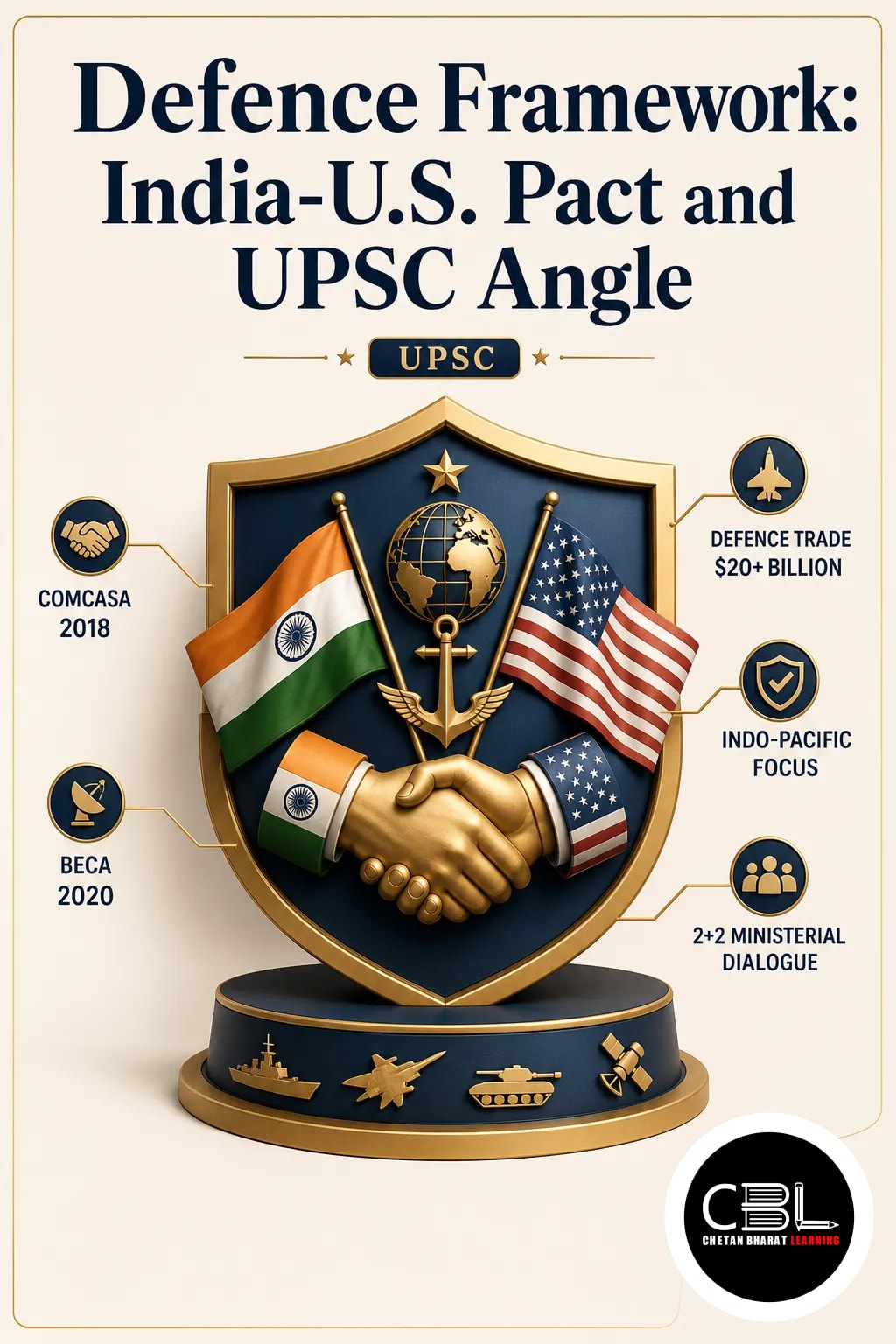

Defence framework talks between India and the U.S. have once again come into focus after the two sides reviewed progress on the pact. For a quick background, see our explainer on major defence partnerships and how such agreements support strategic cooperation.
What is defence framework?
The defence framework is a long-term bilateral roadmap that guides military cooperation, technology collaboration, and operational coordination. In this case, India and the U.S. are using it to deepen convergence in sensitive defence areas.
Such frameworks usually build on existing agreements and give direction to future cooperation. They matter because they can shape procurement choices, joint development, and the pace of defence innovation.
Why in News?
Defence Minister Rajnath Singh and U.S. Secretary of War Pete Hegseth reviewed progress on the 10-year pact in Cebu, Philippines, on the sidelines of the ADMM-Plus meeting. The discussion covered bilateral defence cooperation and wider regional security in the Indo-Pacific.
The latest review matters because it shows that the pact is not a ceremonial document. It is being treated as an active instrument for aligning priorities in technology, intelligence-related cooperation, and hardware co-production.
Key Features
- 10-year roadmap: The pact sets a decade-long direction for the defence partnership and allows planning beyond short political cycles.
- Critical technologies: It seeks deeper cooperation in advanced military technologies that can improve capability building.
- Information sharing: The framework supports better exchange of defence-related information between the two sides.
- Co-production focus: It encourages joint production of military hardware, which can support supply-chain resilience and indigenous capacity.
- Indo-Pacific lens: The pact links bilateral defence cooperation with a shared interest in a free, open, and secure Indo-Pacific.
- Built on earlier agreements: India-U.S. defence ties already rest on instruments such as LEMOA, COMCASA, and BECA.
Challenges
- Policy friction: Defence cooperation can advance even when wider diplomatic ties face strain, but that creates uncertainty.
- Technology sensitivity: High-end military technology involves export controls, trust, and careful safeguards.
- Interoperability limits: Working together more closely still requires compatible systems, training, and doctrines.
- Supply-chain dependence: Co-production helps, yet critical inputs may still depend on external approvals or vendors.
- Strategic balancing: India must preserve strategic autonomy while expanding partnership with a major power.
Way Forward
India can use the defence framework to push joint development, faster technology transfer, and practical interoperability. The emphasis should remain on building domestic capability rather than simple equipment purchases.
Regular ministerial reviews can help convert broad statements into measurable outcomes. A steady focus on co-production, training, and maritime security can make the pact more useful for both sides.
Source: The Hindu, 28 October 2026
- Project Seabird: Karwar Naval Base and Phase IIA (15 Oct 2026)
- Sohar Port: Oman’s Strategic Offer to India (18 Sep 2026)
This topic is useful for international relations and defence policy sections in state PCS exams. It also helps explain how strategic partnerships affect maritime security, industrial cooperation, and India’s wider foreign policy choices.
FAQ
Why does the India-U.S. defence framework matter?
It gives a structured roadmap for cooperation in defence technology, information exchange, and co-production. That makes the partnership more predictable and more useful for long-term planning.
How is this different from earlier defence agreements?
Earlier agreements such as LEMOA, COMCASA, and BECA handled specific areas like logistics, communications, and geospatial cooperation. The new framework is broader and gives an overall direction for the partnership.
Why is the Indo-Pacific mentioned in this context?
The Indo-Pacific is central to India-U.S. strategic cooperation because both sides seek a stable regional order. Defence collaboration is therefore linked to maritime security and broader regional balance.
Leave a Reply
You must be logged in to post a comment.