
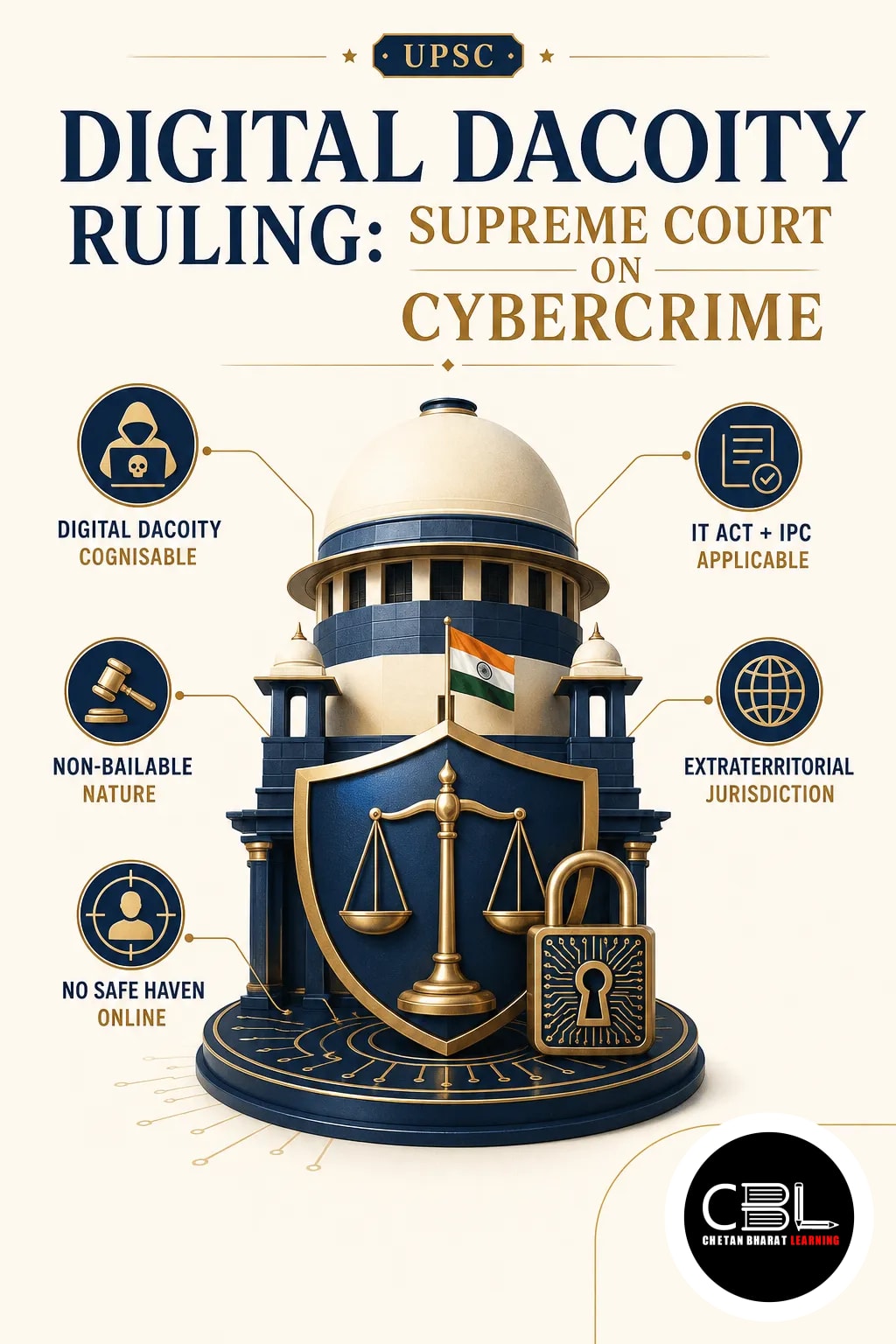

Digital dacoity entered legal debate after the Supreme Court rejected a plea linked to India’s cybercrime response framework and refused to consolidate multiple cases. The Bench treated the alleged conduct as part of organised online fraud, not a routine procedural matter.
What the Court Held
The Supreme Court refused to club over 30 criminal complaints filed in different states against two accused persons. It said such requests cannot weaken investigations spread across jurisdictions.
The Bench used the phrase digital dacoity to describe cyber offences such as digital arrest scams. It also stressed that victims should not be inconvenienced for an accused’s preferred forum.
Background of the Case
The plea concerned two persons accused of permitting the use of their company account as a mule account. According to the Court, money defrauded from victims was routed through that account.
The Bench noted that the complaints arose in several states, including Delhi, Maharashtra, Kerala, Telangana and Gujarat. The petitioner ultimately withdrew the plea after the Court declined relief.
Constitutional and Legal Provisions
| Article/Act | What it says |
|---|---|
| Article 32 | Protects the right to approach the Supreme Court for enforcement of fundamental rights. |
| CrPC / procedural law | Provides transfer and trial-related procedures, subject to judicial discretion and fairness. |
| Information Technology Act, 2000 | Deals with electronic offences, identity misuse, and computer-related fraud. |
| Bharatiya Nyaya Sanhita | Covers cheating, organised crime-related conduct, and fraud-based offences under the current criminal law framework. |
Implications
- Stronger judicial signal: The Court’s language shows that organised cyber fraud will be treated seriously.
- Victim-centric approach: Courts may prefer investigation convenience and victim access over accused convenience.
- Multi-state coordination: Cybercrime cases often need police cooperation across state borders.
- Deterrence value: The ruling may discourage requests that delay or fragment probes.
Criticism and Concerns
- Forum challenges: Multi-jurisdiction cases can still create procedural confusion for courts and police.
- Evidence collection: Digital trails, bank layers, and foreign links can complicate investigation.
- Victim burden: Senior citizens and other vulnerable targets may face severe financial and emotional harm.
- Capacity gap: State police units need better cyber forensics and faster inter-state coordination.
Source: The Hindu, 28 October 2026
- Cybercrime Coordination Centre (I4C): UPSC Analysis (21 Oct 2026)
- Bharatiya Nyaya Sanhita: Transforming India’s Criminal Justice System (10 Sep 2026)
- NHRC Instagram Probe: Safeguarding Children Online (10 Sep 2026)
This ruling is useful for PCS prelims and mains under criminal justice, policing, and cyber governance. State administrations must coordinate with police, banks, and cyber cells to trace mule accounts and protect vulnerable citizens. It also highlights how courts balance procedural convenience against victims’ rights.
FAQ
Why did the Court use the phrase digital dacoity?
The Court used it to underline the organised and aggressive nature of cyber frauds. It compared digital arrest scams and similar offences to serious robbery-like harm in the online space.
Why was consolidation of cases refused?
The Bench said accused convenience cannot override the interests of victims and investigating agencies. It also noted that multi-state cybercrime probes should not be disrupted.
How is this relevant for UPSC aspirants?
It links the judiciary, cybercrime law, and victim protection in one case study. The topic can be used in both Polity and Internal Security answers.
Leave a Reply
You must be logged in to post a comment.