

UPSC Mapping
- Prelims: Species in News, Wetlands and Biodiversity
- Mains: GS Paper 3 – Environment and Biodiversity Conservation
Quick Facts
| Attribute | Value |
|---|---|
| Scientific Name | Antigone antigone |
| IUCN Status | Vulnerable |
| Legal Protection | Schedule I, WPA 1972 |
| State Bird | Uttar Pradesh |
Location and Key Features
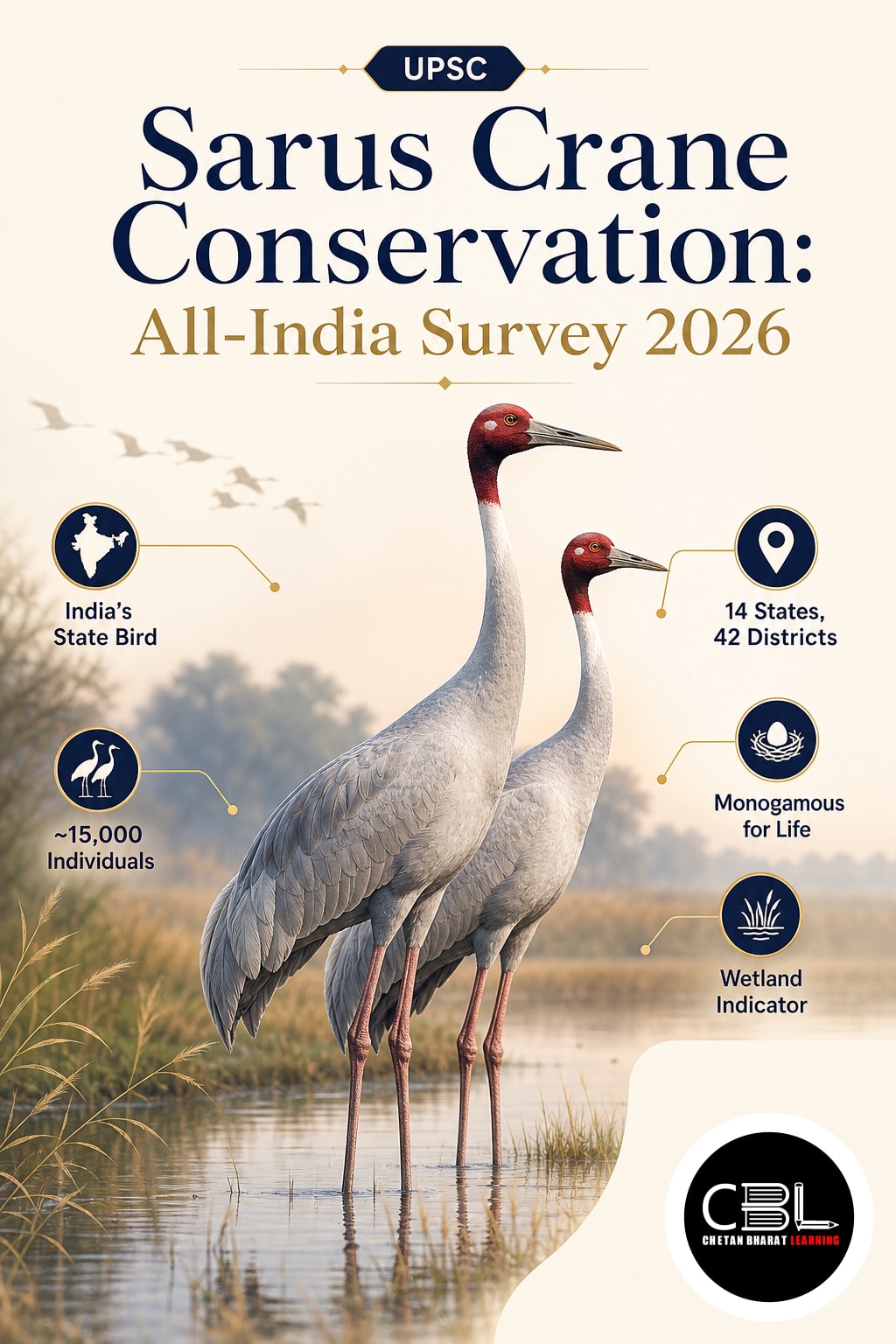
The Sarus crane (Antigone antigone) is the world’s tallest flying bird and India’s only resident breeding crane species. It depends on shallow wetlands, grasslands and agricultural fields and maintains resident populations in northern and central India.
Distribution and Habitat
The species occurs in India, Nepal, Pakistan, Southeast Asia and northern Australia. In India, major populations are in Uttar Pradesh, Gujarat, Rajasthan and Madhya Pradesh.
- Freshwater wetlands: Marshes, shallow lakes and seasonal ponds.
- Agricultural fields: Flooded paddy fields and agricultural wetlands.
- Grasslands: Open areas for foraging and movement.
- Canals and village ponds: Human-managed water bodies.
- Low-altitude plains: Shallow water access in open landscapes.
Physical and Biological Characteristics
| Characteristic | Description |
|---|---|
| Height | 1.5–1.8 m in adults |
| Wingspan | About 2.4 m |
| Plumage | Ash-grey with bare red head and neck |
| Diet | Omnivorous: plants, grains, insects, molluscs, small vertebrates |
| Breeding | Linked to monsoon flooding and shallow wetlands |
| Pair Bonding | Strong, long-lasting monogamous bonds |
Why in News?
The Bombay Natural History Society announced a coordinated All-India Sarus Crane Survey in October 2026 to improve population estimates, map nesting and roosting sites, and identify threats such as power-line collisions.
Conservation Status and Legal Protection
| Framework | Status |
|---|---|
| IUCN Red List | Vulnerable |
| Wild Life (Protection) Act, 1972 | Schedule I |
| CITES | Appendix II |
| State Recognition | State Bird of Uttar Pradesh |
| Family | Gruidae; Species Antigone antigone |
The IUCN Vulnerable status indicates a high risk of extinction in the wild. Schedule I affords stringent legal protection against hunting and trade.
Ecological and Cultural Significance
1. Indicator of Wetland Health
Dependence on freshwater wetlands makes the Sarus crane a bioindicator; its trends reflect overall ecosystem condition.
2. Pair Bonds and Courtship
Known for elaborate courtship dances and long-lasting monogamous bonds, symbolising fidelity in Indian culture.
3. Agriculture–Wildlife Coexistence
Breeds in working agricultural landscapes; community protection of nests shows conservation alongside farming.
4. Umbrella for Wetland Biodiversity
Protecting Sarus crane habitats benefits many wetland species and ecological connectivity.
Major Threats to Sarus Crane Conservation
- Wetland destruction: Drainage and land conversion.
- Power-line collisions: Fatal strikes near flight routes.
- Pesticide contamination: Threatens food resources.
- Nest disturbance: Mechanised farming and human activity.
- Predation: Free-ranging dogs and other predators.
- Habitat fragmentation: Roads and land-use changes.
- Climate variability: Unpredictable rainfall and droughts.
Conservation and Policy Measures
- Conduct synchronised all-India population assessments.
- Protect agricultural wetlands and seasonal marshes.
- Mitigate power-line mortality with bird diverters.
- Engage farmers and communities in nest protection.
- Promote wetland-sensitive farming and reduced pesticide use.
- Strengthen ecological monitoring of breeding success and trends.
- Improve coordination across agriculture, infrastructure and conservation.
Effective conservation demands action across wetlands, agricultural landscapes and infrastructure corridors, and community stewardship beyond formal reserves.
Prelims Practice Corner
Q1. What is the IUCN Red List status of the Sarus crane?
- (a) Least Concern
- (b) Endangered
- (c) Vulnerable
- (d) Critically Endangered
Answer: (c) Vulnerable
Q2. Which statements about the Sarus crane are correct?
1. It is the world’s tallest flying bird.
2. It is India’s only resident breeding crane species.
3. It breeds exclusively in the Himalayan alpine zone.
- (a) 1 and 2 only
- (b) 2 and 3 only
- (c) 1 and 3 only
- (d) 1, 2 and 3
Answer: (a) 1 and 2 only
Q3. Which state recognises the Sarus crane as its State Bird?
- (a) Gujarat
- (b) Uttar Pradesh
- (c) Rajasthan
- (d) Madhya Pradesh
Answer: (b) Uttar Pradesh
Q4. Under which schedule of the Wild Life (Protection) Act, 1972 is the Sarus crane listed?
- (a) Schedule II
- (b) Schedule III
- (c) Schedule IV
- (d) Schedule I
Answer: (d) Schedule I
Q5. Regarding the All-India Sarus Crane Survey:
1. Announced by BNHS.
2. Aims to establish a baseline and identify breeding habitats.
3. Intended to replace wetland conservation legislation.
Which are correct?
- (a) 1 only
- (b) 2 and 3 only
- (c) 1 and 2 only
- (d) 1, 2 and 3
Answer: (c) 1 and 2 only
Mains Practice Questions
Q1. Conservation of species in human-dominated landscapes requires approaches beyond protected areas. Discuss with reference to the Sarus crane’s dependence on agricultural wetlands. (15 marks)
Answer Structure:
- Intro: Introduce the Sarus crane as a Vulnerable wetland species in agricultural landscapes.
- Body: Cover habitat needs, wetland loss, pesticides, power-line collisions, community engagement, monitoring.
- Conclusion: Emphasise community-led conservation and integrating biodiversity in land-use planning.
Q2. Explain how synchronised wildlife surveys improve conservation planning. Discuss in the context of the All-India Sarus Crane Survey. (10 marks)
Answer Structure:
- Intro: Importance of accurate baselines for threatened species.
- Body: Standardised methods, habitat mapping, mortality hotspots, trend analysis, targeted interventions.
- Conclusion: Science-based decisions with local participation and sustained monitoring.
Frequently Asked Questions
- What is the conservation status of the Sarus crane? It is Vulnerable on the IUCN Red List and listed under Schedule I of the Wild Life (Protection) Act, 1972, and CITES Appendix II.
- Why is the All-India Sarus Crane Survey important? It establishes a reliable population baseline, maps breeding and roosting sites, and identifies threats to guide targeted conservation.
- Why is the Sarus crane important for biodiversity conservation? Its dependence on freshwater wetlands and agricultural habitats means protecting its populations benefits a wide range of wetland species and supports human–wildlife coexistence.
Related Current Affairs
Preparing for UPSC, PCS or HCS?
Talk to a mentor at Chetan Bharat Learning, Chandigarh. Free guidance on choosing the right exam and building a study plan.
Chat on WhatsAppCall 97793 53345UPSC / IAS / PCS coaching in Chandigarh · Trusted by aspirants across Punjab & Haryana
Leave a Reply
You must be logged in to post a comment.