

UPSC Mapping
| Exam | Subject |
|---|---|
| Prelims | Art & Culture |
| Mains | GS Paper 1 (Art & Culture), GS Paper 2 (Polity) |
Quick Facts
| Composer | Bankim Chandra Chattopadhyay |
|---|---|
| Year Composed | 1875 |
| Constitutional Status | National Song (equal honour) |
What is Vande Mataram Stanza?
Vande Mataram Stanza refers to the national song composed by Bankim Chandra Chattopadhyay in 1875 and included in his novel Anandamath in 1882. The first two stanzas describe the beauty of the motherland—its fertility, waters, and greenery—in a non-sectarian manner. The later stanzas liken the motherland to the divine mother (Durga, Lakshmi, Saraswati) and speak of installing statues in temples.
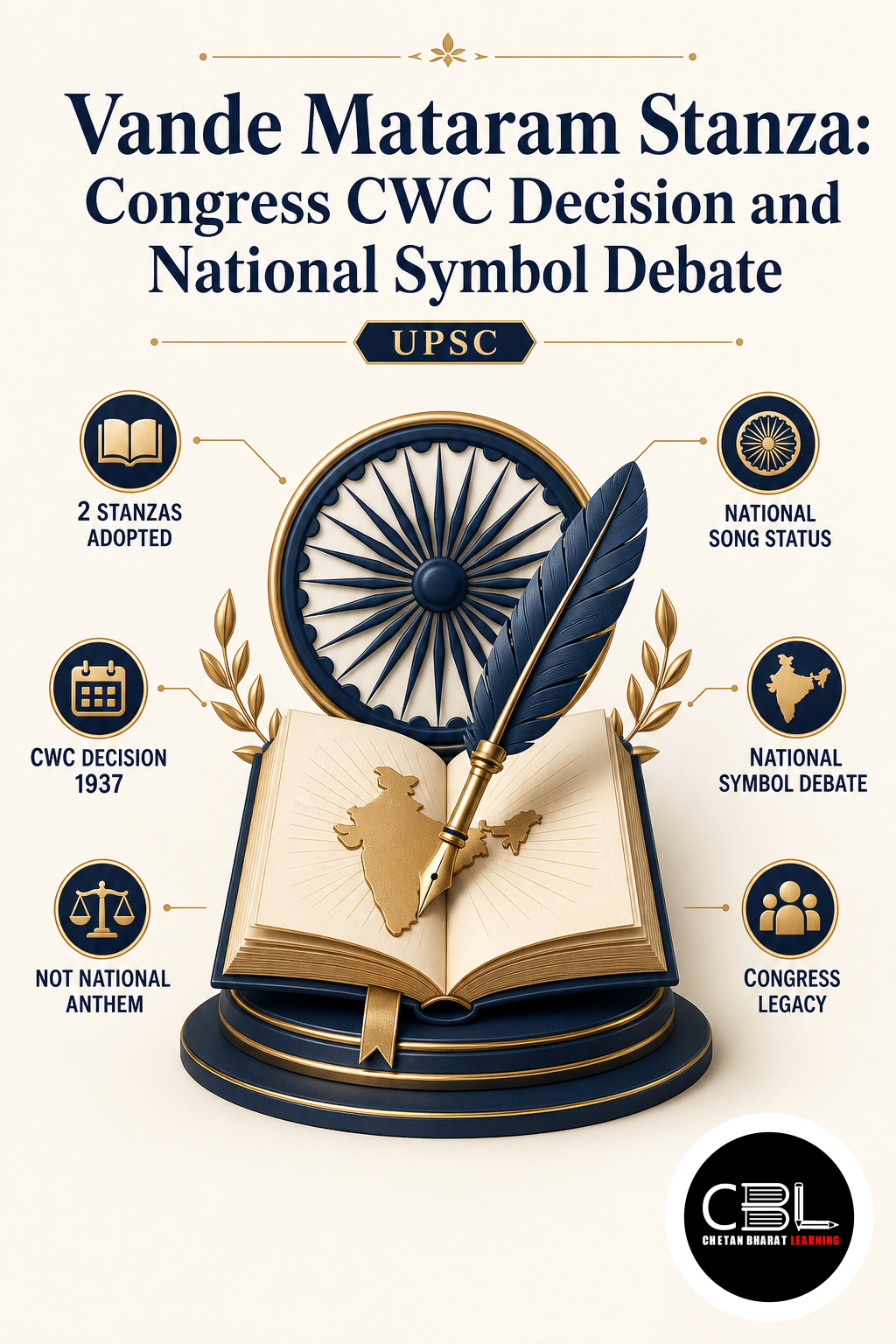
The Congress Working Committee (CWC) in 1937 decided that only the first two stanzas should be sung at national gatherings, as the other stanzas contain religious imagery that may not be in keeping with the ideology of other religious groups. In 1950, President Rajendra Prasad declared that Vande Mataram would have equal status with Jana Gana Mana, the national anthem.
Why is Vande Mataram Stanza in News?
Vande Mataram Stanza is in the news because the Congress’s highest decision-making body reiterated its 1937 stand, while the BJP has been pushing for singing all six stanzas. Parliament recently passed the Prevention of Insults to National Honour (Amendment) Act, 2026, extending the same legal protection to Vande Mataram that the National Anthem enjoys.
The debate centres on whether religiously evocative patriotism can be treated as an obligatory national expression in a religiously diverse constitutional democracy. Mahatma Gandhi had also expressed that if any person objected to singing Vande Mataram at a mixed gathering, it should be dropped.
Key Features of Vande Mataram Stanza
- Composition: Composed by Bankim Chandra Chattopadhyay in 1875; included in Anandamath (1882).
- First Two Stanzas: Non-sectarian description of the motherland’s natural beauty.
- Later Stanzas: Religious imagery—Durga, Lakshmi, Saraswati, and temple statues.
- 1937 CWC Decision: Only first two stanzas to be sung at national gatherings.
- Constitutional Status: National Song with equal honour to Jana Gana Mana.
Challenges in Vande Mataram Stanza
- Religious Imagery: Later stanzas may offend religious sensibilities of minority communities.
- Compelled Participation: Legal protection may be misconstrued as compelling participation.
- National vs Pluralist: Balancing patriotic sentiment with religious and linguistic pluralism.
- Legal Ambiguity: The Constitution does not explicitly designate the National Song.
- Political Polarisation: The issue has become politically charged.
Way Forward for Vande Mataram Stanza
To address the Vande Mataram Stanza debate, a broad national consensus on the appropriate rendition in public functions is needed. The Supreme Court’s precedent in Bijoe Emmanuel v. State of Kerala (1986) protects the right to respectfully stand without singing due to religious beliefs. Respect for national symbols does not automatically require compulsory verbal participation.
Clear guidelines on the rendition of Vande Mataram in official functions, with sensitivity to India’s religious diversity, can reduce friction. The focus should be on the song’s historical role in the freedom struggle while respecting constitutional pluralism.
Prelims Practice Corner
Q1. Who composed Vande Mataram?
(a) Rabindranath Tagore (b) Bankim Chandra Chattopadhyay (c) Subhas Chandra Bose (d) Mahatma Gandhi
Answer: (b) Bankim Chandra Chattopadhyay composed Vande Mataram.
Q2. In which year did the CWC decide to sing only the first two stanzas?
(a) 1935 (b) 1937 (c) 1940 (d) 1947
Answer: (b) The CWC decision was made in 1937.
Q3. What is the constitutional status of Vande Mataram?
(a) National Anthem (b) National Song (c) State Song (d) Not recognised
Answer: (b) Vande Mataram is the National Song.
Q4. Which landmark case upheld the right to not sing the national anthem due to religious beliefs?
(a) Kesavananda Bharati (b) Bijoe Emmanuel v. State of Kerala (c) Maneka Gandhi v. Union of India (d) Golaknath v. State of Punjab
Answer: (b) Bijoe Emmanuel (1986) protected the right to stand respectfully without singing.
Q5. What does Article 51A(a) of the Constitution require?
(a) Singing the national anthem (b) Respecting the Constitution, National Flag, and National Anthem (c) Learning all Indian languages (d) Promoting Hindi
Answer: (b) Article 51A(a) mandates respect, not compulsory singing.
Mains Practice Questions
Q1. Discuss the constitutional and cultural dimensions of the debate over the rendition of Vande Mataram in India. (250 words, 15 marks)
Answer Structure:
- Intro: Introduce Vande Mataram and the current debate.
- Body: Discuss the history, the 1937 decision, and the constitutional status. Analyse the religious imagery issue and the balance between nationalism and pluralism. Evaluate the 2026 amendment and the potential for legal challenges.
- Conclusion: Suggest a consensus-based approach respecting diversity.
Q2. What is the difference between a National Anthem and a National Song in the Indian context? (150 words, 10 marks)
Answer Structure:
- Intro: State that Jana Gana Mana is the National Anthem and Vande Mataram is the National Song.
- Body: Explain that the National Anthem has a formal constitutional status, while the National Song has equal honour but a different legal status. The Anthem is sung on official occasions; the Song has a historical role.
- Conclusion: Conclude that both are national symbols with distinct but complementary roles.
FAQs on Vande Mataram Stanza
Why are the later stanzas of Vande Mataram controversial?
They contain religious imagery, referring to Durga, Lakshmi, and Saraswati, and speak of installing statues in temples.
What is the 1937 CWC decision?
The CWC decided that only the first two stanzas of Vande Mataram should be sung at national gatherings.
What is the constitutional status of Vande Mataram?
It is the National Song with equal honour to the National Anthem, Jana Gana Mana.
Related Current Affairs
Preparing for UPSC, PCS or HCS?
Talk to a mentor at Chetan Bharat Learning, Chandigarh. Free guidance on choosing the right exam and building a study plan.
Chat on WhatsAppCall 97793 53345UPSC / IAS / PCS coaching in Chandigarh · Trusted by aspirants across Punjab & Haryana
Leave a Reply
You must be logged in to post a comment.