
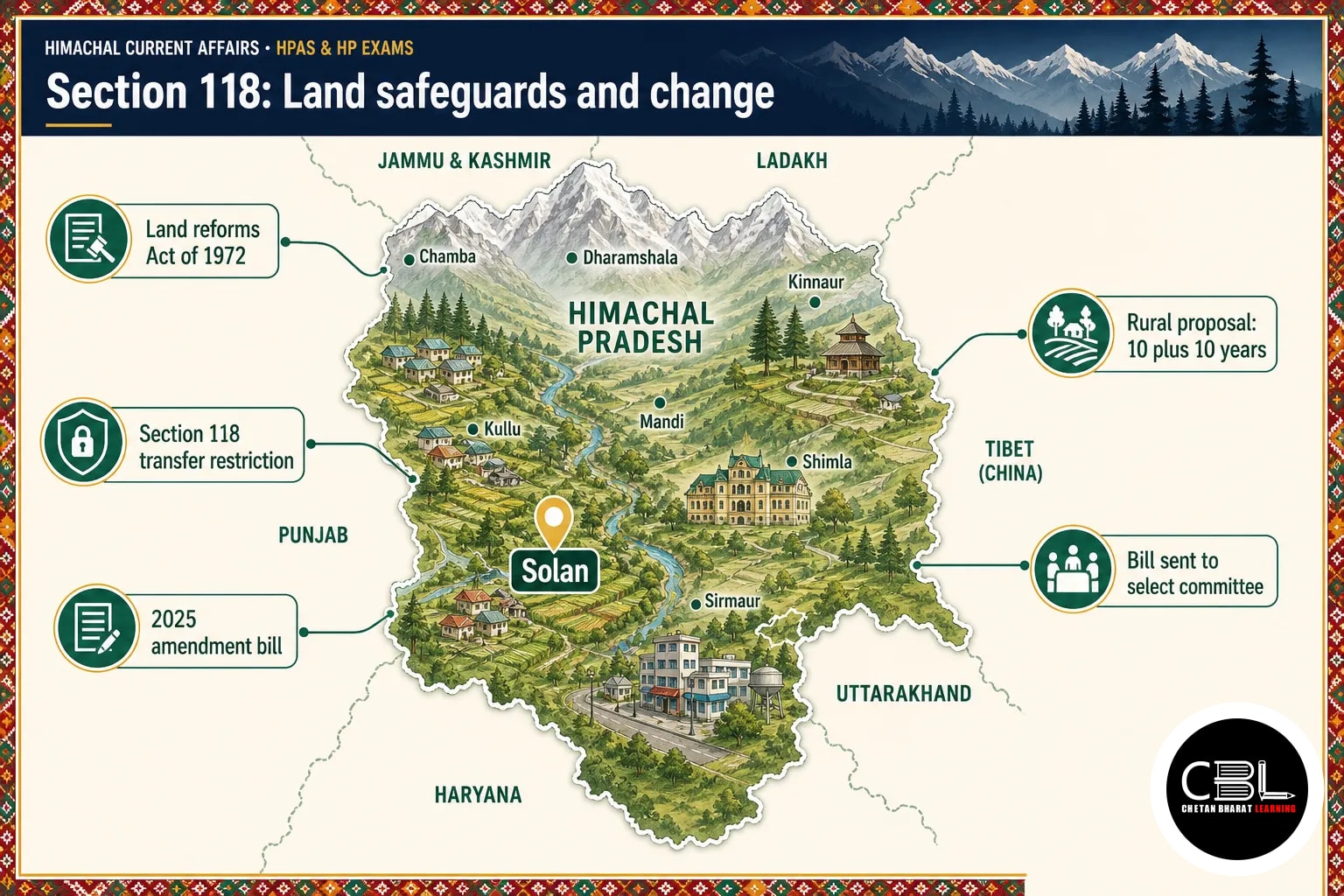
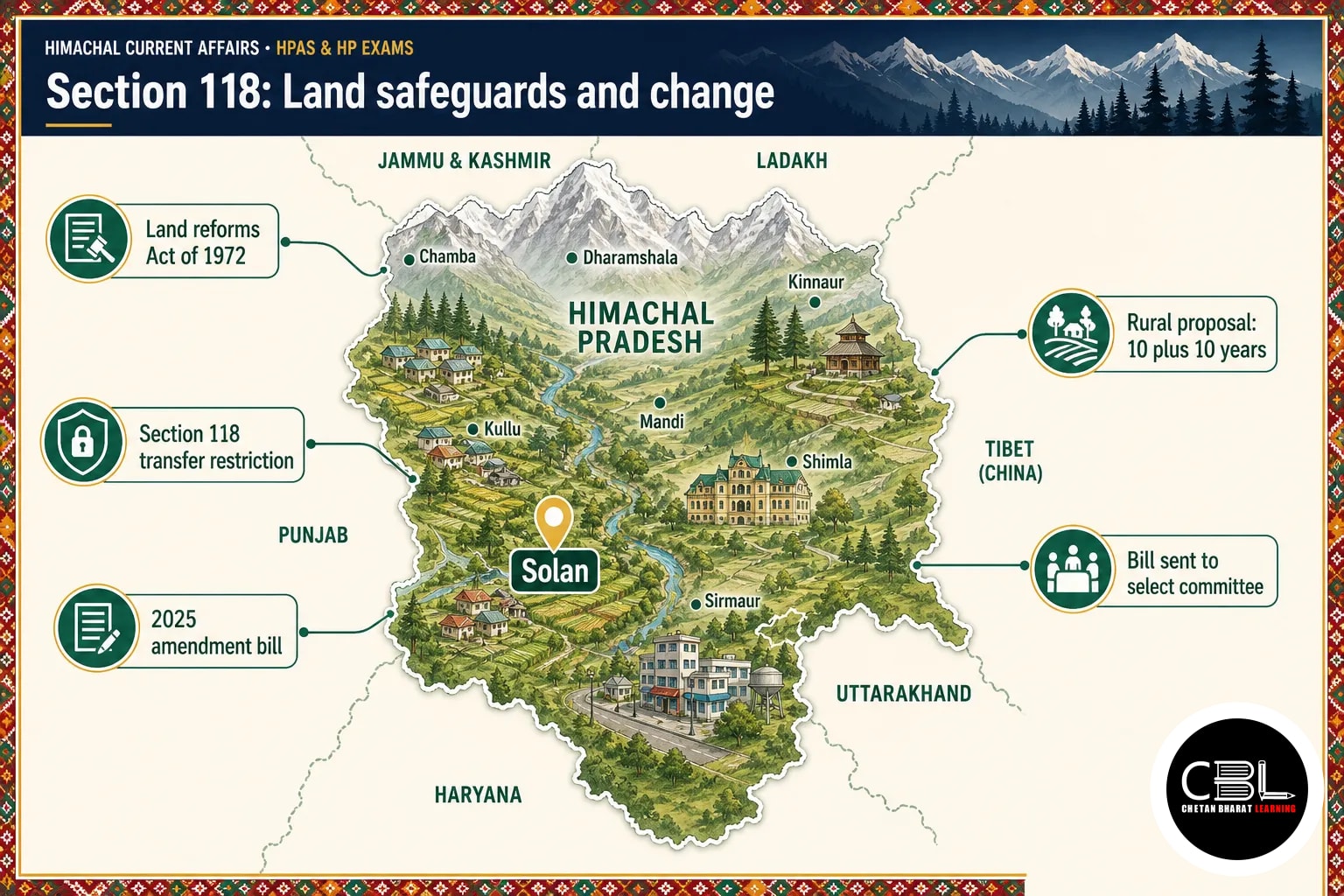
Section 118 restricts land transfers to non-agriculturists in Himachal Pradesh (HP) without government permission. In December 2025, an amendment bill proposed exemptions for taking over rural buildings or property for commercial purposes for 10 years, extendable by another 10. It also proposed changes concerning private developers’ flats and farmers’ cooperatives. After opposition protests, the bill was referred to a select committee. The government said Section 118 would remain intact.
Timeline: the law and the bill
- 1972Act enactedSafeguard
The 1972 Act introduced land-transfer safeguards under Section 118.
- Dec2025Bill introduced
The 2025 amendment bill proposed changes during the winter session.
- Dec2025Exemptions proposed
The bill proposed a 10-year rural commercial property exemption, extendable by another 10 years.
- Dec2025Other changes
The 2025 bill also addressed private developers’ flats and farmers-only cooperatives.
- Dec2025Committee referral
Following protests, the 2025 bill went to a select committee with ruling-party and opposition members.
- Section 118 restricts land transfers to non-agriculturists without government permission.
- The provision is part of the Himachal Pradesh Tenancy and Land Reforms Act, 1972.
- The amendment bill was introduced in December 2025.
- The proposed rural commercial property exemption was for 10 years, extendable by another 10.
- After protests, the bill was referred to a select committee.
What is Section 118?
Section 118 of the Himachal Pradesh Tenancy and Land Reforms Act, 1972 bars transfer of land to a non-agriculturist without government permission. Built-up property in municipal areas and plots of the Himachal Pradesh Housing and Urban Development Authority (HIMUDA) generally need no such permission.
Dr Y.S. Parmar’s government enacted the Act to protect small hill farmers. The 2025 bill proposed changes to the permission framework, including for rural commercial property, private developers’ flats and farmers-only cooperative societies.
Why it matters
The existing restriction seeks to protect small farmers’ access to land. The bill also proposed allowing farmers-only cooperative societies to buy land.
Commercial use of rural property raises questions about pressure on fragile hill environments. Ecological concerns were raised during the debate.
The proposal tests how investment facilitation can be balanced with safeguards and enforcement. The Revenue Minister said violations could lead to action, including reversion of land to the government.
- District: Solan is the headquarters of Solan district.
- Institution: The Himachal Pradesh Legislative Assembly sits at Shimla.
- Reform: The 1972 land reforms law was enacted under Dr Y.S. Parmar’s government.
Key data
| Point | Details |
|---|---|
| Parent law | Himachal Pradesh Tenancy and Land Reforms Act, 1972 |
| Core restriction | Section 118 bars land transfers to non-agriculturists without government permission. |
| Bill | Himachal Pradesh Tenancy and Land Reforms (Amendment) Bill, 2025 |
| Rural commercial proposal | Exemption for taking over buildings or property for 10 years, extendable by another 10. |
| Other proposals | Non-agriculturists could buy private developers’ flats; farmers-only cooperatives could buy land. |
| Legislative action | Referred to a select committee after opposition protests. |
Way forward
- Clear safeguards: Define eligible transactions and conditions precisely in any legislative change.
- Ecological scrutiny: Assess water, slope stability and infrastructure pressures before commercial use.
- Farmer protection: Consult small farmers and cooperatives on land access and proposed safeguards.
- Transparent enforcement: Maintain accessible records and act promptly on violations.
- Legislative review: Examine investment benefits alongside land rights and environmental concerns.
HPAS Mains practice questions
Explain the purpose of Section 118 and the main proposals in the 2025 amendment bill. (150 words)
Answer pointers:
- Introduce the 1972 Act and its protection for small hill farmers.
- Explain the permission requirement for transfers to non-agriculturists.
- Outline the rural commercial, flat and cooperative proposals.
- Conclude with the bill’s referral to a select committee.
Critically examine the 2025 amendment proposals in light of investment needs and land safeguards. (250 words)
Answer pointers:
- Introduce the proposed changes to the permission framework.
- Consider potential commercial activity and access to flats and cooperative landholding.
- Assess farmer protection, ecological pressures and enforcement concerns.
- Conclude with transparent conditions and effective scrutiny.
As Sub-Divisional Magistrate (SDM) in Solan, how would you examine a proposed rural commercial use of property while protecting land rights and ecology? (150 words)
Answer pointers:
- Identify the transaction and applicable law.
- Verify ownership, land records and required permissions.
- Consult affected residents and assess local ecological risks.
- Record a reasoned decision and monitor compliance.
Discuss how Himachal’s land-transfer safeguards can be linked to sustainable development in the Himalayan region. (150 words)
Answer pointers:
- Introduce land as a livelihood and ecological resource.
- Link safeguards with small farmers’ interests and land governance.
- Consider commercial opportunities alongside water and slope pressures.
- Conclude with locally informed, sustainable planning.
For Himachal Pradesh Administrative Service (HPAS) prelims and Himachal Pradesh Rajya Chayan Aayog (HPRCA) papers, memorise the 1972 Act, Section 118 and the proposed 10-plus-10-year period. For mains, distinguish the existing restriction from the bill’s proposals.
MCQ Practice Corner
Q1. Which provision restricts land transfers to non-agriculturists without government permission in Himachal Pradesh?
(a) Section 118 (b) Section 144 (c) Article 275 (d) Article 371
Show answer
Answer: (a) because Section 118 contains the land-transfer restriction.
Q2. Consider the following statements about the 2025 amendment bill:
1. It proposed a rural commercial property exemption for 10 years, extendable by another 10.
2. It proposed allowing non-agriculturists to buy flats built by private developers.
3. It was referred to a select committee after opposition protests.
Which statements are correct?
(a) 1 and 2 only (b) 2 and 3 only (c) 1 and 3 only (d) 1, 2 and 3
Show answer
Answer: (d) because all three describe the bill or its legislative referral.
Q3. In which year was the Himachal Pradesh Tenancy and Land Reforms Act enacted?
(a) 1948 (b) 1966 (c) 1972 (d) 2025
Show answer
Answer: (c) because the parent Act was enacted in 1972.
Q4. Which body received the 2025 amendment bill after opposition protests?
(a) Select committee (b) Finance Commission (c) Election Commission (d) District court
Show answer
Answer: (a) because the bill was referred to a select committee.
Frequently Asked Questions
What is Section 118 in Himachal Pradesh?
Section 118 restricts land transfers to non-agriculturists without government permission. It is part of the Himachal Pradesh Tenancy and Land Reforms Act, 1972.
What did the 2025 Section 118 amendment bill propose?
It proposed changes for rural commercial property, private developers’ flats and farmers-only cooperatives. The rural commercial exemption was proposed for 10 years, extendable by another 10.
Was the 2025 Himachal land amendment bill referred to a committee?
Yes, it was referred to a select committee after opposition protests. The committee included ruling-party and opposition members.
Sources: Outlook, The Wire, Himalayan Geographic, Outlook Money
Related Current Affairs
More Himachal topics for HPAS & HP exams
Preparing for UPSC, PCS or HCS?
Talk to a mentor at Chetan Bharat Learning, Chandigarh. Free guidance on choosing the right exam and building a study plan.
Chat on WhatsAppCall 97793 53345UPSC / IAS / PCS coaching in Chandigarh · Trusted by aspirants across Punjab & Haryana



Leave a Reply
You must be logged in to post a comment.