Important for:
UPSC, Haryana HCS, Punjab PCS
Prelims: NEP 2020, School Management Committees (SMCs), education governance
Mains: GS Paper 2 — Education, Governance, Social Justice
Why in News?
The Ministry of Education has issued fresh guidelines making School Management Committees (SMCs) mandatory for schools to improve governance, financial transparency and community participation.
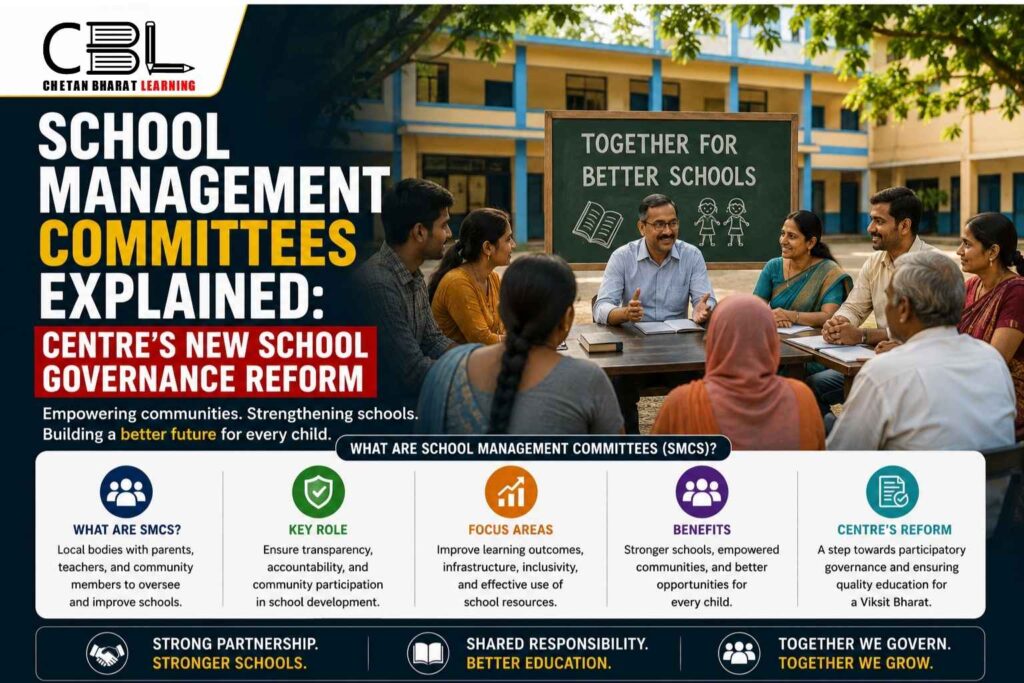
What are School Management Committees (SMCs)?
→ SMCs are local committees formed to:
✔ Oversee school functioning
✔ Improve accountability
✔ Ensure community participation in education
They are part of:
→ Decentralised school governance.
Key Features of the New Guidelines
1. Mandatory SMC Formation
Every school must create:
→ A School Management Committee.
2. Community Participation
Parents and local stakeholders will participate in:
✔ Decision-making
✔ Monitoring school performance
3. Financial Oversight
SMCs will monitor:
✔ School budgets
✔ Spending
✔ Transparency in fund use
4. Inclusive Representation
Committees must include:
✔ Women
✔ Parents
✔ Marginalised communities
✔ Local education stakeholders
Objectives of the Reform
The policy aims to:
✔ Strengthen grassroots governance
✔ Improve school accountability
✔ Increase local participation
✔ Improve learning outcomes
Connection with NEP 2020
The reform supports:
→ National Education Policy (NEP) 2020
which promotes:
✔ Participatory governance
✔ Community engagement
✔ Better school management
Why is This Important for India?
1. Better Accountability
Schools become more answerable to communities.
2. Improved Transparency
Reduces misuse of funds and administrative inefficiency.
3. Stronger Public Education
Encourages local ownership of schools.
4. Inclusive Governance
Marginalised communities gain representation.
Challenges
1. Lack of Awareness
Many parents may not understand governance roles.
2. Capacity Issues
Committee members may need training.
3. Political Interference
Local politics can affect decision-making.
4. Uneven Implementation
States may implement guidelines differently.
Broader Governance Significance
This reflects:
→ Shift from centralised administration to participatory governance.
Special Note for Aspirants
Students preparing through:
UPSC coaching Chandigarh
or
IAS coaching Chandigarh
should focus on:
✔ NEP 2020
✔ Education governance
✔ Decentralisation
✔ Social sector reforms
These topics are highly important for:
→ GS2 + Essay + Interview.
Key Insight for UPSC
→ Education reform is no longer only about infrastructure.
Modern governance focuses on:
✔ Participation
✔ Transparency
✔ Community ownership
PRELIMS PRACTICE QUESTIONS
Q1. School Management Committees are mainly related to:
A. Defence reforms
B. Education governance
C. Banking regulation
D. Foreign policy
⇢ Answer: B
Q2. The new SMC guidelines are linked with:
A. GST reforms
B. NEP 2020
C. Forest Rights Act
D. Digital India Mission
⇢ Answer: B
Q3. SMCs aim to improve:
A. Military preparedness
B. Judicial appointments
C. Community participation in schools
D. Foreign investment
⇢ Answer: C
Q4. Which ministry issued the SMC guidelines?
A. Ministry of Home Affairs
B. Ministry of Education
C. Ministry of Finance
D. Ministry of Panchayati Raj
⇢ Answer: B
Q5. Decentralised governance means:
A. Complete central control
B. Local participation in administration
C. Judicial governance
D. Corporate administration
⇢ Answer: B
CBL Mains Practice Question
“Decentralised governance and community participation are essential for improving public education in India.”
Discuss in the context of School Management Committees and NEP 2020.
FAQs
1. What are School Management Committees?
Local committees that oversee school functioning and governance.
2. Which policy supports SMC reforms?
National Education Policy (NEP) 2020.
3. Why are SMCs important?
They improve accountability and community participation.
4. Who participates in SMCs?
Parents, women, local stakeholders and community members.
5. Which GS paper covers this topic?
GS Paper 2.
Related Current Affairs
Preparing for UPSC, PCS or HCS?
Talk to a mentor at Chetan Bharat Learning, Chandigarh. Free guidance on choosing the right exam and building a study plan.
Chat on WhatsAppCall 97793 53345UPSC / IAS / PCS coaching in Chandigarh · Trusted by aspirants across Punjab & Haryana
Leave a Reply
You must be logged in to post a comment.