
UPSC Mapping
| Exam | Topics |
|---|---|
| Prelims | Governance & Economy |
| Mains | GS Paper 2 (Governance) & GS Paper 3 (Economy) |
Quick Facts
| Indicator | Detail |
|---|---|
| Pillar 1 | Manufacturing Excellence |
| Target Year | 2047 |
| AI Skilling Target | 1 crore youth |
What is Saptadhara Vision?
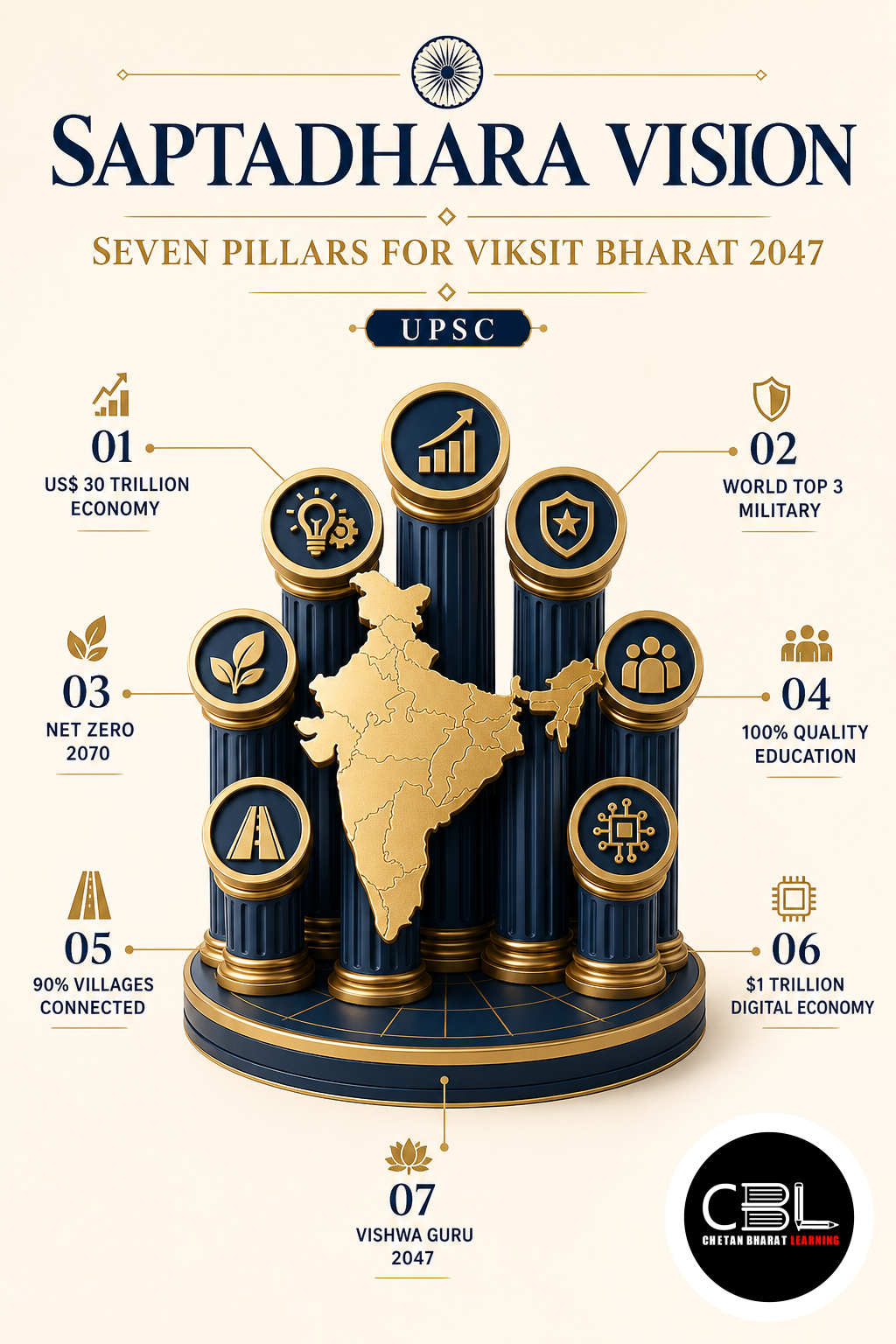
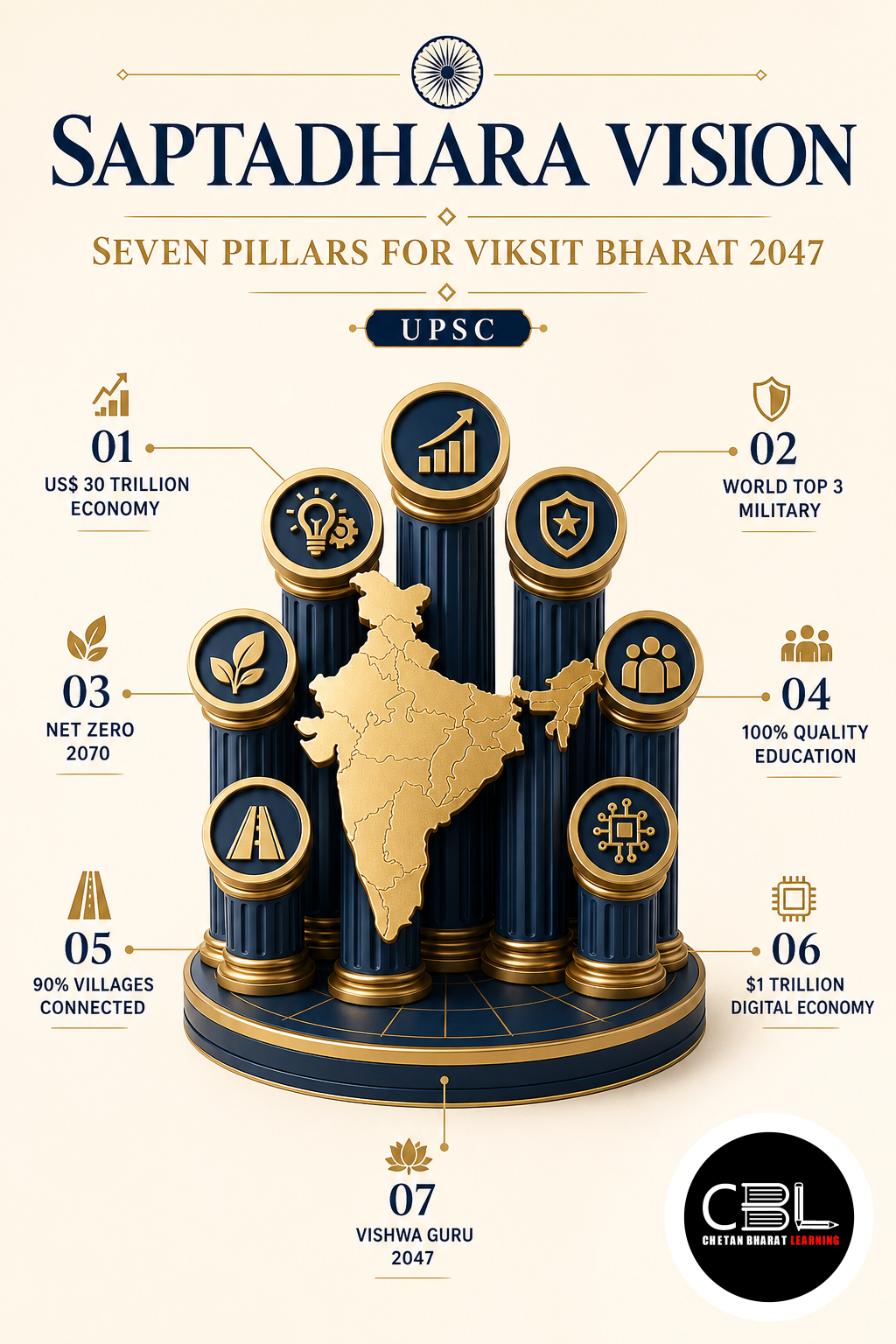
Saptadhara Vision is a seven-pillar reform blueprint for India’s transformation into a developed nation by 2047. The seven pillars are: Manufacturing Excellence, Agricultural and Food Processing, Technological Innovation, Gati Shakti (infrastructure), Defence Shakti, Green and Blue Economy, and India’s Soft Power.
The vision includes key announcements such as skilling one crore youth in AI, expanding nuclear capacity to 100 GW by 2047, building five to eight new semiconductor plants, and creating three crore additional Lakhpati Didis. It also envisions a voluntary Civil Defense force and integrating digital public infrastructure for free online exam coaching.
Why is Saptadhara Vision in News?
Saptadhara Vision was unveiled by the Prime Minister in his Independence Day address, outlining a comprehensive roadmap for India’s development. The vision emphasises India’s global leadership in manufacturing, technology, defence, green economy, and soft power.
Key announcements include training one crore youth in AI skills, a nationwide sports talent hunt, five new nuclear reactors this decade, and expanding semiconductor manufacturing to five to eight new plants.
Key Features of Saptadhara Vision
- Manufacturing Excellence: Transform domestic manufacturing into a competitive global supply-chain hub.
- Agricultural and Food Processing: Connect Indian farms to global markets through trade agreements and promote millets and spices.
- Technological Innovation: Position India as a leading centre for AI, data infrastructure, and advanced communication.
- Gati Shakti: Invest in high-speed rail, expressways, and port-led infrastructure.
- Defence Shakti: Strengthen domestic production of military systems and position India as a global supplier.
Challenges in Saptadhara Vision
- Financing: Massive investment is required for infrastructure, defence, and technology.
- Skill Gaps: Skilling one crore youth in AI requires robust training infrastructure.
- Global Competition: Competing with established manufacturing and technology hubs is challenging.
- Energy Transition: Expanding nuclear and renewable energy requires policy support and public acceptance.
- Implementation Capacity: Coordinating across ministries and states for seamless execution.
Way Forward for Saptadhara Vision
To realise Saptadhara Vision, India must adopt a mission-mode approach with clear timelines and accountability. Public-private partnerships can mobilise investment for infrastructure and technology. Strengthening vocational training and R&D will support manufacturing and innovation.
Policy coherence across sectors—agriculture, industry, services—is essential. Regular monitoring and evaluation of progress against the seven pillars can ensure corrective actions.
Prelims Practice Corner
Q1. How many pillars does the Saptadhara Vision have?
- (a) 5
- (b) 6
- (c) 7
- (d) 8
Answer
(c) Saptadhara Vision has seven pillars.
Q2. What is the target for AI skilling under the vision?
- (a) 10 lakh
- (b) 50 lakh
- (c) 1 crore
- (d) 5 crore
Answer
(c) One crore youth will be trained in AI skills.
Q3. What is the nuclear capacity target by 2047?
- (a) 50 GW
- (b) 100 GW
- (c) 150 GW
- (d) 200 GW
Answer
(b) India aims to reach 100 GW nuclear capacity by 2047.
Q4. How many new semiconductor plants are planned over eight years?
- (a) 2-3
- (b) 3-4
- (c) 5-8
- (d) 10-12
Answer
(c) Five to eight new semiconductor plants will be built.
Q5. What is the target for Lakhpati Didis?
- (a) 1 crore
- (b) 3 crore
- (c) 6 crore
- (d) 10 crore
Answer
(c) The target is six crore Lakhpati Didis.
Mains Practice Questions
Q1. Discuss the significance of the Saptadhara Vision in India’s journey towards Viksit Bharat 2047. (250 words, 15 marks)
- Intro: Introduce Saptadhara Vision and its seven pillars.
- Body: Discuss each pillar’s objectives and key announcements. Analyse the vision’s importance for India’s economic, technological, and strategic transformation. Address challenges: financing, skill gaps, global competition.
- Conclusion: Suggest a mission-mode approach with public-private partnerships.
Q2. What is the role of green and blue economy in the Saptadhara Vision? (150 words, 10 marks)
- Intro: Define the green and blue economy pillar.
- Body: Discuss India’s leadership in green hydrogen, renewable energy storage, coastal tourism, and ocean technologies. Explain how it balances growth with sustainability.
- Conclusion: Conclude that sustainable growth is essential for Viksit Bharat.
FAQs on Saptadhara Vision
What is the Saptadhara Vision?
It is a seven-point reform blueprint for achieving Viksit Bharat by 2047, unveiled by PM Modi.
What are the seven pillars?
Manufacturing, Agriculture, Technology, Infrastructure, Defence, Green Economy, and Soft Power.
What are the key announcements under the vision?
AI skilling (1 crore youth), 100 GW nuclear capacity, 5-8 semiconductor plants, and 6 crore Lakhpati Didis.
Related Current Affairs
Preparing for UPSC, PCS or HCS?
Talk to a mentor at Chetan Bharat Learning, Chandigarh. Free guidance on choosing the right exam and building a study plan.
Chat on WhatsAppCall 97793 53345UPSC / IAS / PCS coaching in Chandigarh · Trusted by aspirants across Punjab & Haryana
Leave a Reply
You must be logged in to post a comment.