
Important for:
UPSC, Haryana HCS, Punjab PCS
Prelims: Voting rights, statutory vs fundamental rights
Mains: GS Paper 2 — Polity, Governance, Constitution
Why in News?
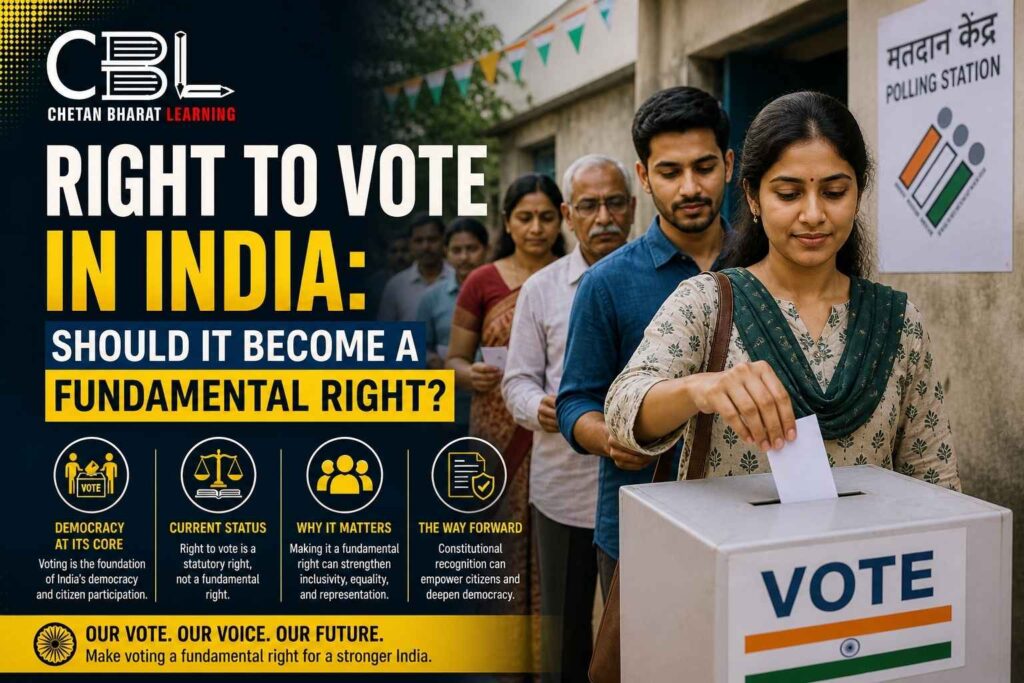
A political debate has emerged over whether the right to vote should be made a fundamental right, highlighting concerns about electoral processes and democratic participation.
What is the Right to Vote in India?
➤ Currently:
- A statutory right
- Provided under:
→ Representation of the People Act, 1951
Statutory vs Fundamental Right
Statutory Right:
- Given by law
- Can be changed by Parliament
Fundamental Right:
- Protected by Constitution
- Enforceable in courts
Arguments for Making It a Fundamental Right
1. Strengthening Democracy
- Ensures:
→ Equal political participation
2. Protection Against Arbitrary Actions
- Prevents:
→ Unfair voter exclusion
3. Judicial Safeguards
- Citizens can:
→ Approach courts if violated
Arguments Against
1. Practical Concerns
- Voting already widely available
2. Constitutional Design
- Framers deliberately made it:
→ A statutory right
3. Administrative Challenges
- Legal complications in enforcement
Historical Context
- Constituent Assembly debates:
→ Voting not made a fundamental right - Leaders like:
→ Dr. B.R. Ambedkar discussed electoral safeguards
Related Issues Highlighted
- Concerns about:
- Electoral rolls
- Exit polls credibility
- Institutional trust
India-Specific Significance
- Voting is:
→ Core of democracy - Ensures:
- Representation
- Accountability
Key Insight for UPSC
→ Democracy is not just about voting
✔ It is about:
- Free and fair elections
- Institutional integrity
PRELIMS PRACTICE QUESTIONS
Q1. Right to vote in India is:
A. Fundamental right
B. Statutory right
C. Legal right only
D. Directive principle
✅ Answer: B
Q2. Voting rights are governed by:
A. Constitution directly
B. Representation of the People Act
C. IPC
D. RBI Act
✅ Answer: B
Q3. Fundamental rights are:
A. Not enforceable
B. Enforceable in courts
C. Temporary
D. Only advisory
✅ Answer: B
Q4. Democracy depends on:
A. Trade
B. Voting participation
C. Industry
D. Transport
✅ Answer: B
Q5. Election Commission ensures:
A. Economic growth
B. Free and fair elections
C. Tax collection
D. Trade
✅ Answer: B
CBL Mains Practice Question
“Making the right to vote a fundamental right can strengthen Indian democracy.”
Critically examine.
FAQs
1. Is voting a fundamental right in India?
No, it is a statutory right.
2. Which law governs voting?
Representation of the People Act, 1951.
3. Why make it a fundamental right?
To strengthen democratic protections.
4. What is the concern?
Electoral integrity and trust.
5. Which GS paper covers this topic?
GS Paper 2 — Polity.
Preparing for UPSC, PCS or HCS?
Talk to a mentor at Chetan Bharat Learning, Chandigarh. Free guidance on choosing the right exam and building a study plan.
Chat on WhatsAppCall 97793 53345UPSC / IAS / PCS coaching in Chandigarh · Trusted by aspirants across Punjab & Haryana
Leave a Reply
You must be logged in to post a comment.