
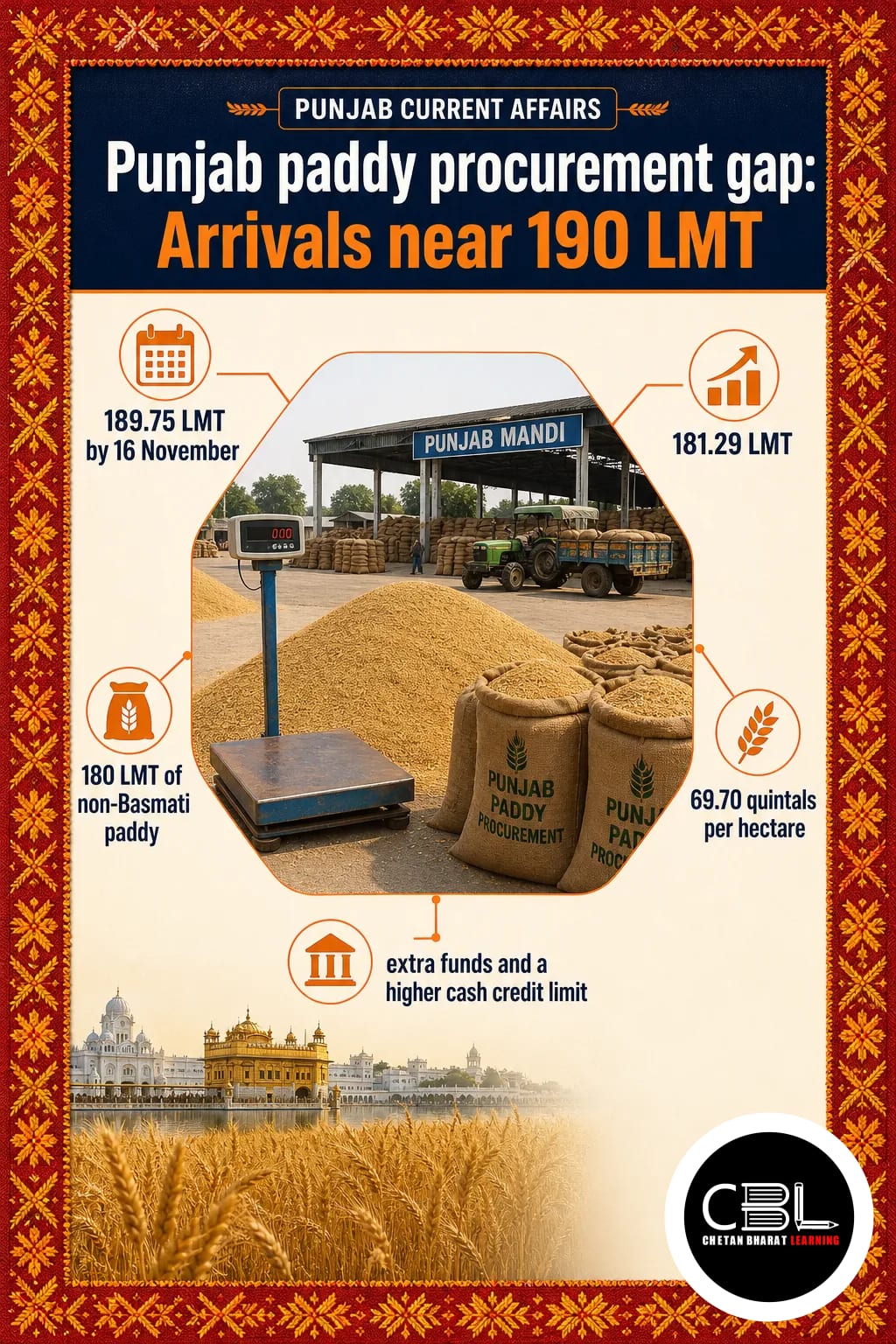
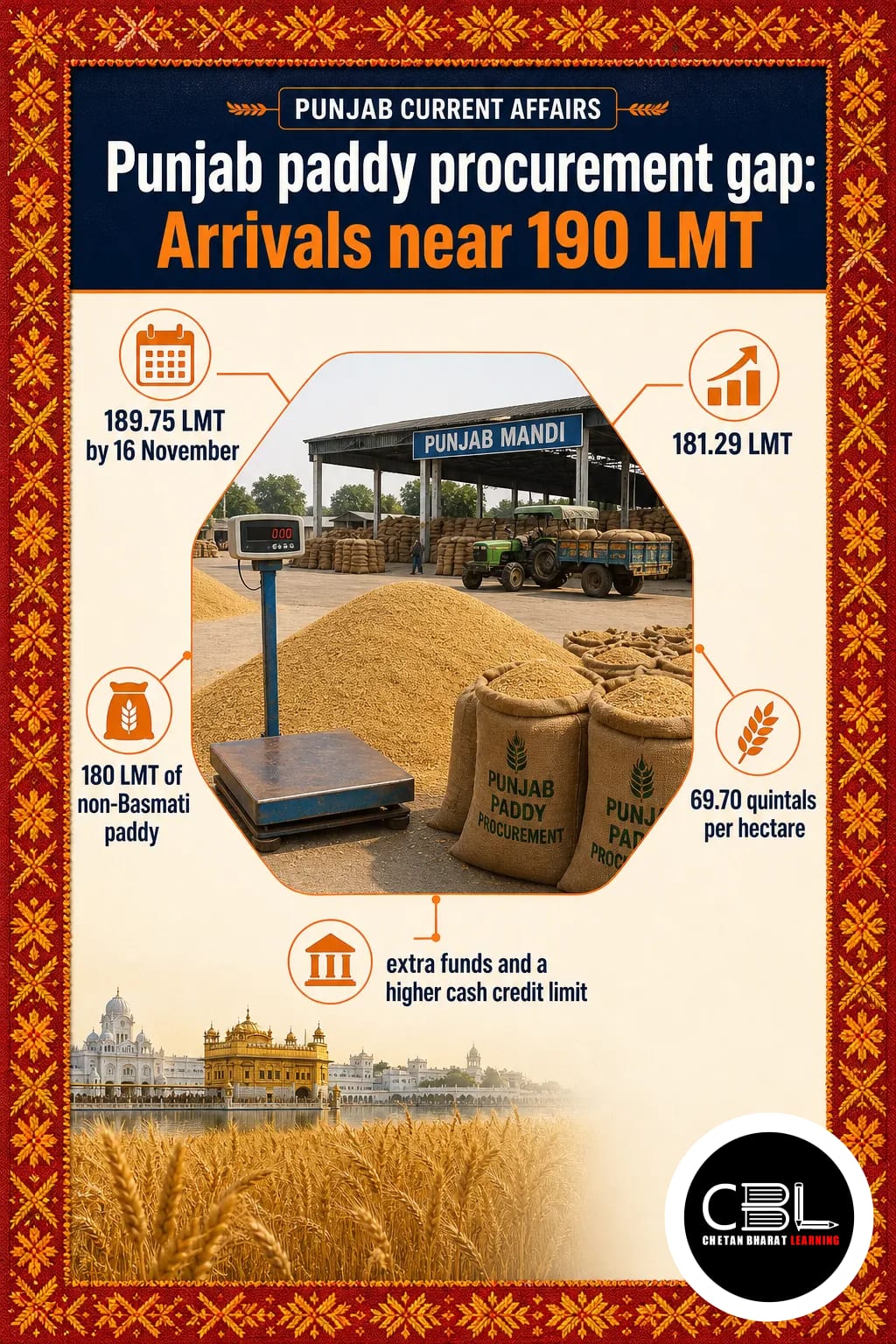
The Punjab paddy procurement gap reflects a mismatch between estimated production and market arrivals. By 16 November 2026, arrivals had reached 189.75 lakh metric tonnes (LMT). Follow Punjab current affairs for state exam updates.
Quick answer: The Punjab paddy procurement gap emerged during the 2026 harvest as arrivals at state mandis reached 189.75 LMT by 16 November. The provisional non-Basmati production estimate was 181.29 LMT. Punjab has sought additional procurement funds and a higher cash credit limit from the Centre.
| Point | Details |
|---|---|
| Non-Basmati production estimate | 181.29 LMT |
| Paddy arrivals by 16 November | 189.75 LMT |
| Centre’s procurement target | 180 LMT of non-Basmati paddy |
| Government agency procurement | Around 183.13 LMT by 16 November |
| Estimated average yield | 69.70 quintals per hectare |
Why is Punjab’s paddy gap in the news?
The Punjab paddy procurement gap has drawn attention because mandi arrivals exceed the provisional non-Basmati production estimate. Arrivals were nearly 190 LMT by 16 November, while the estimate was about 181 LMT. Moreover, arrivals were projected to cross 200 LMT.
Government agencies had already procured around 183.13 LMT. That was more than 3 LMT above the Centre’s 180 LMT target. Meanwhile, the state was assessing how much more paddy might arrive.
However, the arrival figure and production estimate describe different measures. The estimate concerns non-Basmati production, while the reported arrival figure covers paddy reaching mandis. Therefore, their difference is an apparent mismatch, not a confirmed final production gap.
How was the crop estimate calculated?
The Agriculture Department used crop-cutting experiments to assess yields during the 2026 harvest. It conducted more than 2,300 experiments across Punjab. Results from about 93 per cent showed an average yield of 69.70 quintals per hectare.
Punjab had around 32.86 lakh hectares under rice cultivation. Initially, 6.85 lakh hectares were estimated under Basmati, leaving 26.01 lakh hectares under non-Basmati. Applying the average yield to that non-Basmati area produced an estimate of 181.29 LMT.
The distinction matters because the Centre’s target applies to non-Basmati paddy. Basmati, meanwhile, is largely bought by private traders.
What could explain the mismatch?
Provisional acreage and higher yields could help explain the larger arrivals, according to state officials. Some land initially counted as Basmati may instead have been planted with non-Basmati varieties. If confirmed, that would raise the estimated non-Basmati area and production.
However, the Revenue Department must complete its assessment before the actual acreage becomes clear. Punjab has also sought extra funds and a higher cash credit limit for procurement. Read more about Punjab paddy procurement funds.
- Punjab was reorganised on 1 November 1966.
- The Sutlej and Beas are major rivers flowing through Punjab.
- Agriculture is a State List subject under the Constitution’s Seventh Schedule.
Source: Indian Express Chandigarh, 18 November 2026
Prelims Practice Corner
Frequently Asked Questions
How much paddy had arrived in Punjab by 16 November 2026?
Arrivals had reached 189.75 LMT. The reported arrivals were projected to cross 200 LMT.
Why might the non-Basmati production estimate change?
The estimate could change if final acreage differs from the provisional figures. Some land initially counted under Basmati may have grown non-Basmati paddy.
What has Punjab sought for paddy procurement?
Punjab has sought extra funds and a higher cash credit limit from the Centre. Government procurement had exceeded the Centre’s target by 16 November.
Related Current Affairs
Preparing for UPSC, PCS or HCS?
Talk to a mentor at Chetan Bharat Learning, Chandigarh. Free guidance on choosing the right exam and building a study plan.
Chat on WhatsAppCall 97793 53345UPSC / IAS / PCS coaching in Chandigarh · Trusted by aspirants across Punjab & Haryana


Leave a Reply
You must be logged in to post a comment.