
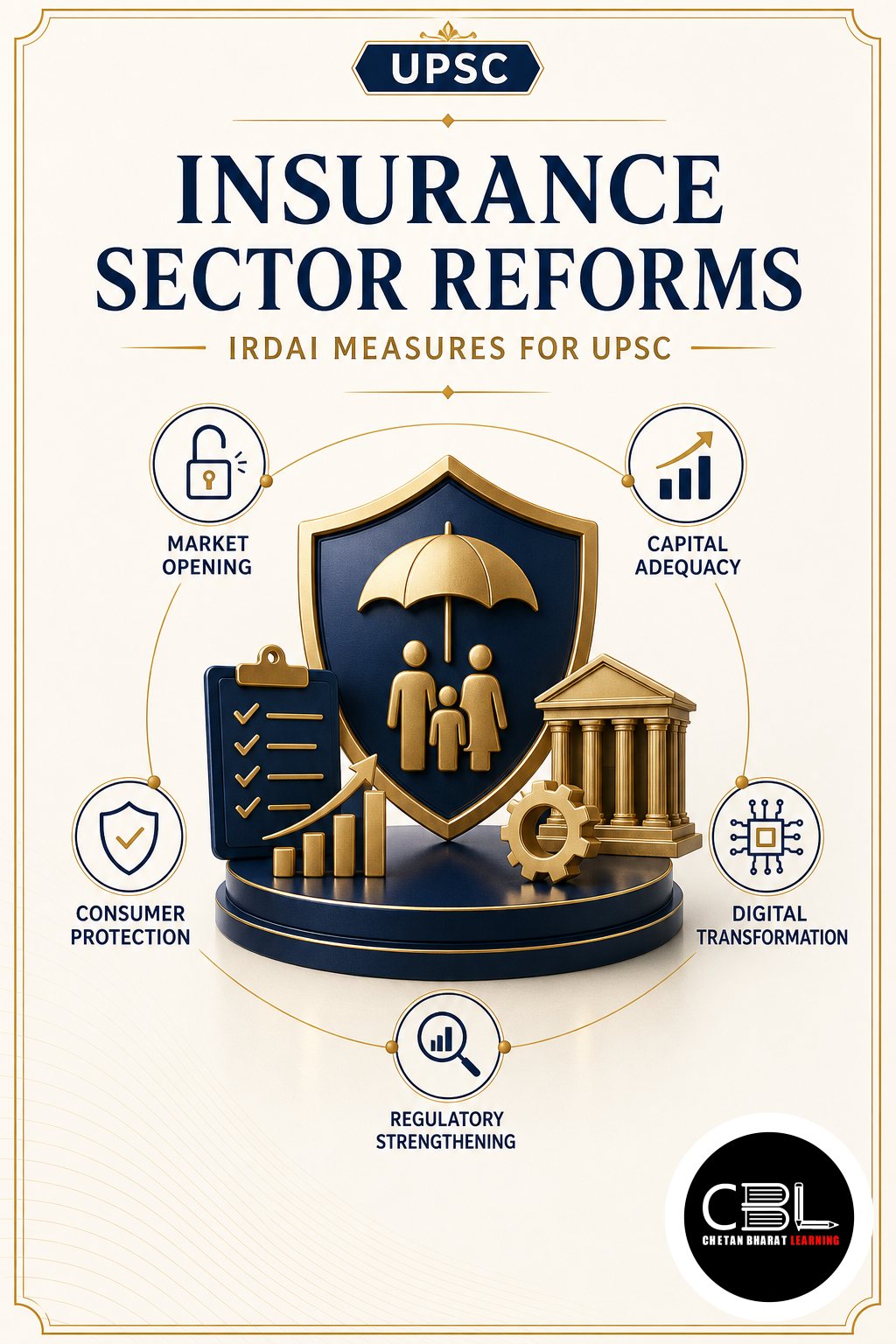

Insurance Sector Reforms have entered a new phase as the Insurance Regulatory and Development Authority of India (IRDAI) approved major regulatory changes to modernise the insurance industry, strengthen consumer protection and facilitate investment. The reforms implement provisions introduced through the Sabka Bima Sabki Raksha (Amendment of Insurance Laws) Act, 2025 while improving regulatory efficiency. Aspirants can also visit the daily current affairs archive for related economy updates.
What are Insurance Sector Reforms?
Insurance Sector Reforms refer to the latest regulatory measures introduced by IRDAI to improve governance, strengthen policyholder protection, simplify business regulations and encourage greater investment in India’s insurance industry.
The reforms operationalise Section 16A of the IRDA Act, 1999 by creating the Policyholders’ Education and Protection Fund (PEPF), modernise licensing norms and enhance prudential regulation while supporting sectoral growth.
Why are Insurance Sector Reforms in News?
IRDAI recently approved a comprehensive package of reforms aimed at modernising insurance regulations, improving transparency and facilitating foreign investment.
The changes also establish a structured enforcement mechanism and strengthen consumer protection through new accountability standards. Official notifications are available through the IRDAI.
Key Features
The reforms introduce significant institutional and regulatory changes.
- Policyholders’ Education and Protection Fund (PEPF): Operationalises Section 16A to finance insurance literacy, grievance redress and tracing of unclaimed amounts.
- Distribution accountability: Every insurance proposal, policy and certificate must be tagged to an authorised salesperson to reduce fraud and mis-selling.
- Perpetual licensing: Registration renewals for intermediaries, third-party administrators and surveyors are replaced by a perpetual licence subject to annual fees.
- Prudential oversight: Revised actuarial, finance and investment regulations provide greater investment flexibility while strengthening actuarial supervision to safeguard solvency.
- Capital liberalisation: Simpler rules for capital raising, share transfers and amalgamations support corporate restructuring and permit up to 100% Foreign Direct Investment.
- Structured enforcement: The Penalties Regulations, 2026 establish a transparent process for show-cause notices and reasoned disciplinary orders.
Challenges
Successful implementation requires balancing market growth with consumer confidence.
- Consumer awareness: Policyholders must understand new protection mechanisms and grievance redress systems.
- Regulatory capacity: Effective monitoring is essential under a perpetual licensing framework.
- Solvency monitoring: Greater investment flexibility requires robust actuarial oversight.
- Implementation consistency: Uniform compliance across insurers and intermediaries remains important.
- Market competition: Higher foreign participation should complement domestic industry development while protecting policyholder interests.
Read more financial sector developments in the current affairs section.
Way Forward
India should strengthen digital supervision, improve insurance literacy and ensure timely grievance redress to maximise the benefits of these reforms. The newly established PEPF can play an important role in promoting consumer awareness and protecting policyholder interests.
Continuous regulatory oversight, transparent enforcement and balanced capital liberalisation will support a resilient and globally competitive insurance sector. Further details are available on the Department of Financial Services website.
FAQs on Insurance Sector Reforms
What is the Policyholders’ Education and Protection Fund (PEPF)?
PEPF is a fund created under Section 16A of the IRDA Act, 1999 to support insurance literacy, grievance redress and tracing of unclaimed policyholder amounts.
Why has IRDAI introduced perpetual licensing?
The reform replaces periodic registration renewals with a perpetual licensing framework maintained through annual fees, reducing regulatory burden while ensuring continued oversight.
What is the role of IRDAI?
IRDAI is a statutory body established under the IRDA Act, 1999. It regulates and promotes the orderly growth of the insurance and reinsurance sector while protecting policyholder interests under the Ministry of Finance.
Related Current Affairs
Preparing for UPSC, PCS or HCS?
Talk to a mentor at Chetan Bharat Learning, Chandigarh. Free guidance on choosing the right exam and building a study plan.
Chat on WhatsAppCall 97793 53345UPSC / IAS / PCS coaching in Chandigarh · Trusted by aspirants across Punjab & Haryana
Leave a Reply
You must be logged in to post a comment.