

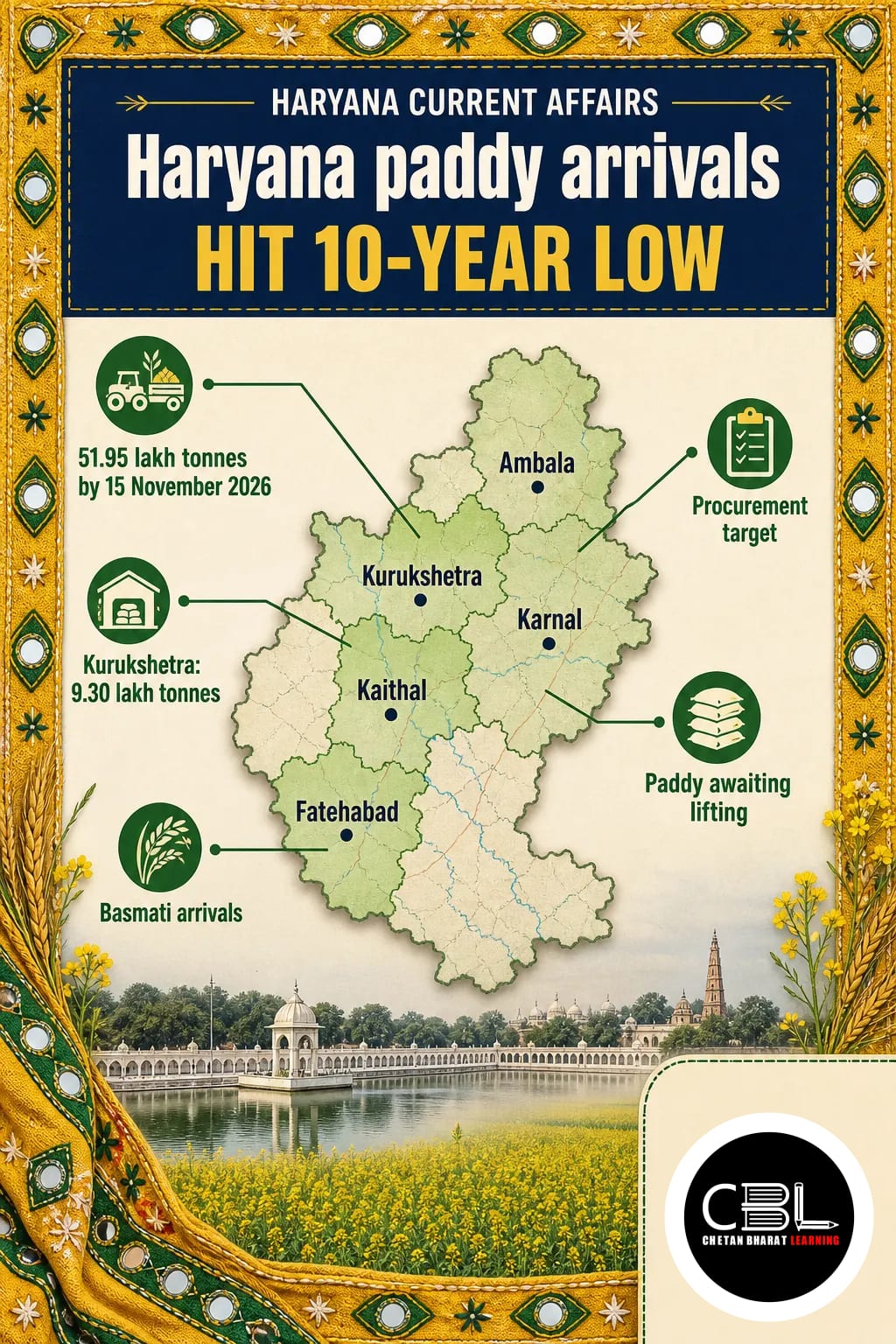
Haryana paddy arrivals reached 51.95 lakh tonnes by 15 November 2026, the lowest in a decade for that point in the season. The figures are important for Haryana current affairs and agricultural economy questions.
Quick answer: Haryana paddy arrivals of common parmal reached 51.95 lakh tonnes in mandis by 15 November 2026. This was about 16% below the previous full season’s 62.07 lakh tonnes and below the 58-lakh-tonne target. Meanwhile, 5.68 lakh tonnes of procured paddy awaited lifting from mandis.
| Point | Details |
|---|---|
| Common paddy arrivals | 51.95 lakh tonnes by 15 November 2026 |
| Procurement target | 58 lakh tonnes |
| Government purchases | 49.62 lakh tonnes of common paddy |
| Paddy awaiting lifting | 5.68 lakh tonnes |
| Leading district | Kurukshetra: 9.30 lakh tonnes |
| Basmati arrivals | 25.10 lakh tonnes by 15 November |
How do arrivals compare with last year?
Common parmal arrivals were 12.8% below the 59.60 lakh tonnes recorded by the same date last year. They were also 16.3% below the entire 2025–26 season’s 62.07 lakh tonnes.
The Haryana State Agricultural Marketing Board reported the figures as of 15 November. Procurement began on 29 September, ahead of the scheduled 1 October start. Government agencies purchased 49.62 lakh tonnes, while private buyers purchased 1.12 lakh tonnes.
Arrivals measure crop brought to mandis; procurement measures purchases. Therefore, the arrival total and government purchase figure are not interchangeable. Lifting refers to moving purchased stock out of mandis; 5.68 lakh tonnes still awaited movement.
Which districts led Haryana paddy arrivals?
Kurukshetra led common paddy arrivals with 9.30 lakh tonnes. Kaithal followed with 8.40 lakh tonnes, while Fatehabad reported 7.91 lakh tonnes.
Karnal recorded 7.25 lakh tonnes and Ambala 5.28 lakh tonnes. Together, these five districts contributed nearly three-fourths of the state total. Their figures help candidates distinguish district contributions from statewide procurement.
Why did common paddy arrivals decline?
Officials cited purchases outside mandis, stricter registration checks and field verification among the factors. They said some traders bought parmal varieties outside mandis above the ₹2,461 per quintal minimum support price.
Meanwhile, Agriculture Minister Shyam Singh Rana said crop diversification could also have reduced paddy production. The Mera Pani Meri Virasat scheme encourages farmers to shift to alternative crops.
However, basmati followed a different trend: arrivals rose about 5.8% to 25.10 lakh tonnes. Bajra arrivals reached 7.24 lakh tonnes; private buyers purchased 7.15 lakh tonnes.
- State formation: Haryana was formed on 1 November 1966.
- River: The Yamuna forms part of Haryana’s eastern boundary.
- District headquarters: Kaithal town is the headquarters of Kaithal district.
Source: Hindustan Times Chandigarh, 17 November 2026
Prelims Practice Corner
Frequently Asked Questions
How much common paddy arrived in Haryana in 2026?
Common paddy arrivals reached 51.95 lakh tonnes by 15 November 2026. This was below the 58-lakh-tonne procurement target.
Which Haryana district recorded the highest paddy arrivals?
Kurukshetra led common paddy arrivals with 9.30 lakh tonnes. Kaithal followed with 8.40 lakh tonnes.
Did basmati arrivals also fall in Haryana?
No, basmati arrivals rose about 5.8% to 25.10 lakh tonnes. The figure is for the period ending 15 November 2026.
Related Current Affairs
Preparing for UPSC, PCS or HCS?
Talk to a mentor at Chetan Bharat Learning, Chandigarh. Free guidance on choosing the right exam and building a study plan.
Chat on WhatsAppCall 97793 53345UPSC / IAS / PCS coaching in Chandigarh · Trusted by aspirants across Punjab & Haryana









Leave a Reply
You must be logged in to post a comment.