

UPSC Mapping
| Prelims | Physical Geography, Climatology and Disaster Management |
|---|---|
| Mains | GS Paper I – Physical Geography; GS Paper III – Environment and Disaster Management |
Quick Facts
| Scientific Name | Pyrocumulonimbus (PyroCb) |
|---|---|
| Cloud Height | Up to 10–15 km |
| Triggered By | Extreme Wildfires |
| Common Regions | Large wildfire-prone areas worldwide |
What are Fire Clouds?
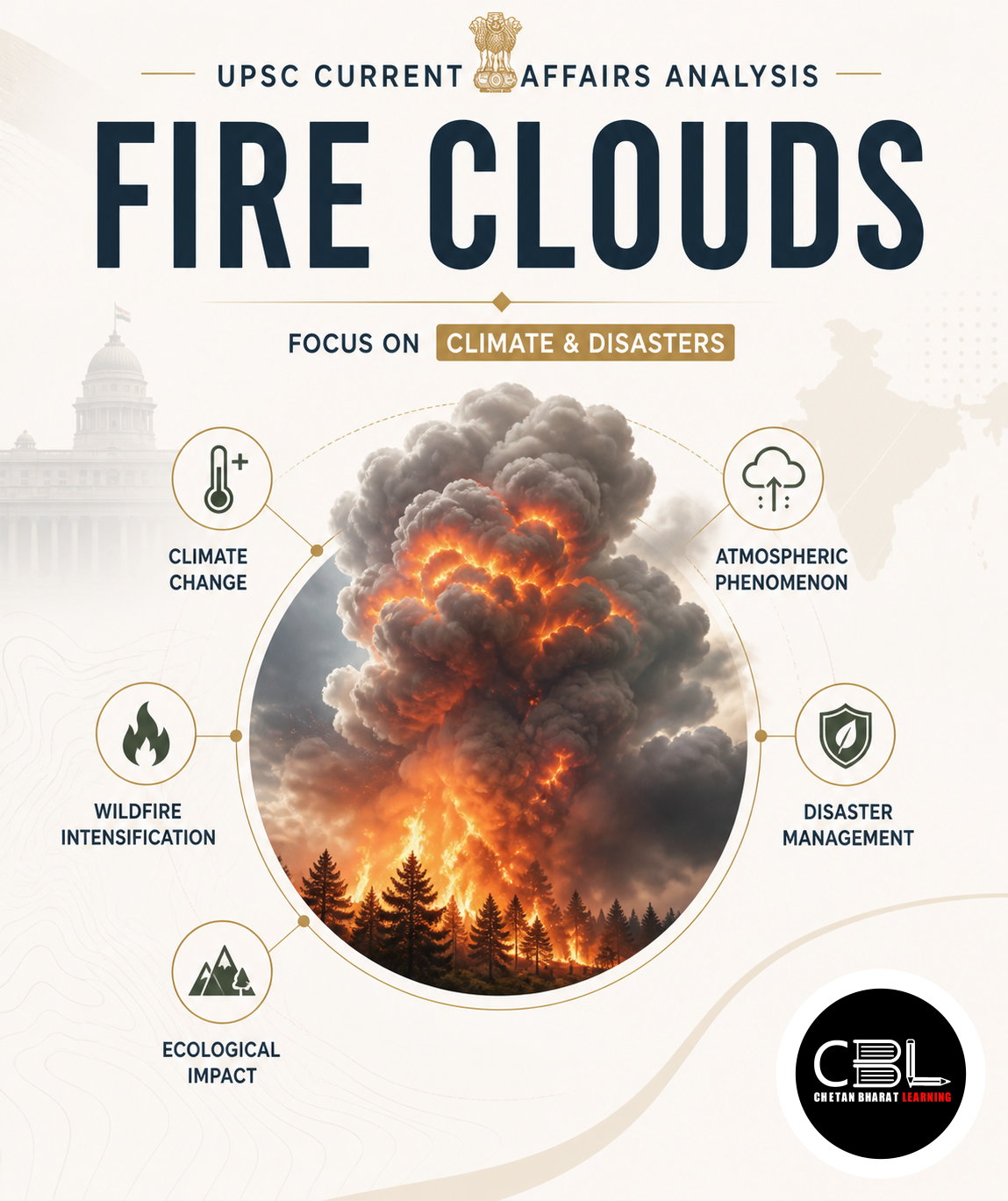
Fire Clouds, scientifically known as pyrocumulonimbus (PyroCb) clouds, are giant thunderstorm-like clouds generated by exceptionally intense wildfires. NASA describes them as the ‘fire-breathing dragon of clouds’ because of their dramatic appearance and destructive potential.
Unlike ordinary clouds, PyroCb clouds originate from the intense heat of wildfires rather than surface heating alone. They transport smoke, ash, water vapour and burning embers high into the atmosphere, sometimes reaching the lower stratosphere.
Why are Fire Clouds in News?
Fire Clouds have gained attention as France and Spain battle severe wildfires during an exceptionally hot and dry season. Scientists have warned that climate change is increasing the likelihood of these dangerous weather systems.
Rising temperatures, prolonged droughts, heatwaves and abundant dry vegetation have extended wildfire seasons, creating favourable conditions for PyroCb formation. More information on wildfire management is available through the World Meteorological Organization.
How Do Fire Clouds Form?
- Extreme heat generation: Intense wildfires release enormous quantities of thermal energy.
- Rapid upward movement: Hot air rises quickly, carrying smoke, ash, burning debris and moisture.
- Condensation: As the air cools at higher altitudes, water vapour condenses into towering cloud columns.
- Thunderstorm development: When the cloud reaches around 10–15 km in height, it evolves into a pyrocumulonimbus cloud capable of producing lightning and strong winds.
- Feedback loop: Lightning generated by the cloud can ignite new fires, worsening the disaster.
Key Features
- Thunderstorm-like behaviour: They generate lightning, turbulence and strong downdrafts.
- Smoke injection: Massive amounts of smoke and aerosols enter the upper atmosphere.
- Rapid fire spread: Powerful winds can accelerate wildfire movement.
- Large vertical extent: Some PyroCb clouds penetrate the lower stratosphere.
- Extreme unpredictability: They significantly complicate firefighting operations.
Challenges
- Climate change: Rising global temperatures create conditions favourable for larger wildfires.
- Longer wildfire seasons: Extended dry periods increase fuel availability.
- Threat to firefighters: Sudden wind shifts make suppression efforts highly dangerous.
- Air pollution: Smoke and particulate matter affect public health over vast regions.
- Ecosystem damage: Severe fires destroy forests, wildlife habitats and biodiversity.
Read related environmental developments in the environment current affairs section.
Way Forward
Governments should strengthen early wildfire detection, improve satellite-based monitoring and invest in climate-resilient forest management. Better forecasting of PyroCb events can enhance disaster preparedness.
Reducing greenhouse gas emissions, restoring degraded forests and improving international cooperation on wildfire management will reduce future risks. Further information can be accessed through the NASA.
Prelims Practice Corner
- Fire Clouds are scientifically known as: (a) Nimbostratus (b) Pyrocumulonimbus (c) Altostratus (d) Cirrostratus
- Fire Clouds primarily form due to: (a) Cyclones (b) Volcanoes only (c) Intense Wildfires (d) Monsoon winds
- Fire Clouds may trigger new fires through: (a) Snowfall (b) Lightning (c) Fog (d) Dew
- Climate change contributes to Fire Clouds mainly by: (a) Increasing humidity (b) Shortening fire seasons (c) Creating hotter and drier conditions (d) Weakening solar radiation
- Pyrocumulonimbus clouds can reach heights of approximately: (a) 2–3 km (b) 5 km (c) 10–15 km (d) 25 km
Mains Practice Questions
Q1. Explain the formation of Fire Clouds and discuss their implications for disaster management. (10 marks)
Answer Structure: Intro: Define Fire Clouds. Body: Formation process, climatic factors, wildfire behaviour, disaster response. Conclusion: Highlight need for improved forecasting and climate resilience.
Q2. Assess how climate change is increasing the occurrence of extreme wildfire events worldwide. (15 marks)
Answer Structure: Intro: Link climate change with wildfire intensity. Body: Heatwaves, droughts, fuel load, Fire Clouds, policy measures. Conclusion: Emphasise mitigation and adaptation strategies.
FAQs on Fire Clouds
What are Fire Clouds?
Fire Clouds are giant thunderstorm clouds produced by intense wildfires and are scientifically known as pyrocumulonimbus clouds.
Why are Fire Clouds dangerous?
They generate strong winds, lightning and turbulence that can spread wildfires rapidly and create new fire outbreaks.
How does climate change influence Fire Clouds?
Hotter temperatures, prolonged droughts and longer wildfire seasons increase the likelihood of large fires capable of generating Fire Clouds.
Related Current Affairs
Preparing for UPSC, PCS or HCS?
Talk to a mentor at Chetan Bharat Learning, Chandigarh. Free guidance on choosing the right exam and building a study plan.
Chat on WhatsAppCall 97793 53345UPSC / IAS / PCS coaching in Chandigarh · Trusted by aspirants across Punjab & Haryana
Leave a Reply
You must be logged in to post a comment.