
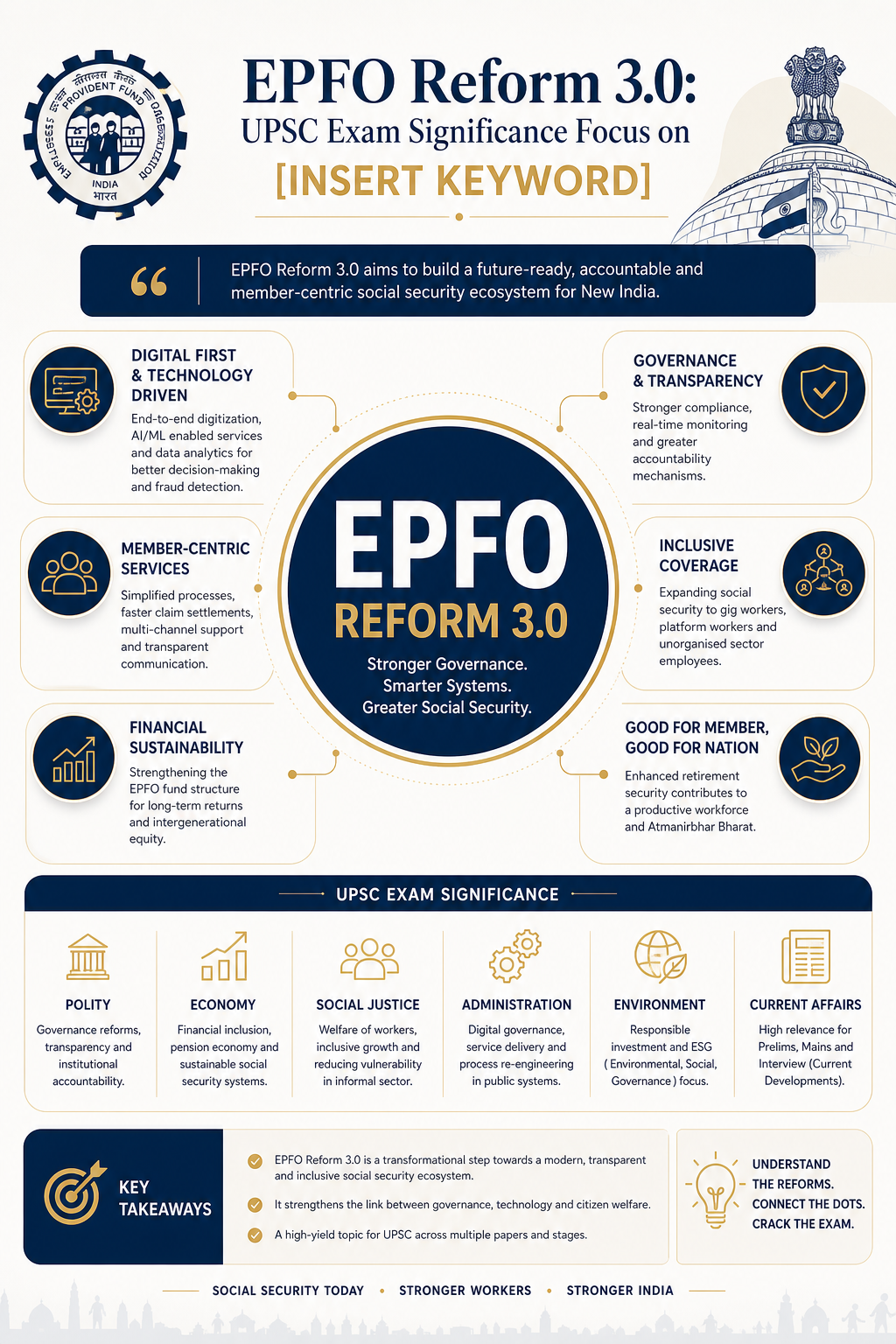
UPSC Syllabus Mapping
- GS Paper: GS-II & GS-III
- Subject: Governance, Social Justice & Indian Economy
- Topic: Social Security and Pension Reforms
EPFO Reform is an important current affairs topic for UPSC because it aims to expand social security coverage to organised, unorganised and gig workers. The proposal under EPFO Reform 3.0 seeks to modernise India’s retirement ecosystem through a flexible contributory pension model backed by government securities.
Why in News?
The Government is working on an EPFO-led contributory pension framework under the EPFO Reform 3.0 initiative. The proposal includes a Target Retirement Sum (TRS), individual pension accounts, digital upgrades and wider inclusion of gig and unorganised workers.
EPFO Reform: Key Features
- Target Retirement Sum converted into pension at 60 years.
- Defined contribution model with multiple contribution sources.
- Individual pension accounts.
- Government-backed investments with annual interest credit.
- Flexibility for members from age 55.
- Family and survivor pension through a pooled Family Benefit Fund.
- Coverage proposed for gig, platform and unorganised workers.
- Technology upgrade through EPFO 3.0 and centralised digital systems.
Background
The Employees’ Provident Fund Organisation administers provident fund, pension and insurance benefits for eligible workers. Previous reforms under EPFO 2.0 focused on digitisation and a centralised database, while EPFO 3.0 aims to improve portability, accessibility and universal social security.
Comparison: OPS, NPS, UPS and Proposed EPFO Reform
| Feature | OPS | NPS | Unified Pension Scheme | Proposed EPFO Reform |
|---|---|---|---|---|
| Funding | Government | Contributory | Hybrid | Contributory |
| Returns | Defined Benefit | Market Linked | Partly Assured | Government-backed with flexibility |
| Coverage | Government Employees | Government & Voluntary | Government Employees | Organised, Unorganised & Gig Workers |
Why is EPFO Reform Important for UPSC?
- Demonstrates expansion of India’s social security architecture.
- Highlights implementation of the Code on Social Security.
- Relevant for labour reforms and inclusive growth.
- Illustrates challenges of pension sustainability and ageing population.
- Useful for Economy, Governance and Social Justice questions.
Static Linkages
- Employees’ Provident Funds and Miscellaneous Provisions Act, 1952
- Code on Social Security, 2020
- National Pension System
- Unified Pension Scheme
- Gig and Platform Workers
- Labour Reforms in India
Analysis
The proposed reform attempts to balance fiscal sustainability with wider social protection. Unlike traditional defined-benefit models, the proposed framework builds a retirement corpus through contributions while retaining safety through government-backed investments. Successful implementation will depend upon digital infrastructure, contribution compliance, financial literacy and portability across occupations.
Challenges
- Ensuring regular contributions by informal workers.
- Administrative coordination among employers and aggregators.
- Adequate pension adequacy despite low contributions.
- Long-term actuarial sustainability.
Way Forward
- Strengthen digital enrolment.
- Promote financial awareness.
- Improve portability and grievance redressal.
- Provide targeted government support for low-income workers.
- Integrate pension reforms with broader labour welfare initiatives.
Prelims Practice Corner
- EPFO functions under which Ministry?
(a) Finance (b) Labour and Employment (c) Commerce (d) MSME
Answer: (b) - The proposed EPFO Reform 3.0 primarily aims to include:
(a) Defence Personnel (b) Gig Workers (c) Judges (d) MPs
Answer: (b) - NPS is based mainly on:
(a) Defined Benefit (b) Pay-as-you-go (c) Defined Contribution (d) Tax Revenue Only
Answer: (c) - EPFO Reform proposes conversion of Target Retirement Sum at:
(a) 50 (b) 55 (c) 58 (d) 60 years
Answer: (d) - Code on Social Security aims to extend benefits to:
(a) Gig Workers (b) Platform Workers (c) Organised Workers (d) All of the Above
Answer: (d)
Mains Practice Questions
- Discuss the significance of EPFO Reform 3.0 in strengthening India’s social security framework. (10 Marks)
- Compare the proposed EPFO pension framework with the National Pension System and examine its implications for inclusive growth. (15 Marks)
FAQs
What is EPFO Reform 3.0?
It is a proposed modernisation of India’s retirement system featuring contributory pensions, digital upgrades and wider worker coverage.
Why is it important for UPSC?
It links Economy, Governance, labour reforms, social justice and welfare policies.
Which official sources should aspirants follow?
Follow updates from the Ministry of Labour and Employment, EPFO and PIB Official Release.
Related Current Affairs
Preparing for UPSC, PCS or HCS?
Talk to a mentor at Chetan Bharat Learning, Chandigarh. Free guidance on choosing the right exam and building a study plan.
Chat on WhatsAppCall 97793 53345UPSC / IAS / PCS coaching in Chandigarh · Trusted by aspirants across Punjab & Haryana
Leave a Reply
You must be logged in to post a comment.