
Important for:
UPSC, Haryana HCS, Punjab PCS
Prelims: NDCs, climate adaptation, ICAR, UNEP
Mains: GS Paper 3 — Climate Change, Environment, Disaster Management
Why in News?
An editorial highlights the urgent need to strengthen climate adaptation in India by translating national-level policies into effective grassroots action, ensuring resilience at the local level.
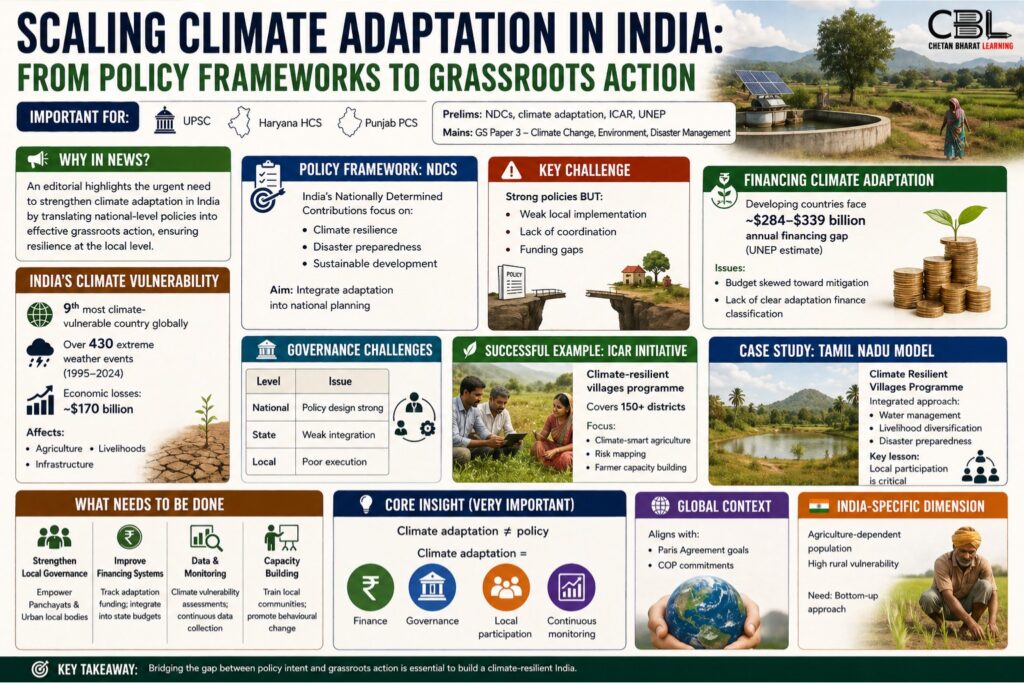
India’s Climate Vulnerability
- 9th most climate-vulnerable country globally
- Over 430 extreme weather events (1995–2024)
- Economic losses:
→ ~$170 billion
➤ Affects:
- Agriculture
- Livelihoods
- Infrastructure
Policy Framework: NDCs
- India’s Nationally Determined Contributions focus on:
- Climate resilience
- Disaster preparedness
- Sustainable development
➤ Aim:
- Integrate adaptation into national planning
Key Challenge
➤ Strong policies BUT:
- Weak local implementation
- Lack of coordination
- Funding gaps
Financing Climate Adaptation
- Developing countries face:
→ ~$284–$339 billion annual financing gap (UNEP estimate)
Issues:
- Budget skewed toward mitigation
- Lack of clear adaptation finance classification
Governance Challenges
| Level | Issue |
|---|---|
| National | Policy design strong |
| State | Weak integration |
| Local | Poor execution |
Successful Example (VERY IMPORTANT)
ICAR Initiative
- Climate-resilient villages programme
- Covers 150+ districts
➤ Focus:
- Climate-smart agriculture
- Risk mapping
- Farmer capacity building
Case Study: Tamil Nadu Model
- Climate Resilient Villages Programme
- Integrated approach:
- Water management
- Livelihood diversification
- Disaster preparedness
➤ Key lesson:
Local participation is critical
What Needs to be Done
✔ Strengthen Local Governance
- Empower:
- Panchayats
- Urban local bodies
✔ Improve Financing Systems
- Track adaptation funding
- Integrate into state budgets
✔ Data & Monitoring
- Climate vulnerability assessments
- Continuous data collection
✔ Capacity Building
- Train local communities
- Promote behavioural change
Core Insight (VERY IMPORTANT)
➤ Climate adaptation ≠ policy
→ Climate adaptation =
✔ Finance
✔ Governance
✔ Local participation
✔ Continuous monitoring
Global Context
- Aligns with:
→ Paris Agreement goals
→ COP commitments
India-Specific Dimension
- Agriculture-dependent population
- High rural vulnerability
➤Need:
- Bottom-up approach
PRELIMS PRACTICE QUESTIONS
Q1. NDCs are related to:
A. Trade
B. Climate change
C. Defence
D. Health
✅ Answer: B
Q2. UNEP deals with:
A. Trade
B. Environment
C. Finance
D. Defence
✅ Answer: B
Q3. Climate adaptation refers to:
A. Reducing emissions
B. Adjusting to climate impacts
C. Increasing GDP
D. Industrialisation
✅ Answer: B
Q4. ICAR focuses on:
A. Space research
B. Agriculture
C. Defence
D. Finance
✅ Answer: B
Q5. Which of the following is a challenge in adaptation?
- Funding gaps
- Weak governance
- Over-regulation
A. 1 and 2 only
B. 2 and 3 only
C. 1 only
D. 1, 2 and 3
✅ Answer: A
Q6. Climate resilience includes:
A. Ignoring risks
B. Preparing for impacts
C. Increasing pollution
D. Reducing population
✅ Answer: B
CBL Mains Practice Question
“Climate adaptation in India requires a shift from policy frameworks to grassroots implementation.”
Discuss with suitable examples. (250 words)
FAQs
1. What is climate adaptation?
Adjusting systems to reduce harm from climate change.
2. What are NDCs?
National commitments under the Paris Agreement.
3. Why is adaptation important?
To reduce vulnerability and build resilience.
4. What is the main challenge?
Gap between policy and implementation.
5. Which GS paper covers this topic?
GS Paper 3 — Environment.
Related Current Affairs
Preparing for UPSC, PCS or HCS?
Talk to a mentor at Chetan Bharat Learning, Chandigarh. Free guidance on choosing the right exam and building a study plan.
Chat on WhatsAppCall 97793 53345UPSC / IAS / PCS coaching in Chandigarh · Trusted by aspirants across Punjab & Haryana
Leave a Reply
You must be logged in to post a comment.