

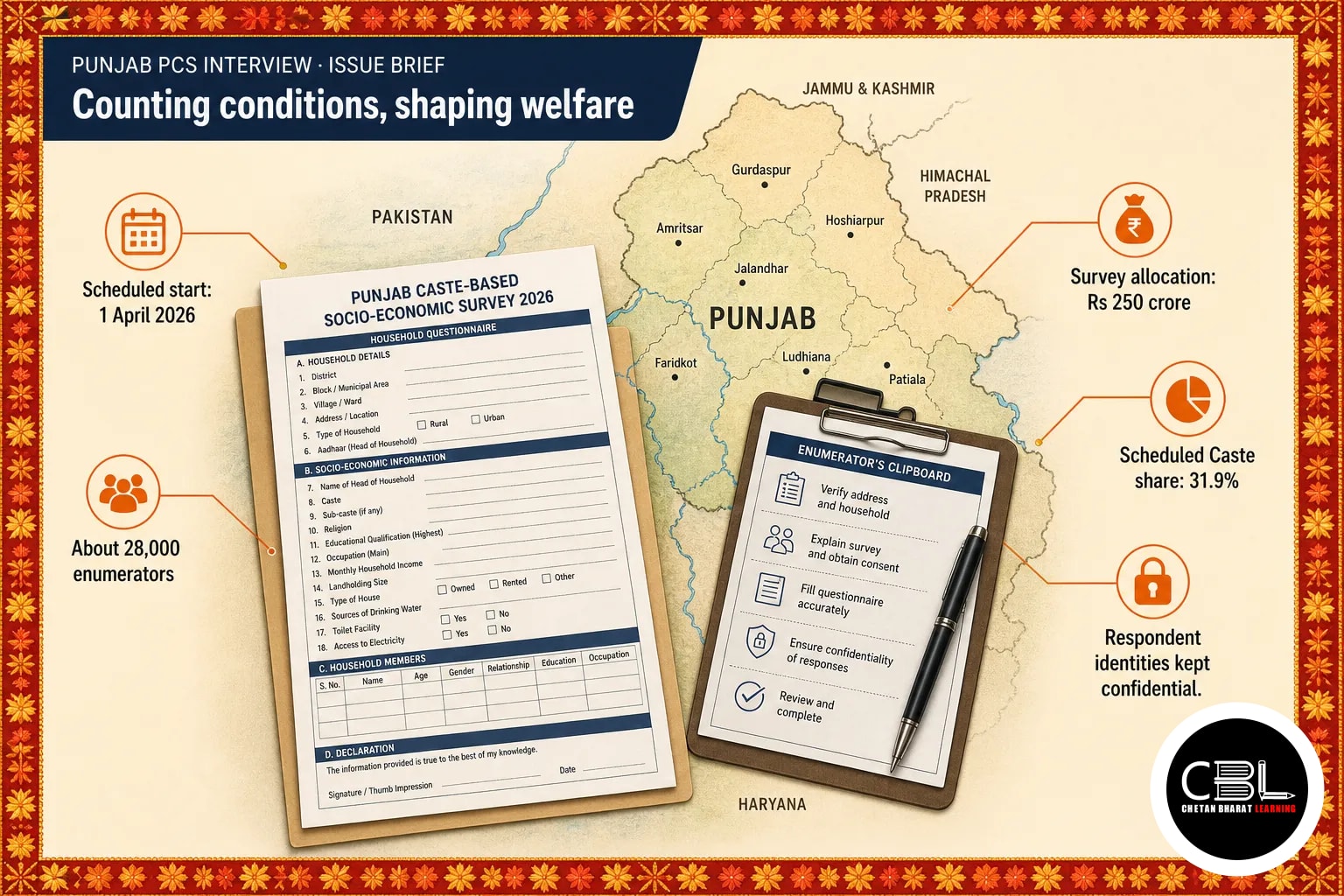
Punjab announced a caste-based socio-economic survey, scheduled to begin on 1 April 2026. It aims to assess living conditions across castes and sub-castes to guide welfare. The allocation is Rs 250 crore, with about 28,000 enumerators and confidential respondent identities. The exercise runs alongside the national Census 2027 process. Supporters see a basis for targeted welfare; critics fear stronger caste divisions. Punjab has the highest Scheduled Caste share among states, at about 31.9% in Census 2011.
Timeline: from population share to survey
- 2011CensusBaseline
Scheduled Castes formed about 31.9% of Punjab’s population, the highest share among states.
- 2023BiharPrecedent
Bihar conducted a caste-based survey in 2023.
- 2024Supreme CourtRuling
The Supreme Court allowed sub-classification of Scheduled Castes.
- 1 Apr2026Scheduled start
Punjab’s survey was scheduled to begin, with about 28,000 enumerators.
- 30 Apr2026Self-enumeration
National Census self-enumeration was scheduled from 30 April to 14 May.
- 15 May2026House-listing
National Census house-listing was scheduled from 15 May to 13 June.
What is the caste-based socio-economic survey?
It is a Punjab government exercise to assess living conditions across castes and sub-castes. Its stated purpose is to guide welfare policy. Respondents’ identities are to be kept confidential.
The survey is distinct from the national Census. Census is a Union subject under Entry 69 of the Union List. Bihar and Karnataka have conducted similar surveys.
The two sides
Case for the survey
- Data can help identify differences in living conditions across communities.
- Evidence can support better targeted welfare.
- Sub-caste data may inform discussion of Scheduled Caste sub-classification.
Concerns and cautions
- Collecting caste data may deepen caste identities.
- Confidentiality requires careful handling of personal information.
- Survey findings must be interpreted carefully before policy decisions.
Key data
| Point | Details |
|---|---|
| Scheduled start | 1 April 2026 |
| Allocation | Rs 250 crore |
| Enumerators | About 28,000 |
| Punjab Scheduled Caste share | About 31.9%, Census 2011 |
| Constitutional hook | Entry 69, Union List: Census |
| Judicial development | Supreme Court allowed Scheduled Caste sub-classification in 2024 |
| National Census schedule | Self-enumeration: 30 April–14 May 2026; house-listing: 15 May–13 June 2026 |
Way forward
- Protect privacy: Limit access to identifiable responses and communicate safeguards clearly.
- Train enumerators: Prepare staff to ask questions consistently and treat every household respectfully.
- Ensure inclusion: Make survey communication accessible across communities and localities.
- Use evidence carefully: Assess differences in living conditions before designing targeted measures.
- Build trust: Explain the survey’s purpose and distinguish it from the national Census.
Likely interview questions
What is Punjab’s caste-based socio-economic survey?
Answer pointers:
- It assesses living conditions across castes and sub-castes.
- It is intended to guide welfare; identities are to remain confidential.
- Distinguish the state survey from the national Census.
Do you think caste-based data improves welfare policy?
Answer pointers:
- It can reveal differences that broad averages may conceal.
- Collection can also raise privacy and social cohesion concerns.
- Use reliable data with safeguards and a clear welfare purpose.
Do you think survey data should lead to sub-classification of Scheduled Castes?
Answer pointers:
- The Supreme Court allowed sub-classification in 2024.
- Data can inform the debate, but a survey does not itself make policy.
- Examine evidence and applicable law before any decision.
As Sub-Divisional Magistrate in Ludhiana, how would you address household concerns about the survey?
Answer pointers:
- Explain the purpose and the confidentiality commitment.
- Train enumerators to communicate respectfully and record responses consistently.
- Provide a way to raise concerns and coordinate prompt responses.
How would you connect this survey to federalism and the national Census?
Answer pointers:
- Census is a Union subject under Entry 69 of the Union List.
- Punjab’s exercise is a state socio-economic survey, distinct from the national Census.
- Communicate the distinction while coordinating field-level work.
Acknowledge both the welfare value of data and concerns about privacy and caste divisions. Avoid assuming that the survey automatically changes reservation policy.
Prelims Practice Corner
Q1. What was the allocation for Punjab’s caste-based socio-economic survey?
(a) Rs 25 crore (b) Rs 250 crore (c) Rs 500 crore (d) Rs 1,000 crore
Show answer
Answer: (b) because the survey allocation was Rs 250 crore.
Q2. Census is listed under which entry of the Union List?
(a) Entry 52 (b) Entry 61 (c) Entry 69 (d) Entry 97
Show answer
Answer: (c) because Census is a Union subject under Entry 69.
Q3. What did the Supreme Court allow in 2024 concerning Scheduled Castes?
(a) Sub-classification (b) Abolition of the Census (c) Removal of all welfare schemes (d) Transfer of Census to the State List
Show answer
Answer: (a) because the Court allowed Scheduled Caste sub-classification.
Frequently Asked Questions
When was the Punjab caste survey scheduled to begin?
It was scheduled to begin on 1 April 2026. It was announced to assess living conditions across castes and sub-castes.
How many enumerators were planned for the Punjab caste survey?
About 28,000 enumerators were planned. The survey had an allocation of Rs 250 crore.
Is the Punjab caste survey the same as Census 2027?
No, the state survey is distinct from the national Census. Census is a Union subject under Entry 69 of the Union List.
Sources: GKToday: April 2026, GKToday: May 2026
Related Current Affairs
More Punjab interview issues
Preparing for UPSC, PCS or HCS?
Talk to a mentor at Chetan Bharat Learning, Chandigarh. Free guidance on choosing the right exam and building a study plan.
Chat on WhatsAppCall 97793 53345UPSC / IAS / PCS coaching in Chandigarh · Trusted by aspirants across Punjab & Haryana


Leave a Reply
You must be logged in to post a comment.