
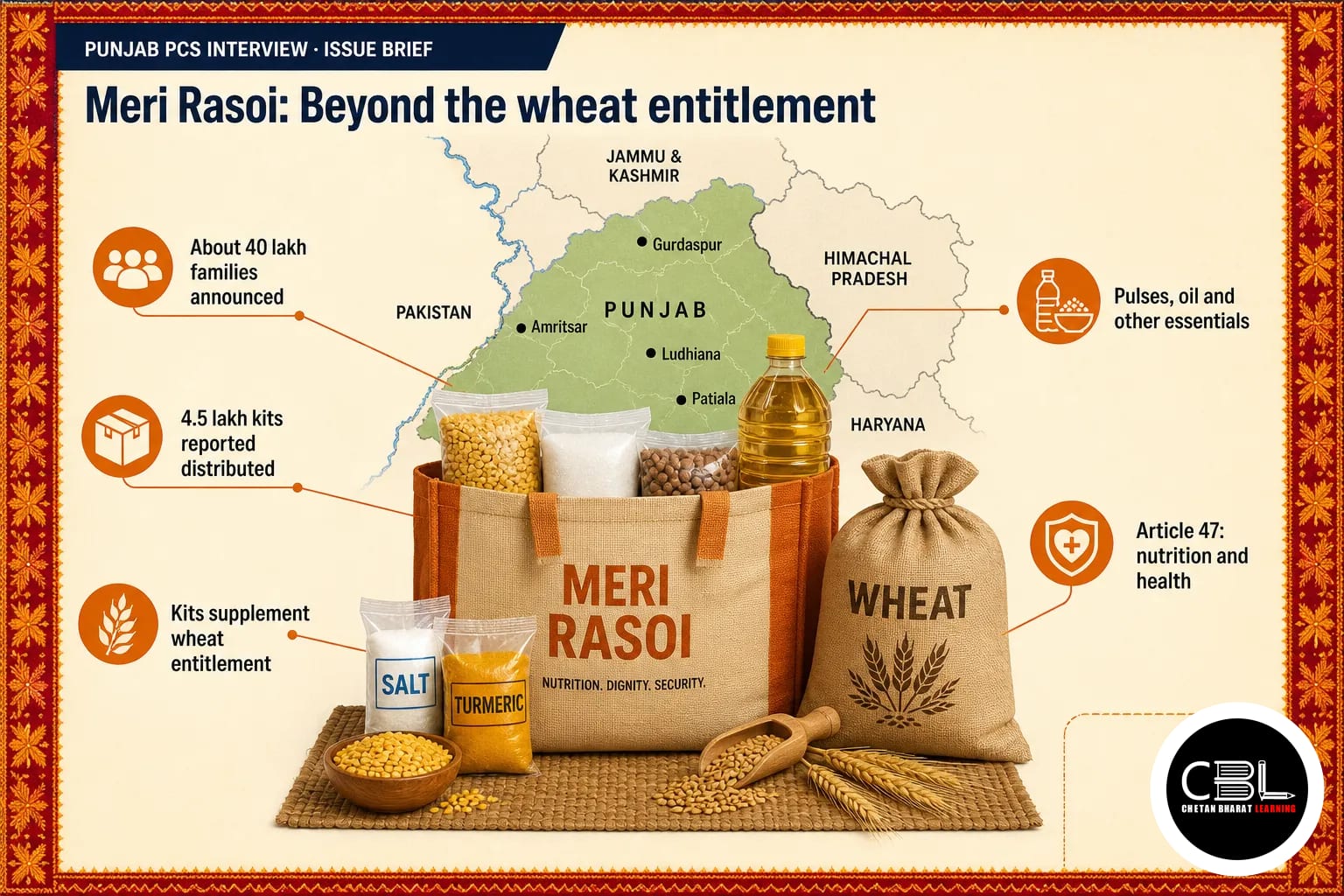
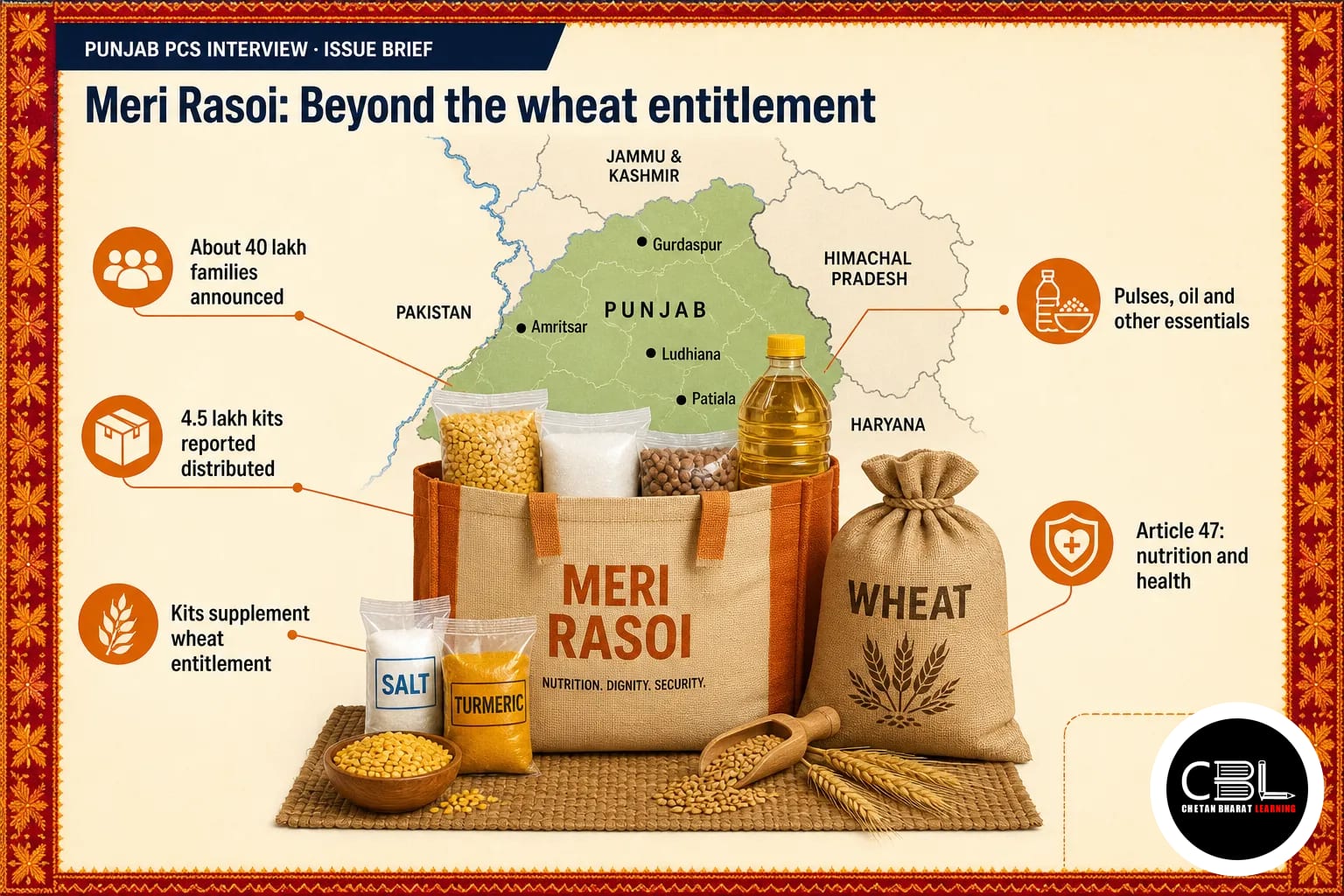
Punjab’s 2026-27 Budget announced Meri Rasoi ration kits for about 40 lakh families, reportedly every quarter. On 2 June 2026, Food Minister Lal Chand Kataruchak said 4.5 lakh kits had been distributed. He described monthly kits for eligible National Food Security Act beneficiaries, containing pulses, sugar, salt, turmeric and mustard oil, alongside wheat. The scheme brings food security, nutrition and the state’s fiscal capacity into interview focus.
Timeline: from food security to ration kits
- 1950ConstitutionNutrition
Article 47 makes nutrition and public health among the state’s primary duties.
- 2013ParliamentEntitlement
The National Food Security Act created statutory foodgrain entitlements for eligible households.
- 2026-27Punjab BudgetAnnouncement
Meri Rasoi kits were announced for about 40 lakh families, reportedly each quarter.
- 2 June2026Distribution
The food minister said 4.5 lakh kits had been distributed and described monthly kits.
What is Meri Rasoi?
Meri Rasoi is Punjab’s ration-kit initiative for eligible food-security beneficiaries. Its kits add pulses, sugar, salt, turmeric and mustard oil to the wheat entitlement.
The National Food Security Act, 2013, provides eligible priority households 5 kg of foodgrain per person per month. The Pradhan Mantri Garib Kalyan Anna Yojana makes entitled foodgrain free. One Nation One Ration Card enables portability of foodgrain entitlements for eligible beneficiaries.
The two sides
The case for ration kits
- Additional essentials can reduce pressure on household food budgets.
- Pulses and oil can complement a grain-centred entitlement.
- Public distribution can help reach eligible families through an existing welfare framework.
Questions about implementation
- Recurring expenditure must be considered alongside other public spending needs.
- Eligible households need reliable access and a clear grievance process.
- Kit quality, distribution frequency and actual household coverage require monitoring.
Key data
| Point | Details |
|---|---|
| Budget announcement | About 40 lakh families; kits reported as quarterly. |
| Distribution update | 4.5 lakh kits distributed, according to the food minister on 2 June 2026. |
| Kit contents | Pulses, sugar, salt, turmeric and mustard oil, in addition to wheat. |
| Distribution frequency | The Budget announcement was reported as quarterly; the June ministerial update described monthly kits. |
| Foodgrain entitlement | Under the National Food Security Act, eligible priority households receive 5 kg per person per month. |
| Constitutional hook | Article 47 identifies nutrition and public health as primary duties of the state. |
Way forward
- Clear communication: Publish eligibility rules, kit contents and the delivery schedule in accessible formats.
- Reliable delivery: Track distribution and stock availability while checking kit quality.
- Accessible grievances: Provide simple complaint channels and time-bound responses, including for excluded households.
- Fiscal review: Assess recurring costs against budget capacity and other essential services.
- Outcome monitoring: Review household access and food-security outcomes, not just the number of kits distributed.
Likely interview questions
What is Meri Rasoi and how does it relate to the foodgrain entitlement?
Answer pointers:
- It is Punjab’s ration-kit initiative for eligible food-security beneficiaries.
- Its essentials supplement, rather than replace, the wheat entitlement.
- Distinguish the announced family coverage from kits reported distributed.
Do you think free ration kits are sound welfare policy or an avoidable fiscal burden?
Answer pointers:
- Kits can ease food costs for eligible households.
- Recurring expenditure can constrain other public priorities.
- Judge the programme by need, outcomes and fiscal sustainability.
Do you think adding food items to a wheat entitlement is enough to improve nutrition?
Answer pointers:
- Pulses and oil can complement a grain-based entitlement.
- Nutrition also depends on dietary diversity and access to other services.
- Assess household outcomes and coordinate with nutrition programmes.
As a sub-divisional magistrate in Punjab, how would you address complaints about ration-kit delivery?
Answer pointers:
- Listen to households and verify eligibility, stocks and distribution records.
- Inspect delivery points and address quality or access problems fairly.
- Resolve complaints within a clear timeframe and review recurring gaps.
How would you link Meri Rasoi with Article 47 and ration portability?
Answer pointers:
- Article 47 places nutrition and public health among the state’s primary duties.
- One Nation One Ration Card supports portability of eligible foodgrain entitlements.
- Coordinate access and communicate the applicable rules to beneficiaries.
Separate the Budget’s reported quarterly announcement from the minister’s monthly-kit description. Discuss welfare benefits and fiscal capacity without labelling either concern as decisive.
Prelims Practice Corner
Q1. Which law provides statutory foodgrain entitlements to eligible households?
(a) National Food Security Act, 2013 (b) Right to Information Act, 2005 (c) Forest Rights Act, 2006 (d) Consumer Protection Act, 2019
Show answer
Answer: (a) because the National Food Security Act establishes eligible households’ foodgrain entitlements.
Q2. How many kits had reportedly been distributed by the ministerial update of 2 June 2026?
(a) 40 lakh (b) 4.5 lakh (c) 5 lakh (d) 45 lakh
Show answer
Answer: (b) because the food minister reported distribution of 4.5 lakh kits.
Q3. Which constitutional provision refers to raising nutrition levels and improving public health?
(a) Article 19 (b) Article 32 (c) Article 47 (d) Article 262
Show answer
Answer: (c) because Article 47 identifies these as primary duties of the state.
Frequently Asked Questions
Who is Meri Rasoi intended to benefit?
The kits are intended for eligible National Food Security Act beneficiaries. The Budget announced coverage of about 40 lakh families.
What is included in a Meri Rasoi kit?
The kit contains pulses, sugar, salt, turmeric and mustard oil. These items are provided in addition to the wheat entitlement.
Are Meri Rasoi kits monthly or quarterly?
The Budget announcement was reported as quarterly, while the minister’s June update described monthly kits. Candidates should distinguish the two descriptions when answering.
Sources: PTC News
Related Current Affairs
More Punjab interview issues
Preparing for UPSC, PCS or HCS?
Talk to a mentor at Chetan Bharat Learning, Chandigarh. Free guidance on choosing the right exam and building a study plan.
Chat on WhatsAppCall 97793 53345UPSC / IAS / PCS coaching in Chandigarh · Trusted by aspirants across Punjab & Haryana


Leave a Reply
You must be logged in to post a comment.