

UPSC Mapping
Prelims
World Geography, International Relations and Map-Based Questions
Mains
GS Paper II – International Relations and GS Paper I – World Geography
Quick Facts
| Capital | Warsaw |
|---|---|
| Region | Central Europe |
| Land Neighbours | 7 Countries |
| Highest Peak | Rysy – 2,499 m |
Location and Key Features
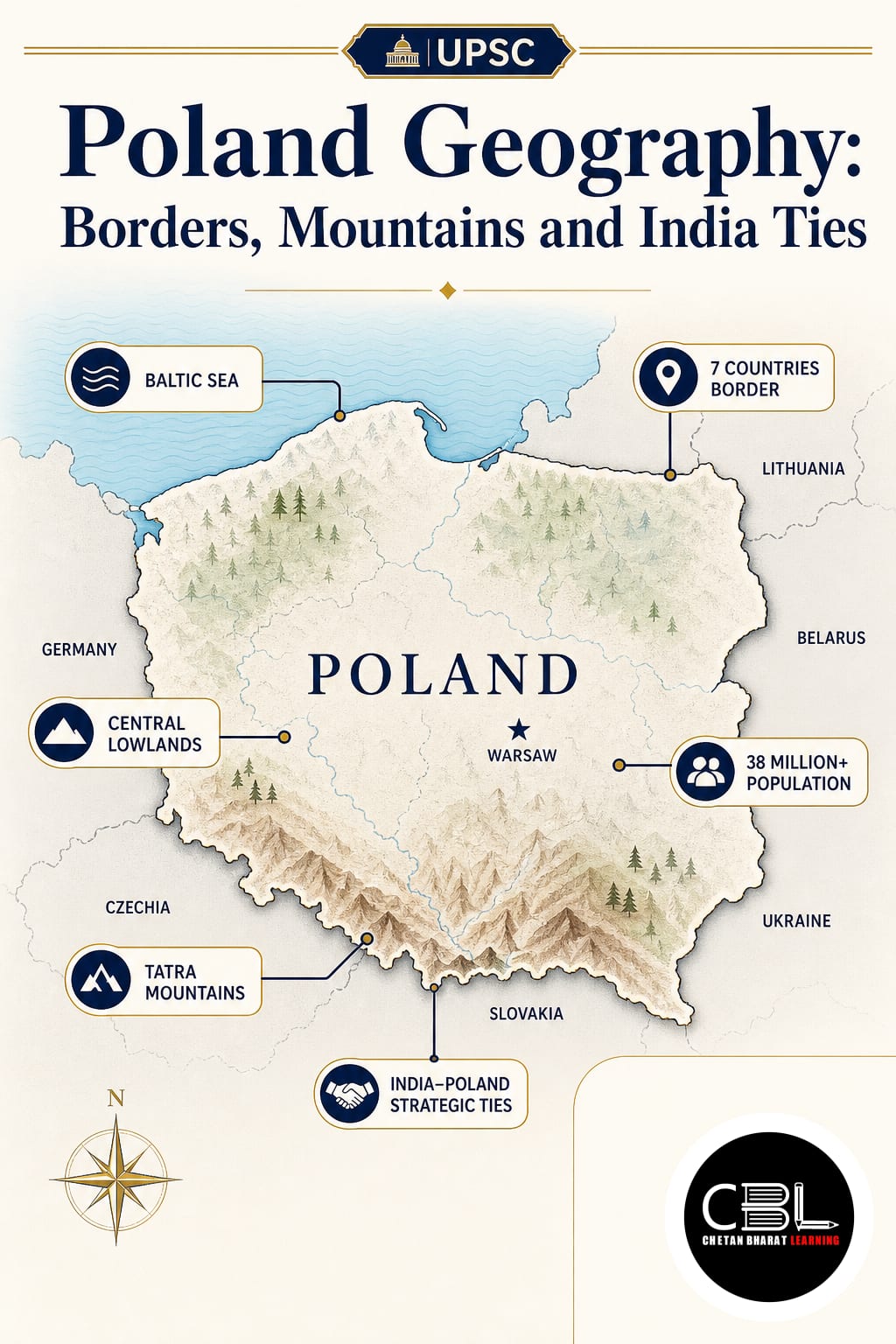
Poland, officially the Republic of Poland, is situated in Central Europe. It occupies an important geographical position between Western and Eastern Europe and has a coastline along the Baltic Sea to the north.
Poland shares land boundaries with seven countries:
- West: Germany.
- South: Czech Republic and Slovakia.
- East: Ukraine and Belarus.
- Northeast: Lithuania and Russia’s Kaliningrad Oblast.
- North: The Baltic Sea forms its maritime boundary.
Poland is predominantly a lowland country, forming part of the North European Plain. Its average elevation is approximately 173 metres above sea level. Southern Poland contains mountain ranges associated with the Carpathians and Sudetes.
The Tatra Mountains form part of the Carpathian system along the Polish-Slovak border. Poland’s highest point is Rysy, reaching 2,499 metres on the Polish side. The Sudetes lie along the southwestern border region.
The two major rivers are the Vistula and Oder (Odra). Both ultimately drain towards the Baltic Sea. Poland has a temperate climate, with stronger maritime influences in the west and more continental conditions towards the east.
Why in News?
On 1 October 2026, Poland called for stronger and more predictable economic and commercial relations with India. Polish Finance and Economy Minister Andrzej Domański highlighted the opportunities for expanding trade and investment between the two countries.
Speaking on the sidelines of the G20 Trade Ministers’ Meeting in Milwaukee, the minister emphasised long-term economic engagement and greater cooperation between Poland, India and the European Union.
India and Poland established diplomatic relations on 30 March 1954. Their relationship was upgraded to a Strategic Partnership in August 2024 during Prime Minister Narendra Modi’s visit to Warsaw. Both countries adopted an Action Plan for 2024–2028 covering economic, technological, defence and other cooperation.
Ecological or Strategic Significance
Poland’s geographical position is central to its economic and strategic importance. Its borders connect major European markets, while its Baltic Sea coastline provides access to maritime trade networks.
- European Union membership: Poland joined the EU in 2004 and participates in the single market.
- NATO membership: Poland joined NATO in 1999, enhancing European security.
- Baltic Sea connectivity: Ports like Gdańsk and Gdynia support international trade and logistics.
- India’s European engagement: Opportunities in manufacturing, technology, pharmaceuticals and IT.
- Defence and technology: Cooperation in defence industries, cybersecurity and emerging technologies.
- Regional economic integration: Participation in the Visegrád Group with the Czech Republic, Hungary and Slovakia.
Threats
- Regional security tensions: Impact of the Russia–Ukraine conflict on Central and Eastern Europe.
- Energy security: Dependence on international energy markets and price volatility.
- Climate-related hazards: Flooding, droughts and extreme weather events.
- Environmental pressures: Industrial emissions, air pollution and aquatic ecosystem degradation.
- International trade uncertainty: Shifts in tariffs, supply chains and global demand.
Conservation and Policy Measures
Poland participates in EU environmental frameworks covering biodiversity, water quality, industrial pollution and climate policy. Protection of Baltic Sea ecosystems, river basins and forest habitats is a priority.
Energy diversification, modern infrastructure and industrial efficiency support economic resilience. Coordination with European partners enhances transport connectivity and regional development.
India and Poland’s 2024–2028 Action Plan strengthens cooperation in investment, technology, industry and education. The seventh India–Poland Joint Commission for Economic Cooperation (July 2026) reviewed these priorities.
Understanding Poland Geography connects physical features with European security, regional trade and India’s diplomatic outreach.
Prelims Practice Corner
Q1. Which of the following countries share a land boundary with Poland?
- (a) 1 and 3 only
- (b) 1, 2 and 4 only
- (c) 2, 3 and 4 only
- (d) 1, 2, 3 and 4
Answer: (b) Germany, Lithuania and Belarus border Poland.
Q2. Poland shares its northern coastline with which sea?
- (a) Black Sea
- (b) Adriatic Sea
- (c) North Sea
- (d) Baltic Sea
Answer: (d) Baltic Sea.
Q3. Which mountain peak is the highest point in Poland?
- (a) Rysy
- (b) Zugspitze
- (c) Mont Blanc
- (d) Triglav
Answer: (a) Rysy at 2,499 m.
Q4. India and Poland upgraded their bilateral relationship to a Strategic Partnership in which year?
- (a) 2019
- (b) 2022
- (c) 2024
- (d) 2026
Answer: (c) 2024.
Q5. Consider the following statements: 1. Poland is a member of the European Union. 2. Poland is a member of NATO. 3. Poland uses the euro as its national currency. Which statements are correct?
- (a) 1 and 3 only
- (b) 1 and 2 only
- (c) 2 and 3 only
- (d) 1, 2 and 3
Answer: (b) Statements 1 and 2 are correct; Poland uses the złoty.
Mains Practice Questions
Q1. Examine Poland’s strategic importance in Central Europe and discuss the significance of the India–Poland Strategic Partnership for India’s engagement with Europe. (15 marks)
Suggested Structure:
- Introduction: Poland’s location and 2024 Strategic Partnership.
- Body: EU/NATO membership, security position, Baltic connectivity, trade, defence and technology ties.
- Conclusion: Need for predictable economic cooperation and diversified partnerships.
Q2. Explain how Poland’s physical geography influences its economic activities and strategic position in Europe. (10 marks)
Suggested Structure:
- Introduction: Location, Baltic coastline and lowland terrain.
- Body: North European Plain, Carpathians, rivers, climate, trade and agriculture.
- Conclusion: Link between geography, economic development and connectivity.
Frequently Asked Questions
Where is Poland located and which countries border it?
Poland is in Central Europe. It borders Germany, the Czech Republic, Slovakia, Ukraine, Belarus, Lithuania and Russia’s Kaliningrad Oblast, and has a Baltic Sea coastline.
Why is Poland important for India?
Poland is India’s largest trading partner in Central and Eastern Europe. The two upgraded to a Strategic Partnership in 2024 and cooperate in trade, investment, technology and defence.
What are the major geographical features of Poland?
Poland is largely part of the North European Plain. Key features include the Baltic Sea coast, Carpathian and Sudetes mountains, the Tatra range, Rysy peak and the Vistula and Oder rivers.
Related Current Affairs
Preparing for UPSC, PCS or HCS?
Talk to a mentor at Chetan Bharat Learning, Chandigarh. Free guidance on choosing the right exam and building a study plan.
Chat on WhatsAppCall 97793 53345UPSC / IAS / PCS coaching in Chandigarh · Trusted by aspirants across Punjab & Haryana
Leave a Reply
You must be logged in to post a comment.