
UPSC Mapping
| Exam | Topic |
|---|---|
| Prelims | Political Personalities and Antyodaya Diwas |
| Mains | GS Paper II: Governance and Social Justice |
| Born | Died | Political Organization | Birth Anniversary |
|---|---|---|---|
| 25 September 1916 | 11 February 1968 | Bharatiya Jana Sangh | Antyodaya Diwas |
Article
What is Pandit Deendayal Upadhyaya?
Pandit Deendayal Upadhyaya was an Indian political thinker, organiser, journalist and prominent Bharatiya Jana Sangh leader. The Jana Sangh later became an important political predecessor of the Bharatiya Janata Party. He played a major organisational role in expanding the party during the decades following independence. In 1967, he became its national president shortly before his death in February 1968.
He also contributed to journalism and political literature through newspapers, journals and books. His associated publications included Rashtradharma, Panchajanya and Swadesh. His writings addressed national identity, economic planning, cultural values and the purpose of political institutions. His most influential contribution was Ekatma Manav Darshan, commonly translated as Integral Humanism.
Why is Pandit Deendayal Upadhyaya in News?
Pandit Deendayal Upadhyaya was remembered nationally on his 110th birth anniversary on 25 September 2026. Prime Minister Narendra Modi paid tribute to his vision of Antyodaya and the upliftment of marginalised communities. The observance renewed discussion about his political philosophy and its claimed relevance to inclusive nation-building. The official tribute release records the current occasion.
India observes 25 September as Antyodaya Diwas in recognition of his emphasis on the last person. The government declared the observance on his 98th birth anniversary in 2014. The date has also been associated with livelihood, skill-development and poverty-alleviation initiatives. Its current-affairs relevance extends beyond biography because it links political ideas with welfare delivery and development administration.
Key Features
His thought combined social philosophy, economic organisation and an Indian conception of national development.
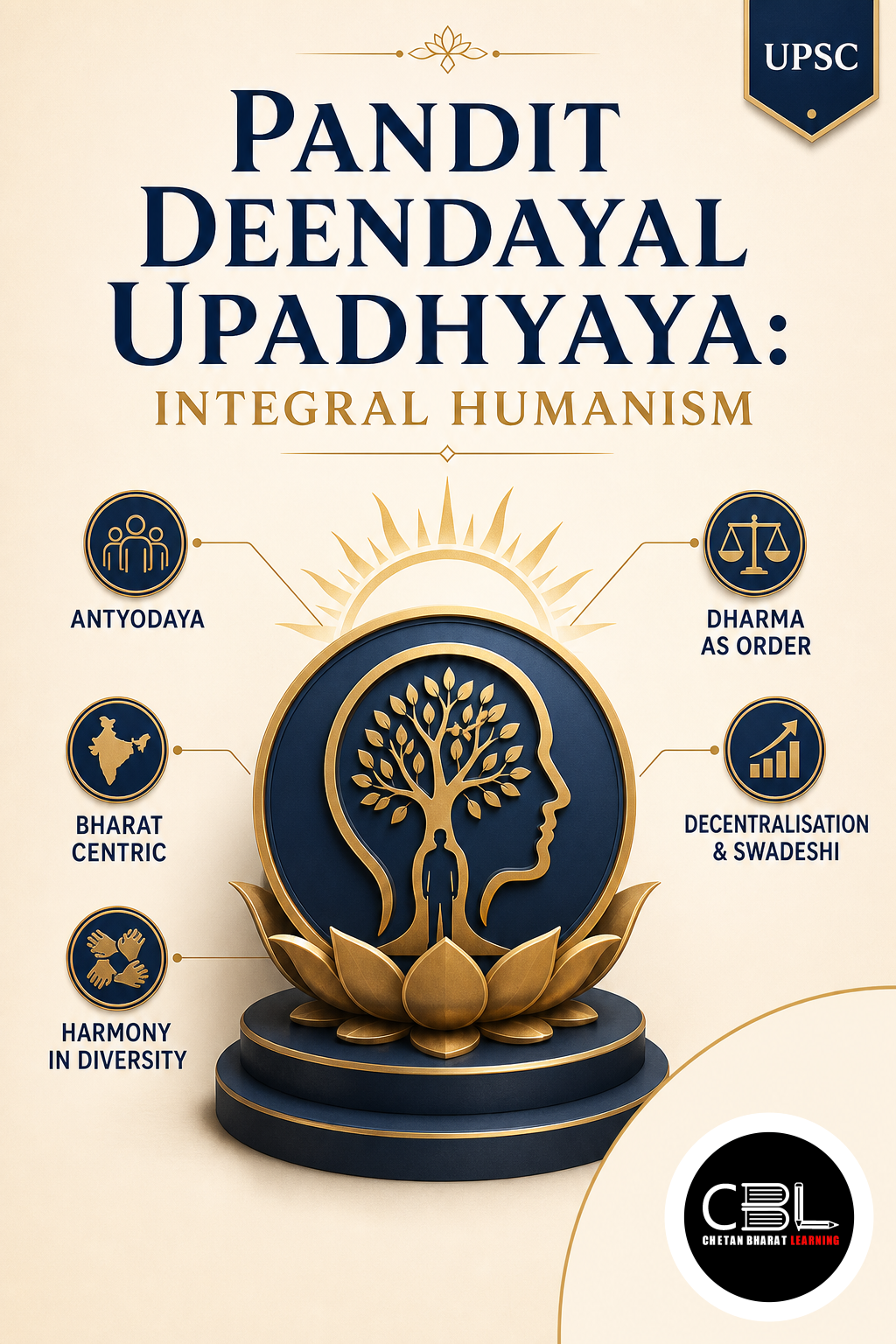
- Integral Humanism: Pandit Deendayal Upadhyaya sought balanced development of the body, mind, intellect and soul within society.
- Antyodaya: He argued that development should first reach the poorest and most marginalised person in society.
- Social harmony: His philosophy viewed individuals, families, communities, the nation and nature as interconnected rather than competing units.
- Decentralised economy: He supported labour-intensive production, cottage industries and locally rooted economic activity alongside necessary modern development.
- Indigenous framework: He maintained that Indian policy should reflect the country’s historical experience, cultural ethos and social realities.
Integral Humanism emerged partly as a response to both unrestrained capitalism and highly centralised socialism. He believed excessive individualism could weaken social responsibility, while rigid collectivism could suppress human dignity and initiative. His framework sought material prosperity without separating economics from ethics, community and environmental balance. It aimed to provide an Indian approach rather than mechanically importing external ideological models.
Challenges
Translating broad philosophical principles into measurable public policy presents several analytical and administrative difficulties.
- Conceptual interpretation: Ideas such as national ethos and holistic development can receive different meanings across political and academic traditions.
- Policy measurement: Governments need objective indicators to determine whether development genuinely reaches the most deprived citizens.
- Economic balance: Decentralised production must coexist with large-scale industries required for infrastructure, technology and global competitiveness.
- Social diversity: Any culturally grounded framework must respect India’s plural identities, constitutional equality and freedom of conscience.
- Implementation gaps: Welfare programmes may face exclusion errors, weak local capacity, corruption and uneven service quality.
Invoking Antyodaya does not by itself guarantee that public spending benefits the most vulnerable. Administrators require accurate beneficiary identification, accessible grievance systems and transparent outcome monitoring. Local participation can improve programme design, but decentralisation must include adequate finance and administrative capacity. Aspirants can examine related governance debates through the current affairs analysis archive. Constitutional values should provide the common framework for applying inclusive-development principles across a diverse society.
Way Forward
The contemporary relevance of Pandit Deendayal Upadhyaya should be assessed through measurable improvements in human welfare. Governments can apply the last-person principle by prioritising nutrition, healthcare, education, housing, skills and livelihood security. Social registries must remain accurate, inclusive and subject to independent scrutiny. Public programmes should measure actual outcomes rather than relying only on expenditure or enrolment figures.
India can combine decentralised enterprise with modern manufacturing through stronger cooperatives, producer organisations and competitive small businesses. Panchayats and urban local bodies need predictable funds, trained personnel and public accountability. Policy must also integrate ecological limits because long-term welfare depends on healthy natural systems. The Prime Minister’s official address explains the ideas of Integral Humanism and Antyodaya. Their practical value ultimately depends on constitutional inclusion, transparent governance and demonstrable benefits for disadvantaged citizens.
Prelims Practice Corner
Q1. Antyodaya Diwas is observed annually on which date?
- a) 11 February
- b) 15 August
- c) 25 September
- d) 2 October
Answer: (c) 25 September.
Q2. Ekatma Manav Darshan is commonly translated into English as which philosophy?
- a) Scientific Socialism
- b) Integral Humanism
- c) Utilitarianism
- d) Classical Liberalism
Answer: (b) Integral Humanism.
Q3. The political leader discussed above was prominently associated with which organisation?
- a) Bharatiya Jana Sangh
- b) Justice Party
- c) Swaraj Party
- d) Forward Bloc
Answer: (a) Bharatiya Jana Sangh.
Q4. The concept of Antyodaya primarily emphasises which objective?
- a) Upliftment of the poorest
- b) Complete industrial centralisation
- c) Elimination of local government
- d) Expansion of colonial trade
Answer: (a) Upliftment of the poorest.
Q5. Which publication was associated with the political thinker discussed above?
- a) Panchajanya
- b) Young India
- c) Kesari
- d) Al-Hilal
Answer: (a) Panchajanya.
Mains Practice Questions
Q1. Discuss Integral Humanism as an attempt to formulate an Indian approach to political economy and social development. (250 words, 15 marks)
Answer Structure:
- Intro: Define Integral Humanism and locate it within post-independence Indian political thought.
- Body: Explain holistic development, social harmony, national ethos, decentralisation, Antyodaya and implementation concerns.
- Conclusion: Evaluate its relevance through constitutional values and measurable human-development outcomes.
Q2. The real test of inclusive governance is whether public policy reaches the last person. Examine. (150 words, 10 marks)
Answer Structure:
- Intro: Connect inclusive governance with the principle of prioritising disadvantaged citizens.
- Body: Cover identification, last-mile delivery, local institutions, digital exclusion, accountability and outcome measurement.
- Conclusion: Support transparent, participatory and rights-based mechanisms for inclusive service delivery.
FAQs on Pandit Deendayal Upadhyaya
What is the meaning of Integral Humanism?
It views human beings as integrated physical, intellectual, emotional and spiritual personalities. It also seeks harmony between individuals, society, the nation and nature.
What does Antyodaya mean?
Antyodaya means the upliftment of the person at the lowest social and economic position. It requires development policies to prioritise the poorest and most marginalised communities.
Why is 25 September observed as Antyodaya Diwas?
The date marks the birth anniversary of the political thinker associated with Antyodaya. The government declared the observance in 2014 to emphasise inclusive development.
Related Current Affairs
Preparing for UPSC, PCS or HCS?
Talk to a mentor at Chetan Bharat Learning, Chandigarh. Free guidance on choosing the right exam and building a study plan.
Chat on WhatsAppCall 97793 53345UPSC / IAS / PCS coaching in Chandigarh · Trusted by aspirants across Punjab & Haryana
Leave a Reply
You must be logged in to post a comment.