
UPSC Mapping
Prelims
Space Technology and International Treaties
Mains
GS Paper II — International Relations; GS Paper III — Security and Technology
| Primary Treaty | Key Provision | India’s ASAT Test | India Joined |
|---|---|---|---|
| Outer Space Treaty, 1967 | Article IV | Mission Shakti, 2019 | Artemis Accords, 2023 |
What is Space Weaponisation?
Space Weaponisation refers to placing, developing or using systems that can damage, disrupt or control assets in outer space. It differs from the broader militarisation of space, which includes using satellites for surveillance, navigation, secure communication and early warning. Militaries have relied on such support functions for decades without necessarily placing offensive weapons in orbit.
Weapon systems may operate through Earth-to-space, space-to-space or space-to-Earth pathways. Ground-launched anti-satellite missiles represent the first category, while an orbital system targeting another satellite represents the second. Space-to-Earth weapons would strike terrestrial targets from orbit. Capabilities may remain dual-use because technologies for satellite inspection, servicing or debris removal can potentially disable another country’s spacecraft.
Why is Space Weaponisation in News?
Space Weaponisation gained renewed attention when United States Air Force Secretary Troy Meink acknowledged that the Space Force possessed on-orbit space-control weapons. He described them as systems capable of defending American joint forces against hostile action. The announcement did not disclose their number, technology or whether they could cause physical destruction.
The acknowledgement represents a significant change in public transparency about military capabilities in orbit. It also intensifies concerns about strategic competition involving the United States, China and Russia. The official United States Space Force statement confirmed the deployment but withheld operational details. This uncertainty complicates threat assessment and may encourage rival states to develop counter-capabilities.
Key Features
Modern counter-space capabilities include destructive systems as well as tools that produce temporary or reversible effects.
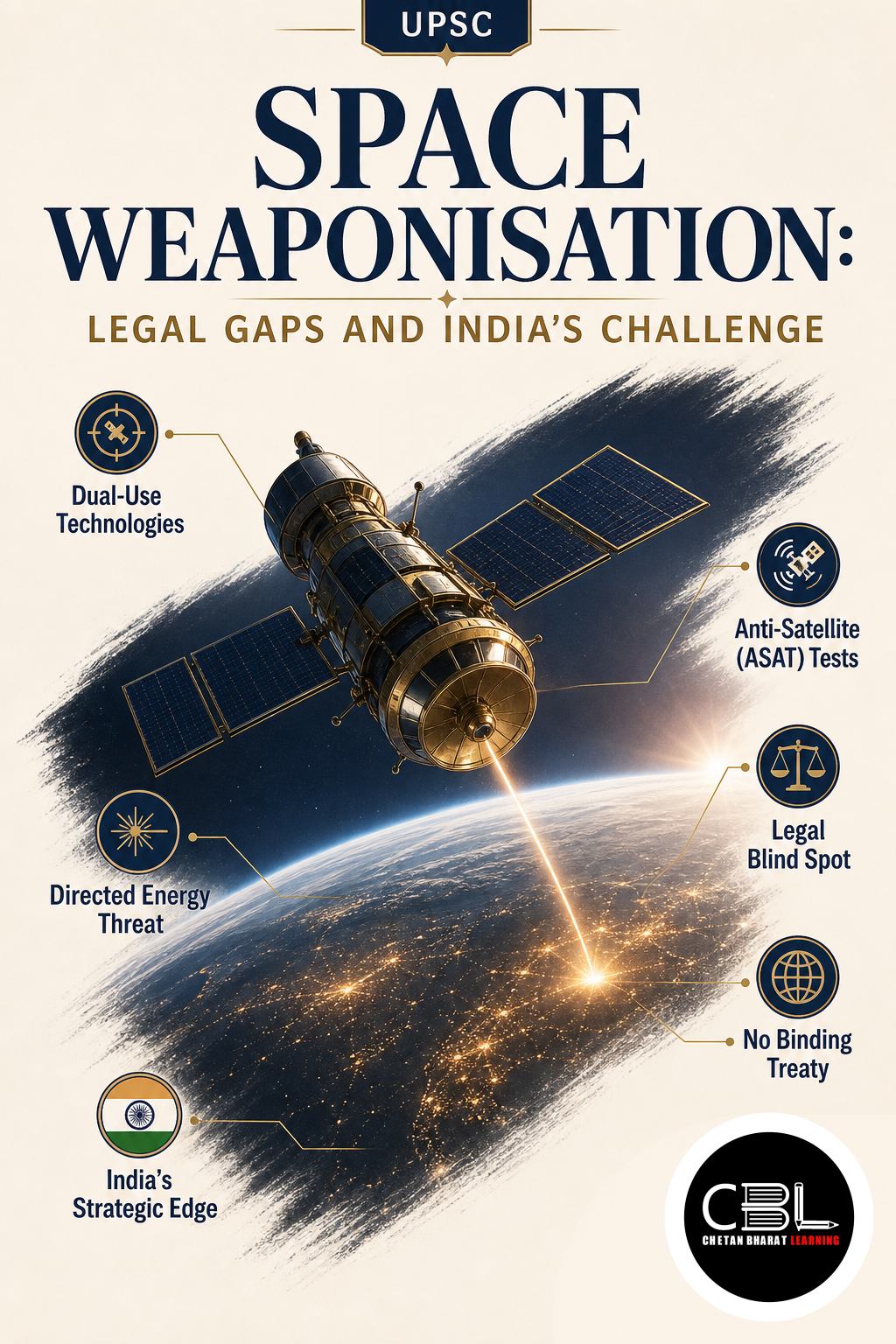
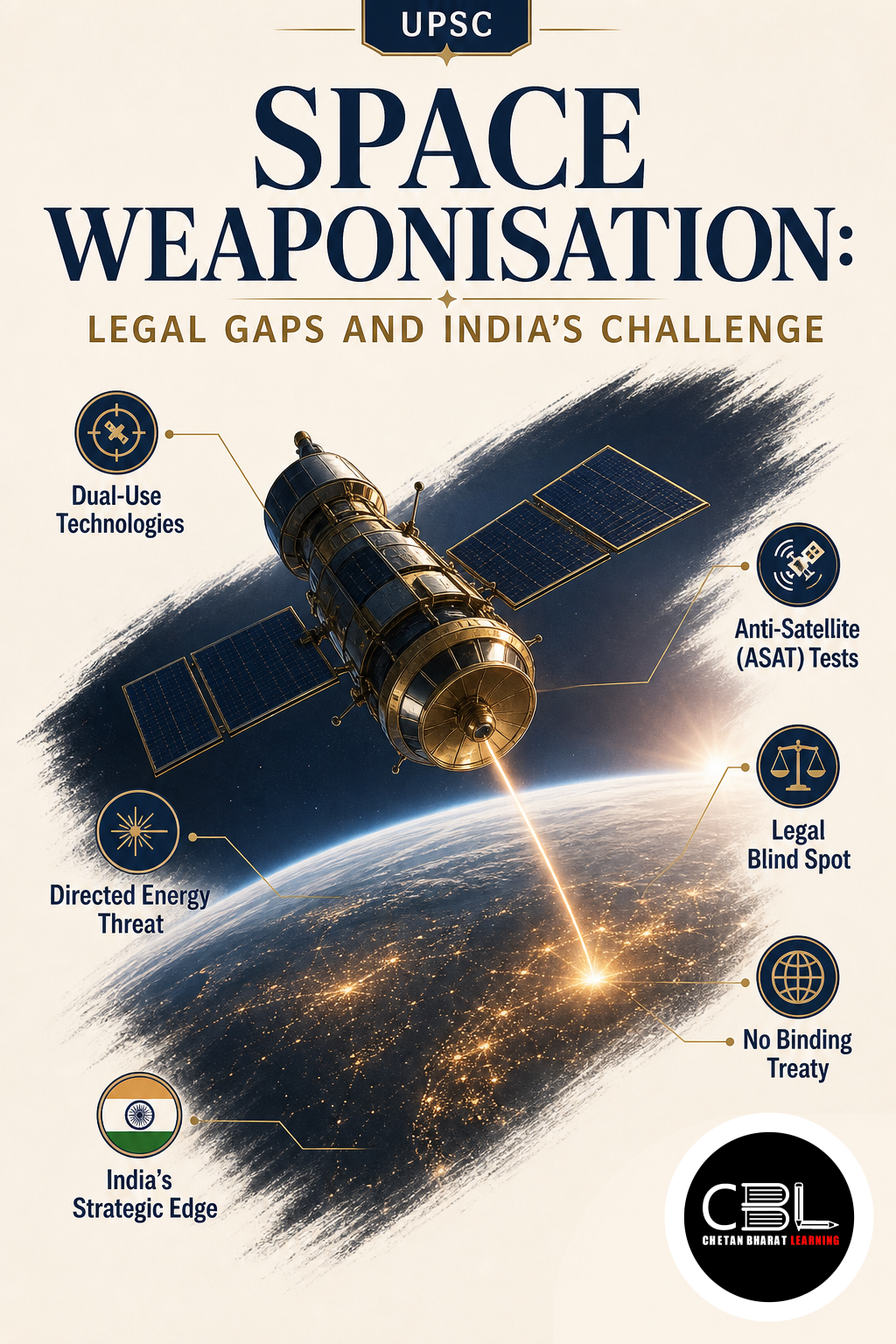
- Kinetic anti-satellite systems: Direct-ascent missiles or co-orbital systems can physically destroy satellites, but the resulting debris may threaten spacecraft operated by every country.
- Electronic warfare: Jammers can interfere with satellite communication or navigation signals without permanently destroying the targeted spacecraft.
- Cyber operations: Attackers may target ground stations, data links or command networks to manipulate information and interrupt satellite services.
- Directed-energy capabilities: Lasers or high-powered electromagnetic systems may temporarily blind sensors, damage components or prevent satellites from collecting reliable information.
- Dual-use spacecraft: Satellites designed for inspection, refuelling or repair can approach other spacecraft and potentially interfere with their movement or functioning.
The legal framework begins with the Outer Space Treaty of 1967. Article IV prohibits placing nuclear weapons or other weapons of mass destruction in orbit or stationing them in outer space. It also reserves the Moon and other celestial bodies for peaceful purposes and prohibits military bases, weapons testing and military manoeuvres on them.
The treaty does not impose a comprehensive prohibition on conventional weapons in Earth orbit. It also lacks detailed rules for electronic interference, cyberattacks, temporary disabling measures and ground-launched anti-satellite systems. States may consequently interpret emerging technologies differently while continuing to invoke the principles of peaceful use, international responsibility and due regard.
Challenges
Space Weaponisation creates interconnected legal, strategic and technological challenges for established and emerging space powers.
- Legal ambiguity: Existing treaties prohibit specific weapons and activities but do not clearly regulate every conventional, cyber or non-kinetic counter-space capability.
- Attribution problem: Operators may struggle to determine whether signal loss resulted from deliberate interference, technical failure, environmental conditions or hostile cyber activity.
- Orbital debris: Destructive tests can create fast-moving fragments that damage satellites, threaten crewed missions and remain hazardous beyond the original conflict.
- Dual-use uncertainty: The same spacecraft may perform legitimate servicing functions or approach another satellite for coercive purposes, making intentions difficult to assess.
- Escalation risks: An attack on an early-warning or communication satellite could appear to precede a wider military strike and trigger rapid retaliation.
Efforts to negotiate stronger restraints have produced limited results. Russia and China proposed the Prevention of the Placement of Weapons in Outer Space treaty, commonly called PPWT. Critics argued that earlier drafts did not adequately address verification or ground-based anti-satellite weapons. Negotiations on the Prevention of an Arms Race in Outer Space have also remained stalled within the Conference on Disarmament.
India faces a distinct policy dilemma because its economy and security increasingly depend on satellites. Communication, navigation, crop assessment, border monitoring and disaster response all require resilient space services. India demonstrated an anti-satellite capability through Mission Shakti in 2019 and joined the Artemis Accords in 2023. Students can follow related developments through the science and technology updates.
Way Forward
States should negotiate practical rules that address behaviour rather than relying solely on disputed definitions of a space weapon. Initial measures could prohibit debris-producing anti-satellite tests, protect civilian space services and establish communication channels for orbital incidents. Transparent notifications, registration of space objects and information-sharing about potentially hazardous manoeuvres can reduce misunderstanding.
India should combine diplomatic advocacy with stronger space situational awareness, cyber resilience, satellite redundancy and rapid replacement capacity. It can support inclusive negotiations while protecting legitimate national security interests. The United Nations space law framework provides the foundation for these efforts. A credible response to Space Weaponisation requires verifiable restraints, responsible conduct and sustained cooperation among all major space powers.
Prelims Practice Corner
Q1. Article IV of the Outer Space Treaty expressly prohibits which of the following?
- (a) Every military satellite
- (b) Nuclear weapons in orbit
- (c) Satellite navigation systems
- (d) Commercial launches
Answer: (b) Article IV prohibits placing nuclear weapons or other weapons of mass destruction in orbit.
Q2. Mission Shakti, conducted by India in 2019, demonstrated which capability?
- (a) Human lunar landing
- (b) Anti-satellite interception
- (c) Space-based solar power
- (d) Reusable orbital tourism
Answer: (b) Mission Shakti demonstrated India’s ability to intercept a satellite using a ground-launched system.
Q3. Which one of the following best describes a non-kinetic counter-space operation?
- (a) Physically destroying a satellite with a missile
- (b) Jamming a satellite communication signal
- (c) Launching a weather satellite
- (d) Removing natural meteoroids
Answer: (b) Jamming interferes with services without necessarily causing physical destruction.
Q4. Consider the following statements about the Artemis Accords: 1. They provide principles for civil space cooperation. 2. India joined them in 2023. 3. They constitute a binding global treaty banning conventional space weapons. How many statements are correct?
- (a) Only one
- (b) Only two
- (c) All three
- (d) None
Answer: (b) Statements 1 and 2 are correct; the Accords are not a binding global arms-control treaty.
Q5. What is a major concern associated with destructive anti-satellite tests?
- (a) Creation of orbital debris
- (b) Permanent loss of gravity
- (c) Elimination of radio waves
- (d) Closure of all launch sites
Answer: (a) Debris generated by destruction can endanger satellites and crewed missions belonging to multiple countries.
Mains Practice Questions
Q1. The existing international legal framework has not kept pace with emerging counter-space capabilities. Discuss. (250 words, 15 marks)
Answer Structure
- Intro: Establish the growing dependence on space systems and the expansion of military capabilities.
- Body: Examine the Outer Space Treaty, conventional weapon gap, cyber and electronic operations, dual-use technology, debris, attribution and failed treaty initiatives.
- Conclusion: Recommend verifiable behavioural norms and inclusive negotiations for sustainable space security.
Q2. How should India balance the protection of its space assets with its commitment to peaceful uses of outer space? (150 words, 10 marks)
Answer Structure
- Intro: Highlight India’s growing civilian, developmental and security dependence on satellites.
- Body: Cover situational awareness, redundancy, cyber protection, deterrence, Mission Shakti, treaty obligations and diplomatic leadership.
- Conclusion: Support responsible defensive capability alongside rules-based and debris-free space operations.
FAQs on Space Weaponisation
Does international law prohibit every type of weapon in outer space?
No. The Outer Space Treaty expressly prohibits nuclear weapons and other weapons of mass destruction in orbit but does not comprehensively ban conventional orbital weapons or ground-based anti-satellite systems.
What is the difference between kinetic and non-kinetic counter-space systems?
Kinetic systems physically damage a satellite and may create debris. Non-kinetic operations use methods such as jamming, cyber intrusion or directed energy to disrupt services without a physical collision.
Why does this issue matter for India?
India relies on satellites for development, navigation, communication, disaster management and national security. It must strengthen the resilience of these systems while supporting credible international rules that prevent miscalculation and harmful debris.
Related Current Affairs
Preparing for UPSC, PCS or HCS?
Talk to a mentor at Chetan Bharat Learning, Chandigarh. Free guidance on choosing the right exam and building a study plan.
Chat on WhatsAppCall 97793 53345UPSC / IAS / PCS coaching in Chandigarh · Trusted by aspirants across Punjab & Haryana
Leave a Reply
You must be logged in to post a comment.