

UPSC Mapping
Important for
| Prelims | Official Language and Constitutional Provisions |
|---|---|
| Mains | GS Paper II: Constitution and Federalism |
Quick Facts
| Observed | 14 September |
|---|---|
| Assembly Decision | 14 September 1949 |
| Constitutional Part | Part XVII |
| Key Articles | 343–351 |
What is Hindi Diwas?
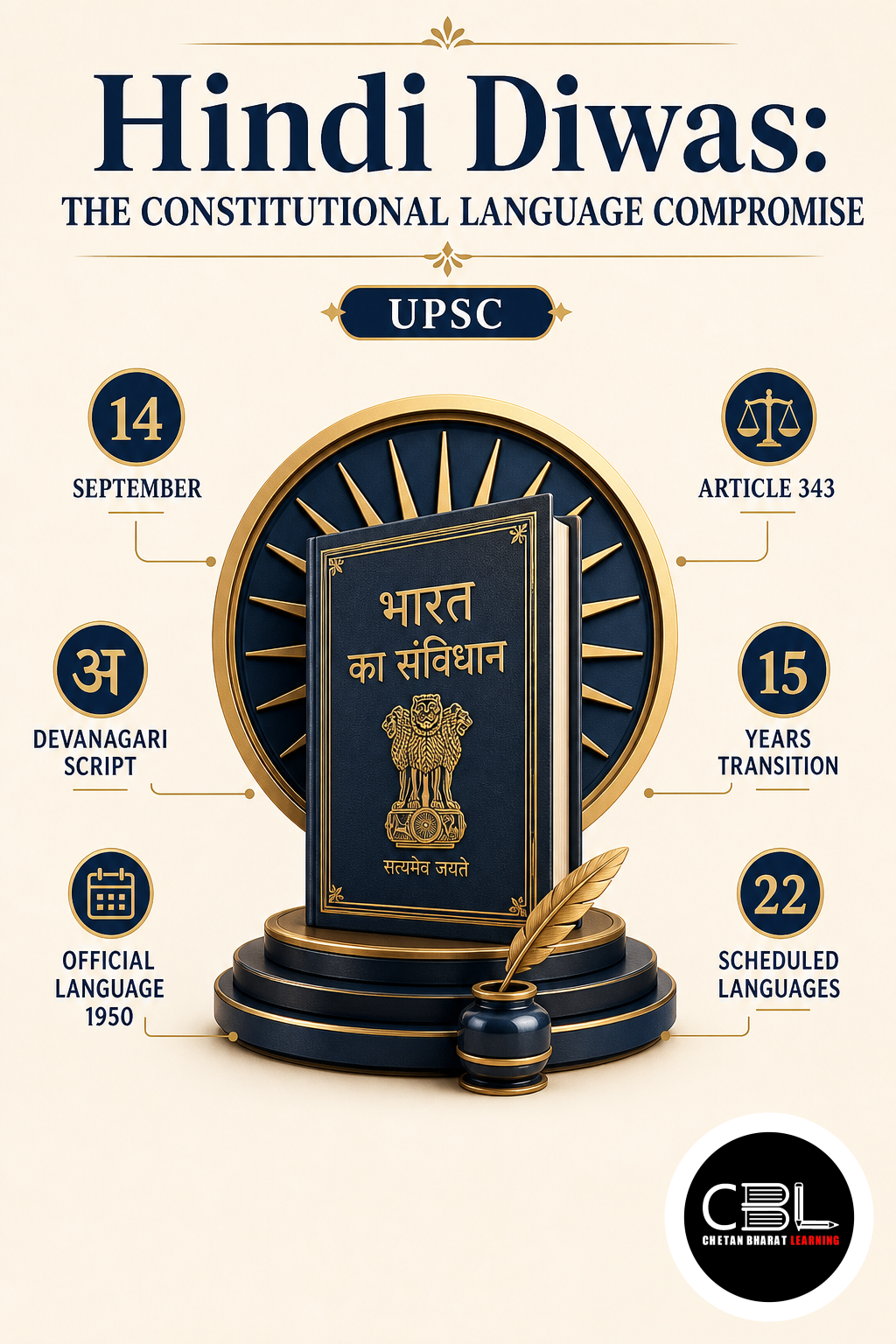
Hindi Diwas is observed annually on September 14 to mark the Assembly’s adoption of Hindi in the Devanagari script as the official language of the Union. Article 343 also adopted the international form of Indian numerals for Union purposes. The Constitution did not designate Hindi, or any other language, as India’s national language, making the distinction between official status and national identity essential.
The decision emerged from extended debates involving supporters of Hindi, representatives from non-Hindi-speaking regions and leaders seeking an administratively workable settlement. Members examined national integration, linguistic equality, legal continuity, technical vocabulary and the practical requirements of a newly independent government. The eventual Munshi-Ayyangar formula avoided immediate linguistic replacement and converted a divisive question into a phased constitutional arrangement.
Why is Hindi Diwas in News?
Hindi Diwas renewed discussion about how the Constituent Assembly reconciled Hindi’s development with multilingual citizenship. The Assembly adopted its compromise on September 14, 1949, after rejecting both permanent dependence on colonial administrative practice and abrupt replacement of English. The constitutional text is available through the Legislative Department, including Part XVII provisions governing Union, state, judicial and intergovernmental language use.
The debate remains relevant because public discussion frequently describes Hindi as the national language, although the Constitution uses the expression official language of the Union. It also illustrates why constitutional decisions affecting cultural identity often require accommodation beyond a simple numerical majority. The settlement preserved administrative continuity, allowed regional languages to function within states and created safeguards for linguistic minorities while directing the Union to promote Hindi’s development.
Key Features
India’s language framework combines Union administration, state autonomy, judicial continuity and minority protection.
- Official, not national: Article 343 identifies Hindi in Devanagari as the Union’s official language but does not create a constitutionally declared national language, preserving space for India’s many linguistic identities and preventing official terminology from becoming a claim of cultural hierarchy.
- Transitional bilingualism: The Constitution initially permitted English to continue for Union purposes for fifteen years, enabling administration, legislation and higher courts to function while institutions developed terminology, trained personnel and expanded the practical use of Hindi without disrupting governance.
- Parliamentary flexibility: Article 343 allowed Parliament to provide by law for continued English use, and the Official Languages Act, 1963, sustained English alongside Hindi after the original transition period ended in 1965.
- Federal accommodation: States may adopt one or more languages used within their territories, or Hindi, for official purposes, allowing regional political communities to organise administration without a uniform model imposed by the Union.
- Constitutional safeguards: Part XVII covers interstate communication, court and legislative language, representations for grievances, mother-tongue instruction at the primary stage and a Special Officer for linguistic minorities.
Challenges
Language policy must promote effective communication without weakening linguistic equality or federal trust.
- Perception of imposition: Uniform measures can generate resistance in regions with strong linguistic traditions, turning communication into a dispute over identity and power.
- Administrative accessibility: Citizens interact with Union institutions through different languages, requiring accurate translation, multilingual digital services and responsive grievance systems.
- Legal precision: Courts and legislatures depend on stable terminology; inconsistent translations can create uncertainty concerning rights and obligations.
- Educational balance: Mother-tongue education supports comprehension but students also seek languages that improve mobility and employment, requiring flexible instructional choices.
- Consensus maintenance: Language arrangements must evolve through consultation with states and linguistic communities, a principle linked with cooperative federalism.
Way Forward
Governments should strengthen multilingual public services through professional translation, accessible terminology databases, technology tools and region-based recruitment, while allocating stable budgets for digitisation, terminology development, staff training and quality review. Hindi can develop through literature, education and technical capacity without diminishing the constitutional space available to other Indian languages, whose digital resources and educational use also require institutional investment. Consultation with states remains necessary before changing language practices that affect examinations, administration, education or access to national institutions.
The constitutional meaning of Hindi Diwas should emphasise unity through accommodation rather than linguistic uniformity. The India Code portal provides access to central legislation, including the statutory framework governing official language use. India can preserve administrative efficiency and national communication by combining Hindi’s development, continued legal clarity, regional-language promotion and enforceable safeguards for linguistic minorities.
Prelims Practice Corner
- Q1. Why is September 14 observed in relation to Hindi?
- (a) Adoption of the Official Languages Act
- (b) Constituent Assembly’s language decision
- (c) Addition of Hindi to the Eighth Schedule
- (d) Formation of the Official Language Commission
Answer: (b) The Constituent Assembly adopted the official-language compromise on September 14, 1949.
- Q2. Which statement about India’s national language is constitutionally correct?
- (a) Hindi is the national language
- (b) Sanskrit is the national language
- (c) Hindi and English are national languages
- (d) The Constitution declares no national language
Answer: (d) The Constitution specifies official languages but does not declare a national language.
- Q3. Article 343 primarily deals with which subject?
- (a) Language of the Supreme Court
- (b) Union’s official language
- (c) Mother-tongue instruction
- (d) Linguistic minorities officer
Answer: (b) Article 343 identifies Hindi in Devanagari as the official language of the Union.
- Q4. Which Article addresses the language of the Supreme Court and High Courts?
- (a) Article 345
- (b) Article 347
- (c) Article 348
- (d) Article 351
Answer: (c) Article 348 contains provisions on court, legislative and authoritative legal texts.
- Q5. What was a major effect of the Official Languages Act, 1963?
- (a) It abolished English
- (b) It declared Hindi a national language
- (c) It continued English for Union purposes
- (d) It removed state language powers
Answer: (c) The Act provided for continued English use alongside Hindi for specified official purposes.
Mains Practice Questions
- Q1. The Constituent Assembly resolved India’s language question through accommodation rather than majoritarianism. Discuss. (250 words, 15 marks)
Answer Structure:
Intro: Introduce the competing linguistic positions before the Constituent Assembly.
Body: Explain the compromise, English transition, federal flexibility and minority protections.
Conclusion: Link linguistic accommodation with constitutional unity and democratic legitimacy.
- Q2. Distinguish between an official language and a national language in the Indian constitutional context. (150 words, 10 marks)
Answer Structure:
Intro: Clarify that the Constitution does not declare a national language.
Body: Discuss Article 343, state autonomy, English use and linguistic pluralism.
Conclusion: Emphasise accurate terminology and respect for India’s multilingual character.
FAQs on Hindi Diwas
Why is the observance held on September 14?
The Constituent Assembly adopted its official-language compromise on September 14, 1949. The annual observance marks that constitutional decision.
Is Hindi India’s national language?
No. Article 343 designates Hindi in Devanagari as the Union’s official language, but the Constitution declares no national language.
Why did English continue after 1965?
Parliament provided for its continued use through legislation amid administrative requirements and opposition to exclusive replacement. India consequently developed a bilingual arrangement for many Union purposes.
Related Current Affairs
Preparing for UPSC, PCS or HCS?
Talk to a mentor at Chetan Bharat Learning, Chandigarh. Free guidance on choosing the right exam and building a study plan.
Chat on WhatsAppCall 97793 53345UPSC / IAS / PCS coaching in Chandigarh · Trusted by aspirants across Punjab & Haryana
Leave a Reply
You must be logged in to post a comment.