

UPSC Mapping
| Prelims | Science & Tech |
|---|---|
| Mains | GS Paper 3 |
Quick Facts
| Pathogen | Streptococcus pneumoniae |
|---|---|
| Diseases | Pneumonia & Meningitis |
| Technology | Reverse Vaccinology |
| Serotypes | Over 100 distinct |
What is Universal Pneumococcal Vaccine?
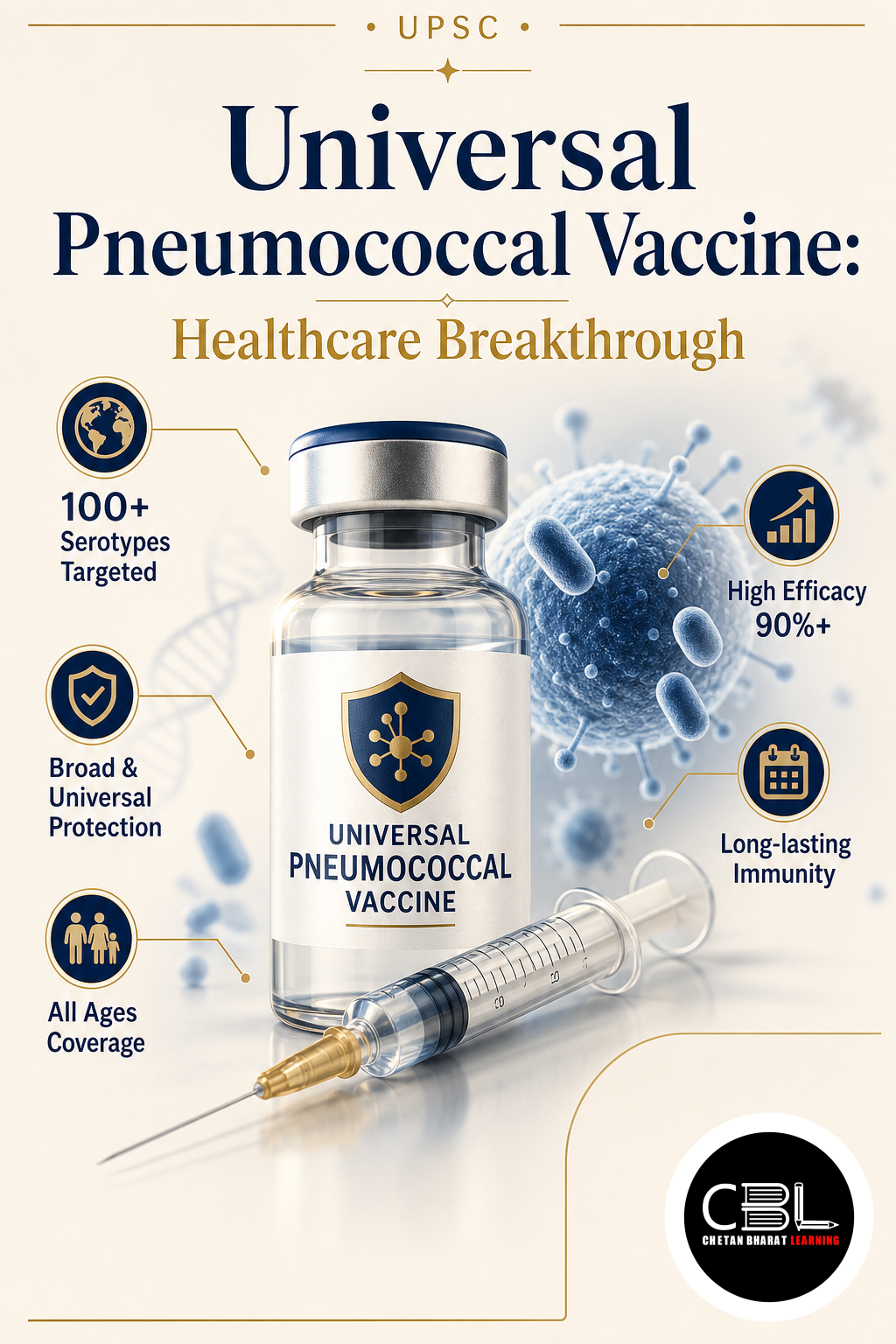
The Universal Pneumococcal Vaccine represents a revolutionary approach to combating invasive bacterial diseases. Streptococcus pneumoniae causes severe pneumonia, meningitis, and sepsis across diverse demographics worldwide. This dangerous pathogen possesses over 100 distinct serotypes, making comprehensive immunization extremely difficult using traditional methods.
Current immunization strategies rely heavily on Pneumococcal Conjugate Vaccines and Polysaccharide Vaccines. These conventional options target the sugar capsules of only a few dominant serotypes effectively. This limitation severely restricts their overall effectiveness against emerging or non‐vaccine strains circulating globally today.
Medical professionals frequently observe replacement disease phenomena where non‐vaccine serotypes rapidly colonize populations after widespread conventional immunization. This continuous evolutionary arms race forces pharmaceutical companies to regularly update their multivalent formulations to include newly dominant strains. Developing a truly universal candidate completely bypasses this frustrating cycle of constant reformulation and regulatory review.
The experimental Universal Pneumococcal Vaccine utilizes conserved surface proteins that remain identical across all known bacterial variations. These structural proteins perform essential cellular functions that the bacteria cannot easily mutate without compromising their own survival. Targeting these vulnerable biological chokepoints provides a highly durable defense mechanism against the entire pathogen family.
The economic burden of treating invasive pneumococcal diseases places immense strain on public healthcare systems worldwide. Hospitalizations for severe pneumonia and bacterial meningitis consume massive financial resources and critical intensive care beds. Preventing these infections through widespread immunization offers the most cost‐effective strategy for preserving limited medical infrastructure.
Pediatric and geriatric populations remain particularly vulnerable to the devastating complications of this dangerous bacterial pathogen. Their developing or declining immune systems struggle to mount adequate defenses against aggressive respiratory infections. A highly effective universal candidate would provide crucial protection for these high‐risk demographic groups across all socioeconomic backgrounds.
Why is Universal Pneumococcal Vaccine in News?
Scientists recently tested this experimental Universal Pneumococcal Vaccine candidate using advanced genomic techniques. The research team successfully utilized reverse vaccinology to scan the entire bacterial genome for shared surface proteins. A recent WHO report highlighted the critical need for broader protection against antimicrobial‐resistant respiratory pathogens.
Global health organizations are simultaneously expanding research access to develop durable cross‐serotype antibody responses. The rising incidence of severe respiratory infections continues to highlight the urgent need for next‐generation immunization tools. These epidemiological shifts create highly lucrative opportunities for pharmaceutical companies scaling up their advanced vaccine pipelines rapidly.
Recent diplomatic engagements have secured multiple bilateral agreements to jointly develop advanced production technologies and clinical standards. These international collaborations significantly reduce the financial risks associated with pioneering such complex and capital‐intensive biomedical projects. Foreign direct investment is expected to surge as global conglomerates seek reliable long‐term pharmaceutical supply contracts.
Domestic research institutions are simultaneously working on reducing the heavy reliance on expensive imported genomic sequencing equipment. Innovations in alternative bioinformatics platforms could dramatically lower the overall capital expenditure required for setting up new research facilities. Such technological breakthroughs remain absolutely essential for making the diagnostic hardware commercially competitive against established global alternatives.
The escalating global crisis of antimicrobial resistance further amplifies the urgent need for advanced preventive strategies. Widespread misuse of antibiotics has rendered many conventional treatments completely ineffective against resistant pneumococcal strains. Preventing the initial infection entirely circumvents the need for potent antimicrobial drugs and slows the evolution of superbugs.
International health forums recently convened to discuss the equitable distribution of next‐generation immunization technologies across developing nations. Ensuring affordable access to the Universal Pneumococcal Vaccine remains a top priority for global health equity advocates. Technology transfer agreements with regional manufacturers will significantly accelerate the deployment of these life‐saving biological products.
Key Features
- Reverse Vaccinology: The technology scans the bacterial genome to identify surface proteins shared across all serotypes.
- Cross‐Serotype Protection: It targets conserved proteins rather than variable sugar capsules, providing broader immunity.
- Advanced Adjuvants: The candidate combines a synthetic DNA stimulant and natural biopolymer to enhance immune recognition.
- Durable Response: The formulation aims to create long‐lasting antibody protection against invasive pneumococcal diseases.
- Pathogen Target: It specifically neutralizes Streptococcus pneumoniae, the primary cause of severe bacterial pneumonia and meningitis.
Challenges
- Clinical Trials: Transitioning from successful laboratory models to large‐scale human trials requires massive financial investments.
- Immune Evasion: The bacteria frequently mutate their surface proteins to evade the host immune system effectively.
- Manufacturing Complexities: Producing complex synthetic DNA stimulants and biopolymers at commercial scales remains highly challenging.
- Regulatory Hurdles: Securing approvals for novel genomic vaccine platforms involves stringent safety evaluations globally.
- Cold Chain Logistics: Maintaining strict temperature controls for advanced biological formulations strains rural healthcare infrastructure.
Way Forward
The medical community must aggressively pursue targeted clinical trials to validate the efficacy of the Universal Pneumococcal Vaccine in diverse populations. Establishing joint research ventures with global health leaders will rapidly bridge existing technological gaps in vaccine development. A comprehensive ICMR strategy should also prioritize specialized training for immunologists to manage complex respiratory pathogens effectively.
Developing robust domestic manufacturing capabilities for the Universal Pneumococcal Vaccine will provide crucial initial market certainty for private investors. Simultaneously, policymakers must streamline regulatory approvals for fast‐tracking novel genomic immunization platforms into clinical practice. Long‐term success ultimately depends on creating a self‐sustaining public health ecosystem independent of perpetual foreign imports.
Policymakers must also introduce standardized safety protocols and certification mechanisms to build confidence among international partners and domestic consumers. Harmonizing these regulatory frameworks with established global standards will eliminate unnecessary trade barriers and facilitate smoother cross‐border technology transactions. A unified national certification authority could oversee quality control across all regional research hubs.
Furthermore, integrating massive clinical databases with artificial intelligence requires advanced machine learning algorithms and high‐capacity data processing systems. Upgrading the existing national health information infrastructure will prevent data bottlenecks and ensure maximum utilization of generated immunological insights. These complementary investments will ultimately determine the true scientific integrity and economic feasibility of the entire value chain.
Academic institutions must actively collaborate with private biotechnology firms to translate fundamental genomic discoveries into viable commercial products. Establishing dedicated incubation centers will provide early‐stage startups with the necessary mentorship and laboratory infrastructure. This symbiotic relationship accelerates the innovation cycle and ensures that breakthrough research reaches the public domain rapidly.
Public‐private partnerships should also focus on developing thermostable formulations that eliminate the need for strict cold chain logistics. Engineering robust biological molecules capable of withstanding ambient temperatures would revolutionize vaccine distribution in remote rural areas. Such logistical innovations are absolutely critical for achieving universal immunization coverage in geographically challenging terrains.
Prelims Practice Corner
Q1. Which bacterial pathogen does this experimental candidate primarily target?
- a) Mycobacterium tuberculosis
- b) Streptococcus pneumoniae
- c) Haemophilus influenzae
- d) Neisseria meningitidis
Answer: (b) Streptococcus pneumoniae
Q2. What is the primary limitation of current Pneumococcal Conjugate Vaccines (PCVs)?
- a) They cause severe autoimmune reactions
- b) They only target the sugar capsules of a few dominant serotypes
- c) They require daily dosing
- d) They only work in adults
Answer: (b) They only target the sugar capsules of a few dominant serotypes
Q3. Which advanced technique was used to identify shared surface proteins for the new candidate?
- a) CRISPR gene editing
- b) Reverse vaccinology
- c) Monoclonal antibody therapy
- d) Phage display
Answer: (b) Reverse vaccinology
Q4. How many distinct serotypes does the targeted pathogen possess?
- a) Less than 10
- b) Around 25
- c) Over 100
- d) Exactly 50
Answer: (c) Over 100 distinct serotypes
Q5. What components are combined in the new candidate to enhance immune recognition?
- a) Live attenuated virus and aluminum salts
- b) Synthetic DNA stimulant and natural biopolymer
- c) Inactivated toxoids and liposomes
- d) mRNA and lipid nanoparticles
Answer: (b) Synthetic DNA stimulant and natural biopolymer
Mains Practice Questions
Q1. Discuss the potential of reverse vaccinology in developing universal vaccines against highly variable bacterial pathogens. What are the key infrastructural bottlenecks hindering their immediate clinical deployment? (250 words)
Answer Structure
Intro: Define reverse vaccinology and its role in identifying conserved surface proteins across multiple bacterial serotypes.
Body: Discuss the shift from targeting variable sugar capsules to conserved proteins. Highlight bottlenecks like complex manufacturing of synthetic adjuvants, cold chain logistics, and stringent regulatory safety evaluations.
Conclusion: Emphasize the need for public-private partnerships and thermostable formulations to ensure equitable global access.
Q2. “Overcoming the limitations of traditional conjugate vaccines requires a paradigm shift in immunological targeting.” Analyze this statement in the context of the new pneumococcal vaccine candidate. (150 words)
Answer Structure
Intro: Explain the phenomenon of serotype replacement where non-vaccine strains colonize populations after conventional immunization.
Body: Discuss how targeting conserved structural proteins prevents this evolutionary arms race. Contrast this with the limited scope of traditional Pneumococcal Conjugate Vaccines.
Conclusion: Conclude that broad-spectrum immunity is essential for reducing the global burden of antimicrobial-resistant respiratory infections.
FAQs on Universal Pneumococcal Vaccine
What is the main advantage of the Universal Pneumococcal Vaccine over traditional options?
Traditional vaccines only protect against a few dominant serotypes, leaving populations vulnerable to others. The universal candidate targets conserved proteins shared across all strains, providing comprehensive cross-serotype immunity.
How does reverse vaccinology differ from traditional vaccine development?
Traditional methods require culturing the pathogen to isolate antigens. Reverse vaccinology uses computational genomics to scan the entire bacterial DNA sequence, rapidly identifying potential vaccine targets without needing live cultures.
Why is Streptococcus pneumoniae such a dangerous pathogen globally?
It causes severe invasive diseases like pneumonia, meningitis, and sepsis, particularly in children and the elderly. Its ability to rapidly develop antimicrobial resistance makes treating these infections increasingly difficult and expensive.
Related Current Affairs
Preparing for UPSC, PCS or HCS?
Talk to a mentor at Chetan Bharat Learning, Chandigarh. Free guidance on choosing the right exam and building a study plan.
Chat on WhatsAppCall 97793 53345UPSC / IAS / PCS coaching in Chandigarh · Trusted by aspirants across Punjab & Haryana
Leave a Reply
You must be logged in to post a comment.