

UPSC Mapping
Prelims
Environment and Ecology
Mains
GS Paper 3 (Environment)
Quick Facts
| Location | Cuddalore, Tamil Nadu |
|---|---|
| Ramsar Status | Designated in 2022 |
| Dominant Species | Avicennia marina and Rhizophora |
What is the Pichavaram mangrove ecosystem?
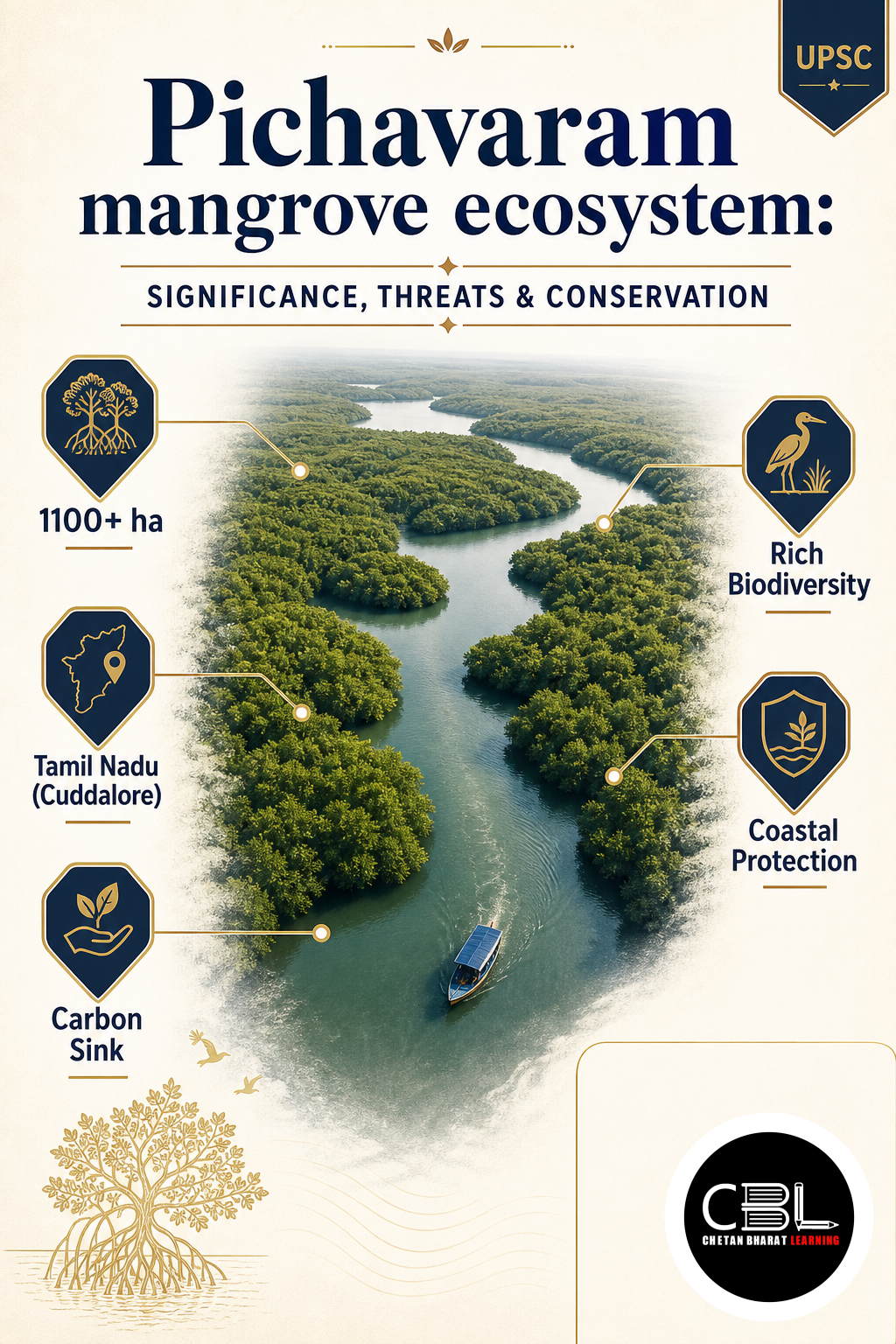
The Pichavaram mangrove ecosystem is one of the largest mangrove forests in India, located in a coastal estuary between the Vellar and Coleroon Rivers. It encompasses the Killai backwaters and connects to the Bay of Bengal through a shallow littoral passage, creating a productive brackish water environment ideal for specialized halophytic flora. Dominant species include Avicennia marina and Rhizophora with pneumatophores that facilitate gas exchange in waterlogged, anaerobic soils. The forest supports diverse fauna, including spotted deer, otters, and various migratory bird species.
Why is the Pichavaram mangrove ecosystem in News?
Recent scientific valuation assessed its Total Economic Value (TEV) at ₹2,485.38 crore, emphasizing its blue carbon stock and the monetary worth of its ecological services. It was designated as a Ramsar Site in 2022, highlighting its international importance. The broader South Indian mangrove region is classified as Critically Endangered on the IUCN Red List, underscoring urgent conservation needs.
Key Features
- Blue Carbon Sequestration: Massive carbon sink in biomass and sediments, mitigating global warming.
- Bio-shield Protection: Dense root networks dissipate wave energy, protecting inland communities from cyclones and tsunamis.
- Marine Nursery Grounds: Sheltered backwaters serve as breeding and nursery habitats for commercially important fish and crustaceans.
- Biodiversity Hotspot: Supports rich avian life, designated as an Important Bird Area (IBA) and a Ramsar Site.
- CRZ-IA Classification: Highest legal protection under Coastal Regulation Zone notifications as an Ecologically Sensitive Area.
Challenges
- Microplastic Infiltration: Riverine pollution introduces microplastics that harm the estuarine food web.
- Unregulated Shrimp Farming: Illegal aquaculture clears mangrove cover and contaminates water bodies.
- Land Conversion: Agriculture, tourism, and urban development fragment the habitat and reduce forest cover.
- Hydrological Alteration: Upstream damming and freshwater diversion reduce silt and nutrient flow essential for regeneration.
- Climate Change Impacts: Rising sea levels and cyclones threaten permanent submergence and salinity balance changes.
Way Forward
Enforce Coastal Regulation Zone norms strictly, halt illegal aquaculture and encroachment, and strengthen local forest departments for effective patrolling and microplastic mitigation. Promote sustainable, low-impact ecotourism and integrate local fishing communities into conservation efforts. Mandate transparent reporting of coastal development, leveraging scientific valuation and inclusive governance for long-term coastal resilience.
Prelims Practice Corner
Q1. With reference to the Pichavaram mangrove ecosystem, consider the following statements:
1. It is situated in a coastal estuary between the Vellar and Coleroon Rivers.
2. It was designated as a Ramsar Site in 2022.
3. The dominant species include Avicennia marina and Rhizophora.
Which of the statements given above is/are correct?
- (a) 1 only
- (b) 1 and 2 only
- (c) 2 and 3 only
- (d) 1, 2 and 3
Answer: (d) All three statements are correct regarding the location, status, and dominant species of the ecosystem.
Q2. The South Indian mangrove region, which includes Pichavaram, is classified as which of the following on the IUCN Red List of Ecosystems?
(a) Least Concern
(b) Vulnerable
(c) Endangered
(d) Critically Endangered
Answer: (d) The broader South Indian mangrove region is currently classified as Critically Endangered.
Q3. What is the primary function of pneumatophores in mangrove species like Avicennia marina?
(a) To absorb excess salt from the soil
(b) To facilitate gas exchange in waterlogged, anaerobic soils
(c) To provide structural support against strong winds
(d) To store freshwater for dry seasons
Answer: (b) Pneumatophores are aerial roots that facilitate essential gas exchange in anaerobic soils.
Q4. Under the Coastal Regulation Zone notifications, the Pichavaram mangrove ecosystem receives which level of protection?
(a) CRZ-I
(b) CRZ-IA
(c) CRZ-II
(d) CRZ-III
Answer: (b) It receives the highest possible legal protection under the CRZ-IA classification as an Ecologically Sensitive Area.
Q5. Consider the following threats to the Pichavaram mangrove ecosystem: 1. Microplastic infiltration 2. Unregulated shrimp farming 3. Hydrological alteration. Which of the above are correct?
(a) 1 and 2 only
(b) 2 and 3 only
(c) 1 and 3 only
(d) 1, 2 and 3
Answer: (d) All three are significant structural and operational threats facing the ecosystem.
Mains Practice Questions
Q1. Discuss the ecological significance of the Pichavaram mangrove ecosystem. What are the major threats to its survival? (150 words, 10 marks)
Answer Structure
- Intro: Define the ecosystem and its location between the Vellar and Coleroon Rivers.
- Body: Discuss significance (blue carbon, bio-shield, marine nursery, biodiversity) and threats (microplastics, aquaculture, land conversion, hydrological alteration).
- Conclusion: Suggest a way forward focusing on strict CRZ enforcement and community-led conservation.
Q2. The recent valuation of the Total Economic Value of the Pichavaram mangrove ecosystem highlights the need for a paradigm shift in coastal management. Critically analyze. (250 words, 15 marks)
Answer Structure
- Intro: Contextualize the TEV assessment and the Ramsar designation of the ecosystem.
- Body: Analyze the paradigm shift (valuing indirect ecological services like carbon sequestration and disaster mitigation over short-term commercial gains). Discuss challenges (illegal encroachment, climate change) and the need for sustainable ecotourism and strict regulatory frameworks.
- Conclusion: Conclude that integrating local communities and leveraging scientific valuation are essential for long-term coastal resilience.
FAQs on Pichavaram mangrove ecosystem
What makes the Pichavaram mangrove ecosystem ecologically significant?
It acts as a massive blue carbon sink, provides a natural bio-shield against cyclones and tsunamis, and serves as a crucial marine nursery ground for commercially important fish species.
Why is the Pichavaram mangrove ecosystem classified under CRZ-IA?
It is classified as an Ecologically Sensitive Area under the Coastal Regulation Zone notifications, granting it the highest level of legal protection and strictly regulating all developmental activities.
What are the primary threats to the Pichavaram mangrove ecosystem?
The major threats include microplastic infiltration, unregulated shrimp farming, land conversion for agriculture and tourism, hydrological alteration from upstream damming, and climate change impacts like rising sea levels.
Related Current Affairs
Preparing for UPSC, PCS or HCS?
Talk to a mentor at Chetan Bharat Learning, Chandigarh. Free guidance on choosing the right exam and building a study plan.
Chat on WhatsAppCall 97793 53345UPSC / IAS / PCS coaching in Chandigarh · Trusted by aspirants across Punjab & Haryana
Leave a Reply
You must be logged in to post a comment.