
UPSC Mapping
- Prelims: Polity & Economy
- Mains: GS Paper 2 & 3
The management of state finances faces severe stress as provincial courts mandate massive retrospective salary payments to government employees who have patiently waited for their statutory dues. The Punjab administration recently approached the Supreme Court challenging a High Court directive to clear pending dearness allowance arrears within a fortnight, arguing that such sudden withdrawals would inevitably cripple essential public services and halt critical infrastructure projects. Students can track similar governance updates in our daily current affairs archive regularly to understand how policymakers balance fundamental employee rights with broader fiscal sustainability in a developing economy.
Quick Facts
| Arrear Amount | Rs 14,191 Crore |
|---|---|
| Directive | HC Fortnight Order |
| Legal Route | Special Leave Petition |
| Core Conflict | Rights vs Capacity |
What is state finances?
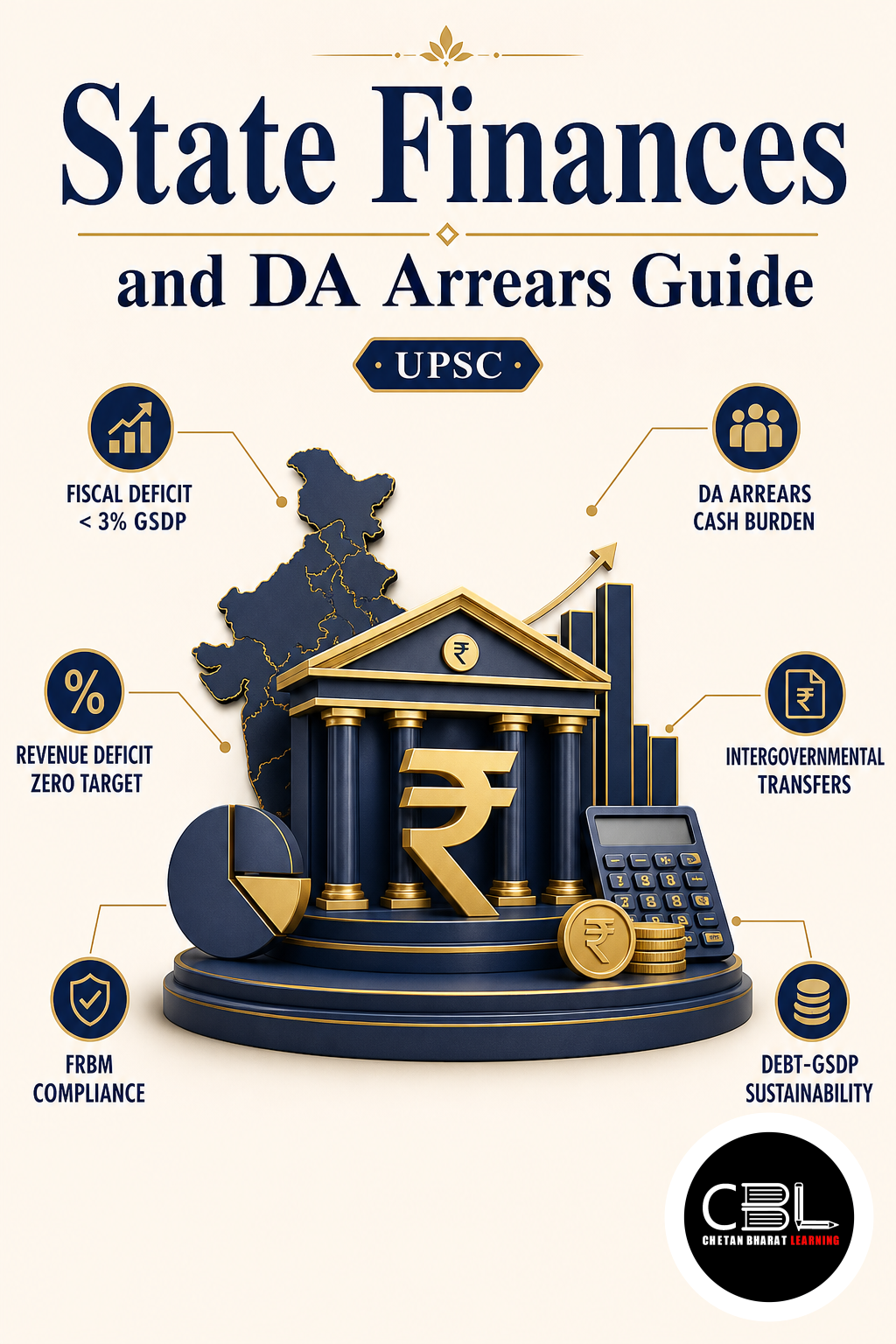
The term state finances refers to the comprehensive management of revenue generation and public expenditure by provincial governments operating under strict constitutional frameworks and fiscal responsibility legislation. Administrations must continuously balance recurring welfare commitments against long-term capital investments to ensure that current legal obligations do not compromise future developmental goals or intergenerational equity. The Fiscal Responsibility and Budget Management Act strictly limits annual borrowing to maintain macroeconomic stability, prevent excessive debt accumulation, and ensure that borrowed funds finance productive assets rather than consumption.
Dearness Allowance and Dearness Relief form crucial components of this recurring expenditure framework by protecting the real purchasing power of public servants against the erosive impact of rising retail inflation. However, delaying these statutory payments creates massive contingent liabilities that eventually burden the public exchequer, distort accurate fiscal accounting, and force governments to pay substantial interest on delayed amounts. Provincial treasuries must categorize their spending into revenue and capital accounts to ensure transparent accounting and avoid crowding out productive asset creation that drives long-term regional economic growth.
Why is state finances in News?
The Punjab government recently moved the apex court seeking an interim stay on a High Court verdict that mandated the immediate release of Rs 14,191 crore towards pending employee dues within an extremely short fifteen-day window. The provincial administration argued that compliance within the allocated timeframe is practically impossible without severely damaging regional macroeconomic stability, halting ongoing developmental projects, and defaulting on other essential statutory obligations. You can review constitutional provisions via this Supreme Court portal for precise legal frameworks governing executive financial obligations and the separation of powers between the judiciary and the executive.
This intense legal battle highlights the growing tension between judicial mandates enforcing statutory rights and the limited executive fiscal capacity available to provincial governments struggling with stagnant tax revenues. Employees argue that delayed payments violate their fundamental right to fair compensation, while state treasuries warn that forced sudden payouts will trigger severe liquidity crises and force abrupt cuts in rural welfare schemes. The provincial employees have already filed a caveat in the apex court to protect their interests ahead of the scheduled contempt petition hearings, setting the stage for a complex constitutional debate.
Key Features
- Revenue Dominance: Salaries, pensions, and interest payments heavily dominate provincial budgets, leaving extremely limited room for new capital asset creation and severely restricting the government’s ability to respond to unexpected economic shocks.
- Judicial Directives: Courts frequently intervene to enforce statutory employee rights while often disregarding the broader macroeconomic constraints faced by elected governments, thereby creating an inherent structural conflict between legal mandates and financial realities.
- Contingent Liabilities: Unpaid arrears accumulate silently over years and eventually transform into massive debt burdens that trigger severe fiscal crises, forcing administrations to divert crucial development funds towards clearing historical dues.
- FRBM Constraints: Fiscal Responsibility legislation mandates strict deficit targets and legally restricts the ability of governments to borrow for recurring revenue spending, ensuring that debt is primarily utilized for productive capital formation.
- Inflation Indexation: The core purpose of these specific allowances is to neutralize the erosive impact of retail inflation on fixed public salaries, ensuring that government servants can maintain a basic standard of living.
Challenges
- High Commitments: A massive portion of total revenue is pre-committed to salaries and interest, severely shrinking the available fiscal space for new welfare schemes and critical infrastructure development.
- Capital Crowding: Forced arrears payments inevitably divert crucial funds away from roads, hospitals, and critical school infrastructure, thereby stalling long-term economic growth and reducing regional competitiveness.
- Borrowing Limits: Strict central regulations prevent states from undertaking unlimited market borrowing to finance sudden and massive judicial payouts mandated by higher courts, forcing difficult reallocation decisions.
- Political Pressures: Electoral compulsions frequently force administrations to announce unsustainable freebies that severely degrade long-term financial health and increase future debt burdens for subsequent governments.
- Stagnant Revenues: Provincial governments lack the sovereign taxation powers required to rapidly generate additional resources during unexpected economic downturns or sudden financial shocks triggered by external factors.
For deeper insights into sustainable regional development and fiscal management, explore our economy section.
Way Forward
The administration must implement medium-term fiscal plans to gradually phase in retrospective payments without shocking the treasury, disrupting essential public services, or violating the core tenets of fiscal responsibility legislation. Establishing dedicated sinking funds will help governments smoothly manage future salary revisions and pension obligations without resorting to emergency market borrowing that crowds out private investment. Providing realistic timelines in judicial orders will drastically improve compliance rates, protect the broader macroeconomic stability of the province, and foster a more cooperative relationship between the judiciary and the executive.
Check the latest RBI state finances report for strategic debt management recommendations and structural reform guidelines tailored for provincial governments seeking to optimize their revenue expenditure. The government must periodically review the baseline methodologies to ensure they reflect current economic realities, demographic shifts affecting public employment, and the evolving needs of a modernizing administrative machinery. Continuous refinement of state finances will guarantee that the initiative delivers genuine public welfare without bankrupting the exchequer, compromising future generations, or undermining the sovereign credit rating of the nation.
Prelims Practice Corner
-
Q1. Which legal mechanism did the Punjab government utilize to approach the Supreme Court against the High Court order?
- (a) Writ Petition
- (b) Special Leave Petition
- (c) Public Interest Litigation
- (d) Review Petition
Answer: (b) The state government filed a Special Leave Petition (SLP) seeking an interim stay on the HC verdict.
-
Q2. What is the primary purpose of Dearness Allowance (DA) for government employees?
- (a) Rewarding performance
- (b) Compensating for inflation
- (c) Covering travel expenses
- (d) Funding housing loans
Answer: (b) DA protects the real purchasing power of public servants against the erosive impact of rising retail inflation.
-
Q3. Under which category of expenditure do salary and pension payments fall in the government budget?
- (a) Capital Expenditure
- (b) Revenue Expenditure
- (c) Plan Expenditure
- (d) Developmental Expenditure
Answer: (b) Salaries and pensions are recurring costs that fall under Revenue Expenditure, as they do not create physical assets.
-
Q4. Which Act primarily restricts the borrowing limits of state governments to maintain fiscal discipline?
- (a) FEMA Act
- (b) FRBM Act
- (c) RBI Act
- (d) SEBI Act
Answer: (b) The Fiscal Responsibility and Budget Management (FRBM) Act mandates strict deficit targets for both central and state governments.
-
Q5. What does the term ‘fiscal space’ refer to in macroeconomic governance?
- (a) Physical office space
- (b) Budgetary room for policy actions
- (c) Foreign exchange reserves
- (d) Tax collection infrastructure
Answer: (b) Fiscal space is the budgetary room a government has to provide resources for a desired purpose without jeopardizing financial sustainability.
Mains Practice Questions
Q1. “Judicial mandates enforcing employee rights often conflict with the executive’s fiscal capacity.” Analyze this statement in the context of recent state arrears disputes. (10 marks)
Answer Structure:
- Intro: Define the core tension between statutory employee rights and the macroeconomic constraints faced by provincial treasuries.
- Body: Discuss the accumulation of contingent liabilities, the crowding out of capital expenditure, and the structural limitations imposed by FRBM legislation on state borrowing.
- Conclusion: Conclude that courts must consider realistic implementation timelines to balance individual justice with broader public welfare and macroeconomic stability.
Q2. Distinguish between Revenue and Capital Expenditure. Why is the continuous diversion of funds towards revenue commitments detrimental to long-term state finances? (15 marks)
Answer Structure:
- Intro: Clearly define Revenue Expenditure (recurring, non-asset creating) and Capital Expenditure (asset creating, growth-oriented).
- Body: Analyze how high committed liabilities (salaries, pensions, interest) shrink fiscal space, leading to capital starvation, lower infrastructure quality, and reduced future revenue generation capacity.
- Conclusion: Suggest structural reforms like dedicated sinking funds and medium-term fiscal plans to ensure intergenerational equity and sustainable regional development.
FAQs on state finances
How do arrears affect state finances?
Unpaid arrears accumulate as massive contingent liabilities that eventually force governments to divert crucial development funds towards clearing historical dues. This sudden reallocation severely disrupts capital infrastructure projects and damages regional macroeconomic stability.
What is the difference between DA and DR?
Dearness Allowance (DA) is paid to current government employees to offset inflation, while Dearness Relief (DR) is the equivalent payment made to pensioners and family pensioners to protect their post-retirement purchasing power.
Can states borrow unlimited funds to pay these arrears?
No, state borrowing is strictly regulated by the Fiscal Responsibility and Budget Management (FRBM) Act and requires central government permission under Article 293 of the Constitution. This prevents provinces from taking on unsustainable debt burdens.
Related Current Affairs
Preparing for UPSC, PCS or HCS?
Talk to a mentor at Chetan Bharat Learning, Chandigarh. Free guidance on choosing the right exam and building a study plan.
Chat on WhatsAppCall 97793 53345UPSC / IAS / PCS coaching in Chandigarh · Trusted by aspirants across Punjab & Haryana
Leave a Reply
You must be logged in to post a comment.