

UPSC Mapping
| Exam | Descriptor |
|---|---|
| Prelims | Polity / Current Affairs |
| Mains | GS Paper II – Constitution, Social Justice |
Quick Facts
| Key case | Indra Sawhney v. Union of India (1992) |
|---|---|
| Constitutional provisions | Articles 15(4), 16(4) |
| Concept | Creamy layer exclusion |
What is OBC Creamy Layer?
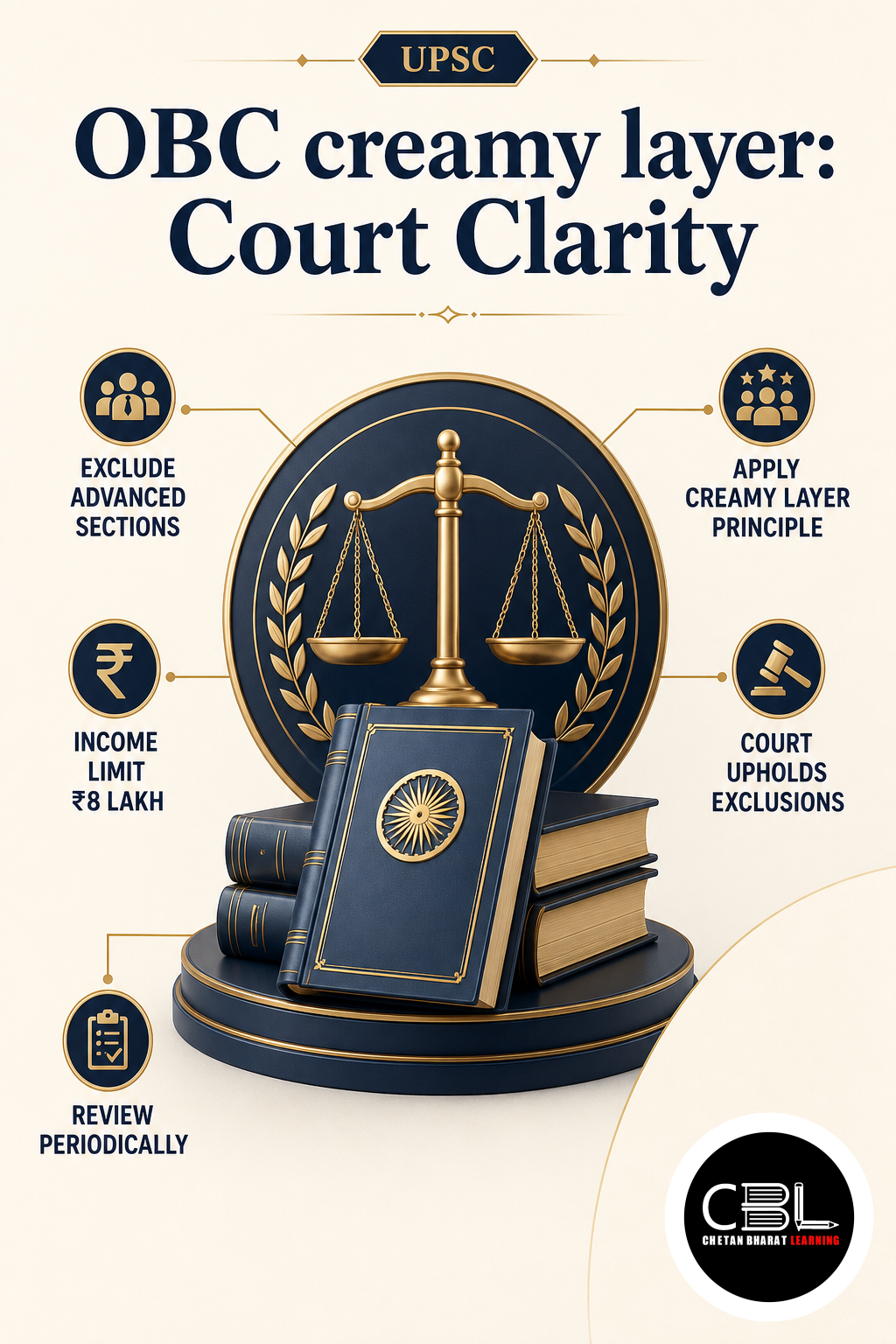
OBC creamy layer refers to the relatively wealthier and better-educated section within the Other Backward Classes that is excluded from reservation benefits. The concept was introduced by the Supreme Court in the Indra Sawhney case of 1992. It ensures that the benefits of reservation reach the genuinely backward among OBCs.
The creamy layer is determined using income and status criteria, such as government officers above a certain rank or families with income above a specified limit. The current issue arises because the government wants judicial clarity on whether the creamy layer principle can be applied to Scheduled Castes and Scheduled Tribes as well. This has created a legal dilemma about the scope of affirmative action.
Why is OBC Creamy Layer in News?
OBC creamy layer is in news because the government has approached the Supreme Court seeking clarity on the ‘rules of the game’ for identifying creamy layer among OBCs and possibly SCs/STs. The court’s interpretation will define the future of reservation policy in India. It also raises the core legal dilemma of balancing equality and affirmative action.
The PIB release indicates that the government wants uniform and transparent criteria to avoid litigation and ensure social justice. The outcome will affect millions of aspirants and shape electoral politics.
Key Features
The creamy layer issue has several important dimensions for UPSC polity and social justice.
- Indra Sawhney case: The Supreme Court upheld 27% OBC reservation but directed exclusion of creamy layer.
- Articles 15(4) and 16(4): These allow special provisions for socially and educationally backward classes in education and public employment.
- Income threshold: The current creamy layer income limit is revised periodically by the central government.
- Rules of the game: The court’s clarity will determine how creamy layer is identified and applied across categories.
- Legal dilemma: The main question is whether the creamy layer principle should extend to SCs and STs, who face untouchability even when economically better off.
Challenges
Applying the creamy layer concept raises several social and constitutional challenges.
- Social vs economic backwardness: SCs and STs face caste-based discrimination that does not disappear with income improvement.
- Verification issues: Determining income and status reliably remains difficult, leading to false inclusions or exclusions.
- Political sensitivity: Any change in reservation criteria can cause social unrest and political backlash.
- Federal complexity: Different states have different creamy layer norms, creating inconsistency.
- Judicial overreach concerns: The judiciary must balance its role in defining social policy with legislative competence.
Way Forward
The Supreme Court should provide clear guidelines on the creamy layer principle while respecting the distinct nature of caste-based discrimination for SCs and STs. The government could set up an expert committee to study the issue and propose uniform criteria. Public consultation and data-driven policy can help build consensus.
The Supreme Court of India is expected to hear the matter in detail. A balanced approach that protects genuine beneficiaries while preventing misuse of reservation is essential for social justice.
Prelims Practice Corner
Q1. In which case did the Supreme Court introduce the creamy layer concept?
- (a) Kesavananda Bharati
- (b) Indra Sawhney v. Union of India
- (c) Golaknath
- (d) Maneka Gandhi
Answer: (b) Indra Sawhney v. Union of India (1992).
Q2. Which articles allow special provisions for backward classes?
- (a) Articles 14 and 15
- (b) Articles 15(4) and 16(4)
- (c) Articles 19 and 21
- (d) Articles 29 and 30
Answer: (b) Articles 15(4) and 16(4).
Q3. What is the creamy layer?
- (a) Top layer of milk
- (b) Affluent section among OBCs
- (c) Government scheme
- (d) Judicial body
Answer: (b) Affluent section among OBCs excluded from reservation.
Q4. Which factor is primarily used to determine creamy layer status?
- (a) Caste only
- (b) Income and government rank
- (c) Religion
- (d) Language
Answer: (b) Income and government rank.
Q5. The current legal demand is clarity on applying creamy layer to which groups?
- (a) General category
- (b) SCs and STs
- (c) EWS
- (d) Minorities
Answer: (b) SCs and STs.
Mains Practice Questions
Q1. Discuss the constitutional basis of the creamy layer principle and its significance for social justice. (15 marks)
Answer Structure:
- Intro: Mention Indra Sawhney and constitutional provisions.
- Body: Cover rationale, income criterion, backwardness and equality, judicial interpretation.
- Conclusion: Suggest balanced reform.
Q2. Examine the legal dilemma in extending the creamy layer principle to Scheduled Castes and Scheduled Tribes. (10 marks)
Answer Structure:
- Intro: Define creamy layer and current demand.
- Body: Analyse caste discrimination vs economic uplift, social stigma, judicial and legislative roles.
- Conclusion: Recommend nuanced policy.
FAQs on OBC Creamy Layer
What is the OBC creamy layer?
The OBC creamy layer is the affluent section within OBCs excluded from reservation benefits to help the genuinely backward.
Why does the government want court clarity?
The government wants clear rules on which categories should be excluded and whether creamy layer applies to SCs and STs.
Which landmark case introduced the creamy layer?
The Indra Sawhney v. Union of India (1992) case introduced the creamy layer concept for OBC reservation.
Related Current Affairs
Preparing for UPSC, PCS or HCS?
Talk to a mentor at Chetan Bharat Learning, Chandigarh. Free guidance on choosing the right exam and building a study plan.
Chat on WhatsAppCall 97793 53345UPSC / IAS / PCS coaching in Chandigarh · Trusted by aspirants across Punjab & Haryana
Leave a Reply
You must be logged in to post a comment.