

UPSC Mapping
| Exam | Topic |
|---|---|
| Prelims | Disaster Management / Geography |
| Mains | GS Paper III – Disaster Management, Environment |
Quick Facts
| Location | Conakry, Guinea |
| Casualties | At least 30 killed |
| Trigger | Heavy rains |
| Site type | Major waste site |
What is Guinea Landfill Collapse?
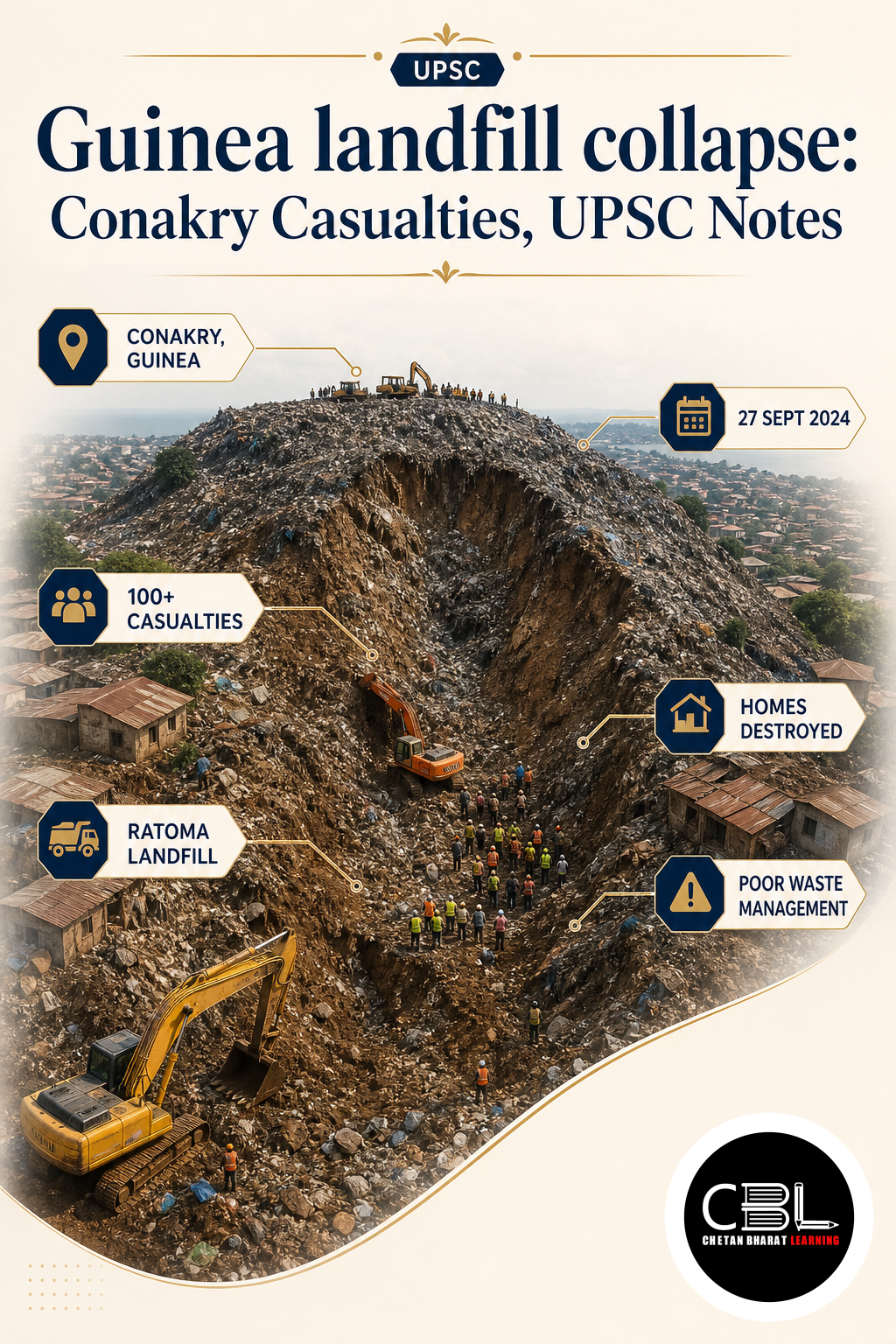
Guinea landfill collapse refers to the failure of a major waste site in Conakry, the capital of Guinea, following heavy rainfall. The collapse buried people and structures under waste material and caused at least 30 deaths. Such events occur when loose waste becomes saturated, unstable and unable to hold its slope.
Why is Guinea Landfill Collapse in News?
Guinea landfill collapse is in news because at least 30 people were killed after a major waste site collapsed following heavy rains in Conakry. The incident draws attention to weak solid waste management and the growing risk of climate-related urban disasters in West Africa. Rescue operations are often complicated by unstable debris and the presence of hazardous material.
The Al Jazeera report emphasises the human cost of poorly managed waste sites. The collapse also raises questions about housing safety, early warning and sanitation in rapidly growing cities.
Key Features
- Heavy rain trigger: Intense rainfall saturated the waste site and triggered its collapse.
- High fatalities: At least 30 people lost their lives in the collapse.
- Urban waste site: The incident occurred at a major waste disposal location in Conakry.
- Vulnerable proximity: People and informal settlements were located near the unstable site.
- Complex rescue: Unstable waste and hazardous materials slowed search and recovery operations.
Challenges
- Waste site stability: Poor compaction, drainage and slope management increase the risk of collapse.
- Unsafe settlements: Housing near waste sites leaves poor communities exposed to sudden landslides and toxic exposure.
- Drainage gaps: Inadequate stormwater systems allow heavy rain to destabilise waste mounds.
- Rescue capacity: Local emergency teams may lack heavy equipment, training and medical support for mass casualty events.
- Health risks: Decomposing waste and contaminated water can spread disease after the collapse.
Way Forward
Guinea and other developing countries should invest in waste site engineering, drainage systems and regular stability assessments. Early warning systems and land-use planning can keep residential areas away from hazardous dumpsites. Waste reduction, recycling and controlled disposal must be integrated into urban development plans.
The United Nations Environment Programme can support technical advice on sustainable waste management and disaster risk reduction. International cooperation and local community awareness are essential to prevent similar tragedies.
Prelims Practice Corner
Q1. The Guinea landfill collapse occurred in which city?
(a) Lagos (b) Conakry (c) Accra (d) Nairobi
Answer: (b) Conakry.
Q2. What triggered the waste site collapse?
(a) Earthquake (b) Heavy rains (c) Volcanic eruption (d) Cyclone
Answer: (b) Heavy rains.
Q3. How many people were reported killed in the collapse?
(a) 10 (b) 20 (c) At least 30 (d) 50
Answer: (c) At least 30.
Q4. A landfill collapse is best classified under which type of disaster?
(a) Biological (b) Industrial and anthropogenic (c) Astronomical (d) Extra-terrestrial
Answer: (b) Industrial and anthropogenic disaster.
Q5. Which measure can reduce landfill collapse risk?
(a) Removing drainage systems (b) Regular stability assessment and drainage (c) Building homes closer to waste sites (d) Reducing waste collection
Answer: (b) Regular stability assessment and proper drainage.
Mains Practice Questions
Q1. Analyse the causes and consequences of landfill collapses in urban areas. (15 marks)
Answer Structure
- Intro: Mention the Conakry collapse and its trigger.
- Body: Cover heavy rain, poor drainage, weak waste site design, unsafe settlements and health impacts.
- Conclusion: Suggest engineering measures and urban planning.
Q2. Discuss the role of disaster risk reduction in managing waste-related hazards in developing countries. (10 marks)
Answer Structure
- Intro: Define disaster risk reduction and link to waste hazards.
- Body: Discuss early warning, land-use zoning, waste site monitoring, community awareness and international support.
- Conclusion: Emphasise prevention and sustainable waste management.
FAQs on Guinea Landfill Collapse
What happened in the Guinea landfill collapse?
A major waste site in Conakry collapsed after heavy rains, killing at least 30 people.
What caused the waste site to collapse?
Heavy rainfall saturated the waste material and destabilised the site, causing it to give way.
Why are landfill collapses dangerous?
Landfill collapses can bury people under waste, spread disease and release hazardous materials, while rescue is slow and risky.
Related Current Affairs
Preparing for UPSC, PCS or HCS?
Talk to a mentor at Chetan Bharat Learning, Chandigarh. Free guidance on choosing the right exam and building a study plan.
Chat on WhatsAppCall 97793 53345UPSC / IAS / PCS coaching in Chandigarh · Trusted by aspirants across Punjab & Haryana
Leave a Reply
You must be logged in to post a comment.