
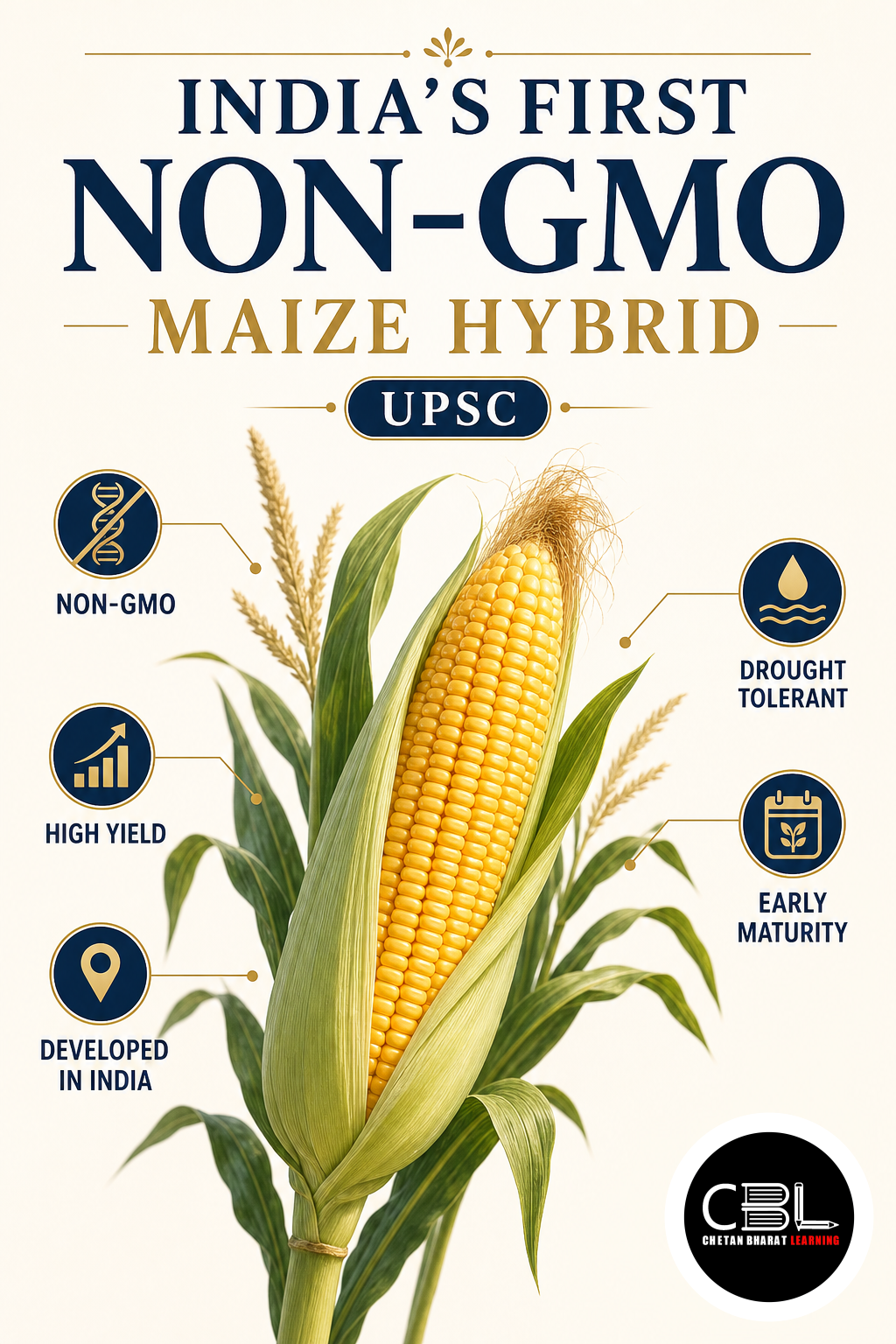

UPSC Mapping
| Prelims | Mains |
|---|---|
| Agriculture & Science | GS Paper III |
Quick Facts
| Varieties | Krisna459, Godari234 |
|---|---|
| Type | Popcorn maize (non-GMO) |
| Launch State | Andhra Pradesh |
What are Non-GMO Maize Hybrids?
Non-GMO maize hybrids are cross-bred varieties developed through conventional breeding techniques without genetic modification. The newly launched hybrids, Krisna459 and Godari234, are popcorn maize, meaning their kernels have a hard outer covering and moisture that causes them to pop upon heating. Unlike ordinary maize, these hybrids have been specially bred for high expansion and quality.
Non-GMO status is significant because it assures consumers and regulators that the product does not contain genetically engineered ingredients. The non-GMO maize hybrid development used traditional crossing and selection, involving no transgenic methods, making it suitable for organic and conventional farming systems.
Why are Non-GMO Maize Hybrids in News?
The launch of India’s first non-GMO maize hybrid popcorn seeds has been in the news because it promises to reduce India’s dependence on imported hybrid popcorn seed technology. The Vice-President launched the varieties at Musunuru in Eluru district, Andhra Pradesh, highlighting their potential for domestic popcorn production.
This development aligns with the government’s push for self-reliance in agriculture and reducing import bills. Popcorn cultivation can also provide better remuneration to farmers compared to feed maize. For official announcements, refer to the PIB release on the launch.
Key Features of Non-GMO Maize Hybrids
- High popping expansion: Bred for high expansion volume, essential for commercial popcorn production.
- Conventional breeding: Developed without genetic engineering, using traditional cross-breeding and selection methods.
- Adaptability: Suitable for cultivation in Andhra Pradesh and potentially other states with similar agro-climatic conditions.
- Import substitution: Reduces reliance on imported hybrid seeds, saving foreign exchange.
- Farmer benefit: Popcorn fetches a premium price, improving farm incomes.
Challenges for Non-GMO Maize Hybrid Adoption
- Limited awareness: Many farmers are unaware of popcorn maize cultivation techniques and market opportunities.
- Processing infrastructure: Popcorn requires specific processing and cleaning equipment, which is not widely available.
- Market linkages: Lack of organized marketing channels for popcorn can hinder profitability.
- Seed availability: Ensuring sufficient seed production and distribution to reach all potential growers.
- Yield risks: Popcorn maize is more sensitive to stress and may have lower yields than feed maize.
Way Forward for Non-GMO Maize Hybrids
To scale up the non-GMO maize hybrid initiative, the government should establish demonstration plots and training programs for farmers in potential popcorn-growing regions. Public-private partnerships can develop processing and marketing infrastructure, while research institutions can breed more region-specific varieties.
Creating a brand for Indian popcorn and linking it to GI tags could enhance market value. Export opportunities in the growing global snack market should also be explored. For international best practices on popcorn production, refer to the FAO on specialty maize.
Prelims Practice Corner
-
Q1. What are the names of India’s first non-GMO popcorn maize hybrid seeds?
(a) Pusa-100 and Pusa-200 (b) Krisna459 and Godari234 (c) HHM-1 and HHM-2 (d) NK-101 and NK-102
Answer: (b) Krisna459 and Godari234 were launched in Andhra Pradesh.
-
Q2. What does non-GMO mean in the context of these hybrids?
(a) They are genetically modified (b) They are developed without genetic engineering (c) They are organic (d) They are imported
Answer: (b) Non-GMO means produced without genetic engineering, using conventional breeding.
-
Q3. In which state were these seeds launched?
(a) Karnataka (b) Maharashtra (c) Andhra Pradesh (d) Punjab
Answer: (c) The launch took place at Musunuru in Eluru district, Andhra Pradesh.
-
Q4. Why is popcorn maize different from ordinary maize?
(a) It has higher oil content (b) Its kernels have a hard outer covering and moisture that allows popping (c) It is sweeter (d) It has larger kernels
Answer: (b) Popcorn kernels have a hard endosperm and moisture that expands upon heating.
-
Q5. What is the primary advantage of these hybrids for India?
(a) They are drought-resistant (b) They reduce dependence on imported popcorn seed technology (c) They have higher yield than all other maize (d) They are pest-resistant
Answer: (b) They reduce reliance on imported hybrid popcorn seed technology.
Mains Practice Questions
-
Q1. Examine the role of conventional plant breeding in achieving self-reliance in India’s seed sector, with reference to the recent non-GMO maize hybrid launch. (15 marks)
Answer Structure:
Intro: Highlight the importance of seed sector and the distinction between GMO and non-GMO.
Body: Discuss the benefits of conventional breeding—consumer acceptance, regulatory ease, and biodiversity. Evaluate the potential of popcorn hybrids for income generation and import substitution. Address challenges.
Conclusion: Suggest policy support for breeder seed production, farmer training, and market development.
-
Q2. What are the opportunities and challenges for promoting specialty maize cultivation in India? (10 marks)
Answer Structure:
Intro: Define specialty maize (popcorn, sweet corn, etc.) and its market.
Body: List opportunities—premium prices, export potential, value addition. Challenges—infrastructure, market linkages, yield sensitivity. Suggest measures.
Conclusion: Stress the need for integrated crop management and public-private partnerships.
FAQs on Non-GMO Maize Hybrid
- What is the difference between GMO and non-GMO maize?
- GMO maize is produced using genetic engineering to introduce foreign genes. Non-GMO maize is developed through conventional breeding without altering the genetic makeup beyond natural recombination.
- Why is popcorn maize important?
- Popcorn is a high-value snack crop with growing demand. India currently imports popcorn, so domestic production can save foreign exchange and boost farmer incomes.
- Can these hybrids be grown across India?
- They were bred for conditions in Andhra Pradesh, but with research, adapted varieties could be developed for other regions. Farmers should consult local agricultural universities for suitability.
Related Current Affairs
Preparing for UPSC, PCS or HCS?
Talk to a mentor at Chetan Bharat Learning, Chandigarh. Free guidance on choosing the right exam and building a study plan.
Chat on WhatsAppCall 97793 53345UPSC / IAS / PCS coaching in Chandigarh · Trusted by aspirants across Punjab & Haryana
Leave a Reply
You must be logged in to post a comment.