
UPSC Mapping
This topic is relevant for the following UPSC papers:
| Prelims | Environment & Geography |
|---|---|
| Mains | GS Paper 1 & 3 |
Article
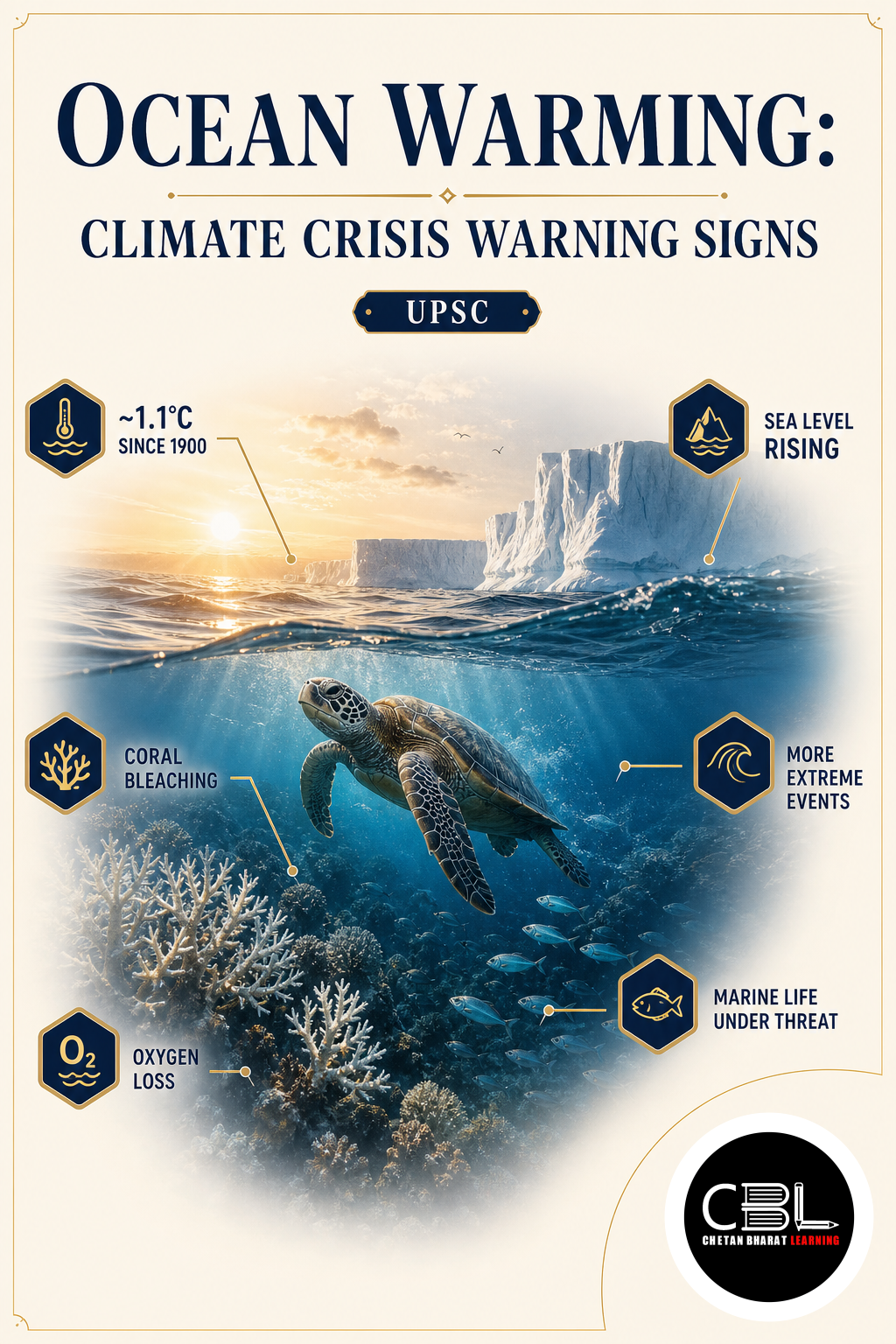
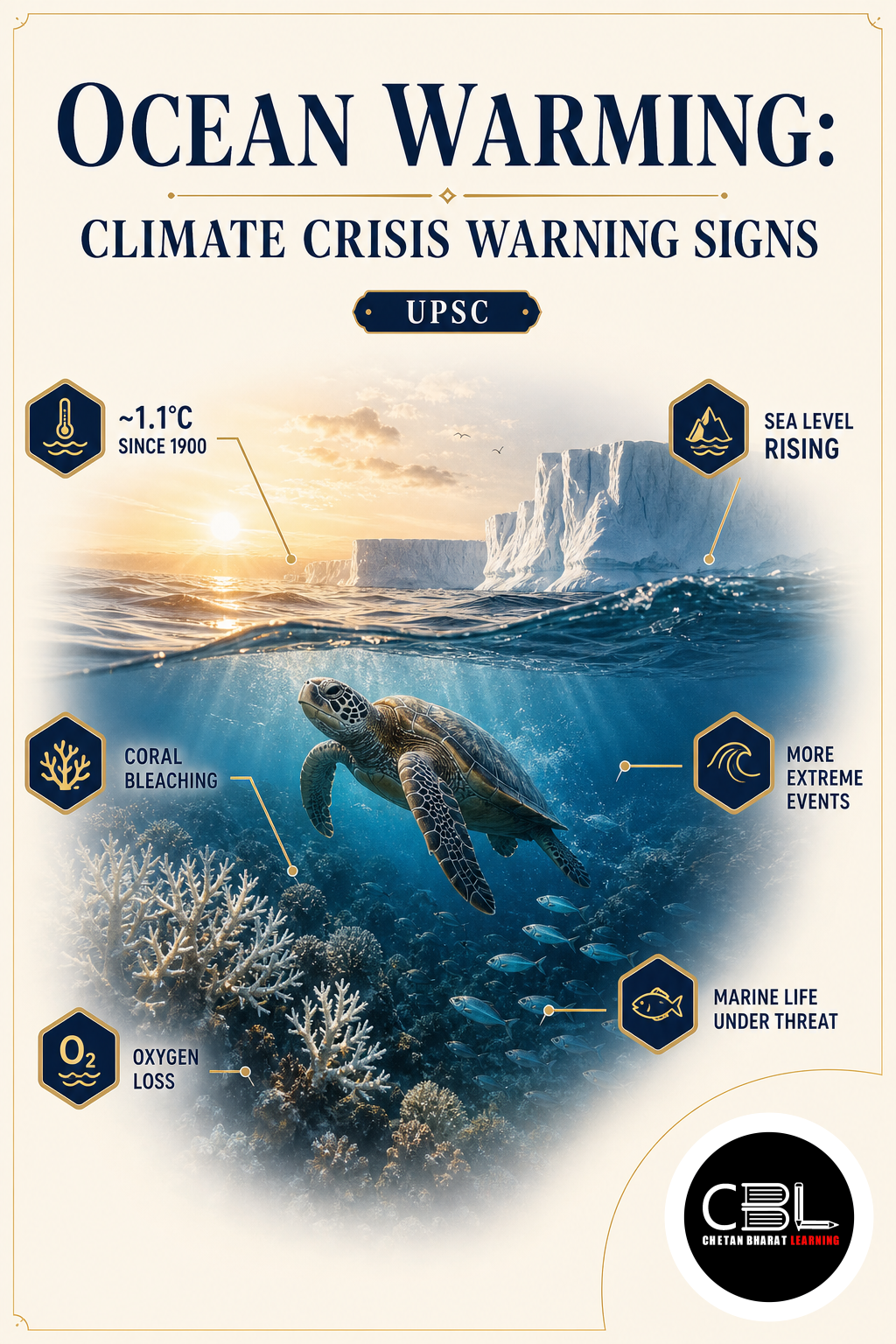
Global ocean warming has reached alarming new records, with sea surface temperatures spiking to 21.1 °C on August 22, surpassing the previous record of 21.09 °C set in March 2024. This acceleration signals that global heating is moving climate into unfamiliar territory, with oceans absorbing more than 90% of excess heat generated by global warming.
Quick Facts
| Record SST (Aug 22) | 21.1 °C |
|---|---|
| Excess Heat Absorbed | Over 90% |
| Sea Level Rise (1993–2025) | ~11 cm |
What is Ocean Warming?
Ocean warming refers to the increase in the average temperature of the world’s oceans, driven primarily by anthropogenic greenhouse gas emissions. The oceans act as a massive heat sink, absorbing over 90% of the excess heat generated by global warming.
This warming is not limited to surface temperatures; ocean heat content (OHC) measures accumulated thermal energy across all depths. Recent records show that June and July 2026 each surpassed previous monthly averages, indicating a sustained warming trend.
Why is Ocean Warming in the News?
On August 22, 2026, a rapidly intensifying El Niño combined with global warming to spike marine temperatures to 21.1 °C, setting a new record. This follows a pattern of repeated record-breaking months, with June and July 2026 also surpassing previous averages.
The warming is upending the ocean calendar—oceans are typically at their warmest in March and April. According to an IPCC report, the oceans’ ability to buffer climate change is coming at a cost, affecting marine ecosystems, weather patterns, and sea levels.
Key Features of Ocean Warming
- Sea Surface Temperature Rise: Global average SST has reached 21.1 °C, with records being broken repeatedly.
- Ocean Heat Content Increase: Thermal energy stored in oceans continues to rise, with long-term warming trends across all depths.
- Marine Heatwaves: Extended periods of anomalously warm ocean temperatures are becoming more frequent and intense.
- Thermal Expansion: Warming causes seawater to expand, contributing to sea level rise.
- Polar Amplification: Polar regions are warming faster, affecting ice sheets and global circulation patterns.
Challenges Posed by Ocean Warming
- Marine Ecosystem Disruption: Coral bleaching, species migration, and food web disruption threaten marine biodiversity.
- Sea Level Rise: Thermal expansion and melting ice contribute to rising sea levels, threatening coastal communities.
- Weather Pattern Changes: Ocean warming affects monsoon patterns, cyclones, and extreme weather events.
- Fisheries Impact: Changes in marine habitats affect fish stocks, impacting livelihoods and food security.
- Ocean Acidification: CO₂ absorption leads to acidification, affecting shell-forming organisms and marine ecosystems.
Way Forward for Addressing Ocean Warming
Mitigation remains critical: cutting fossil fuel consumption, accelerating the clean energy transition, and reducing greenhouse gas emissions are essential. However, even with sharp emission reductions, the consequences of past warming will persist for years.
India, with a coastline of over 10,000 km, must invest in coastal protection, restoring natural barriers, improving urban drainage, and developing climate-informed agriculture. As suggested by a Ministry of Earth Sciences report, improving climate resilience cannot be postponed.
Prelims Package
Prelims Practice Corner
Q1. What was the record sea surface temperature recorded on August 22, 2026?
- (a) 20.5 °C
- (b) 21.0 °C
- (c) 21.1 °C
- (d) 21.5 °C
- Answer: (c) Global sea surface temperature reached 21.1 °C on August 22, 2026.
Q2. What percentage of excess heat from global warming have the oceans absorbed?
- (a) 50%
- (b) 70%
- (c) 90%
- (d) 100%
- Answer: (c) According to IPCC, oceans have absorbed more than 90% of excess heat from global warming.
Q3. What is the primary cause of ocean warming?
- (a) Natural ocean cycles
- (b) Anthropogenic greenhouse gas emissions
- (c) Volcanic activity
- (d) Solar radiation changes
- Answer: (b) Human-induced greenhouse gas emissions are the primary driver of ocean warming.
Q4. What is the estimated sea level rise since 1993 due to ocean warming and ice melt?
- (a) 5 cm
- (b) 11 cm
- (c) 15 cm
- (d) 20 cm
- Answer: (b) Global average sea level was about 11 cm higher by end of 2025 than in January 1993.
Q5. Which of the following is NOT a consequence of ocean warming?
- (a) Coral bleaching
- (b) Sea level rise
- (c) Reduced atmospheric CO₂
- (d) Marine ecosystem disruption
- Answer: (c) Ocean warming does not reduce atmospheric CO₂; it results from increased CO₂ absorption.
Mains Package
Mains Practice Questions
Q1. “Ocean warming is an indicator of accelerating climate change with profound implications for India.” Discuss the causes, impacts, and policy responses. (15 Marks)
- Answer Structure:
- Intro: Contextualize ocean warming as a key indicator of climate change.
- Body: Discuss causes (GHG emissions, El Niño), impacts on marine ecosystems, monsoons, sea levels, and India’s coastal vulnerability. Include adaptation and mitigation measures.
- Conclusion: Emphasise the need for integrated climate action combining mitigation and adaptation.
Q2. Examine the relationship between ocean warming and India’s monsoon variability. (10 Marks)
- Answer Structure:
- Intro: Briefly explain the link between ocean temperatures and monsoon dynamics.
- Body: Discuss how ocean warming affects land-sea thermal contrast, atmospheric circulation, ENSO, and IOD, and their impact on monsoon rainfall patterns.
- Conclusion: Suggest policy responses for climate-resilient agriculture and water management.
FAQs
What is ocean warming?
Ocean warming refers to the increase in global ocean temperatures driven by anthropogenic greenhouse gas emissions, with the oceans absorbing over 90% of excess heat from global warming.
How does ocean warming affect India?
Ocean warming affects India through monsoon variability, sea level rise, coastal erosion, fisheries impact, and increased cyclone intensity, threatening coastal communities and livelihoods.
What is the difference between SST and ocean heat content?
Sea Surface Temperature (SST) measures surface conditions, while Ocean Heat Content (OHC) measures accumulated thermal energy across all depths, providing a more comprehensive measure of ocean warming.
Related Current Affairs
Preparing for UPSC, PCS or HCS?
Talk to a mentor at Chetan Bharat Learning, Chandigarh. Free guidance on choosing the right exam and building a study plan.
Chat on WhatsAppCall 97793 53345UPSC / IAS / PCS coaching in Chandigarh · Trusted by aspirants across Punjab & Haryana
Leave a Reply
You must be logged in to post a comment.