

UPSC Mapping
| Prelims | Mains |
|---|---|
| Agriculture & Farmer Welfare | GS Paper 3 (Agriculture & Food Security) |
| Launch | Budget (2026-27) |
|---|---|
| September 2018 | ₹7,200 crore |
What is the PM-AASHA Scheme?
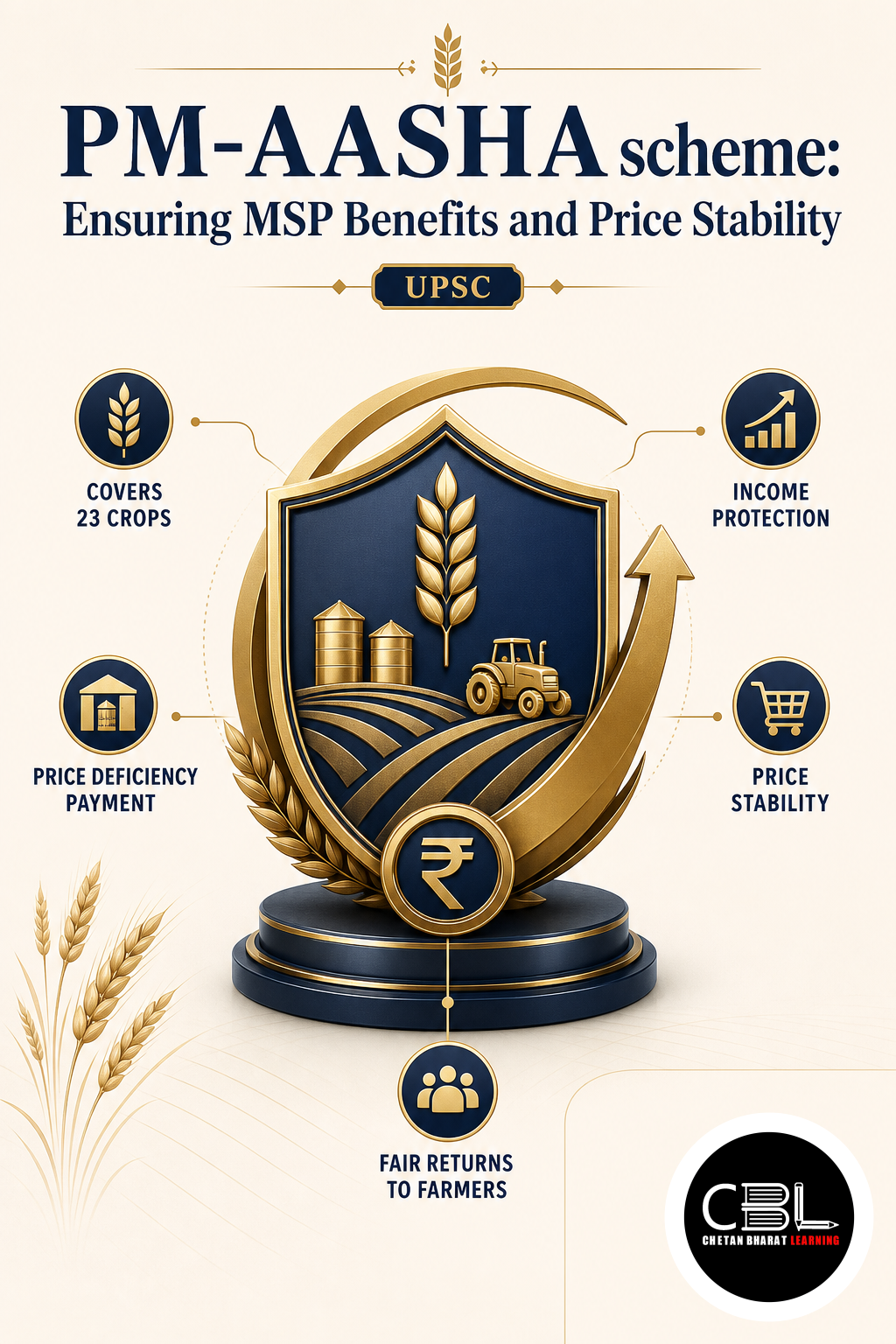
The PM-AASHA scheme (Pradhan Mantri Annadata Aay Sanrakshan Abhiyan) is a comprehensive umbrella programme that integrates multiple price support mechanisms to ensure that the benefits of Minimum Support Price (MSP) reach all farmers, including small and marginal ones. Launched in September 2018, the scheme aims to stabilise farm incomes and ensure food price stability through procurement, price deficiency payments, and market intervention. This scheme is a cornerstone of India’s agricultural policy and a vital topic for agriculture current affairs.
The scheme’s objectives include strengthening MSP implementation, stabilising farm incomes, ensuring food price stability, and enhancing procurement infrastructure. The government has steadily increased budget allocation for PM-AASHA, from ₹6,941.36 crore in 2025–26 to ₹7,200.00 crore in 2026-27, reflecting its commitment to farmer welfare.
Why is PM-AASHA Scheme in News?
The PM-AASHA scheme has been in the news following the government’s announcement of increased budget allocation and the successful implementation of MSP procurement in recent seasons. For example, in 2026–27, paddy (common) has a production cost of ₹1,627 per quintal and an MSP of ₹2,441, yielding a margin of ₹814. Similarly, wheat has a production cost of ₹1,239 per quintal and an MSP of ₹2,585, ensuring a ₹1,346 margin. These figures highlight the scheme’s role in ensuring remunerative returns for farmers.
The scheme has also introduced recent reforms, including biometric farmer authentication, direct procurement, transportation support for Tomato, Onion, and Potato (TOP) crops, and price differential payments under MIS. The integration of 1,656 mandis with e-NAM and onboarding of 7,334 FPOs onto ONDC has strengthened farm-to-market connectivity. For official details, refer to the PIB release on PM-AASHA.
Key Components of PM-AASHA
- Price Support Scheme (PSS): Ensures procurement of crops like pulses, oilseeds, and copra at MSP when market prices fall below MSP. NAFED and NCCF are the procuring agencies.
- Price Stabilization Fund (PSF): Maintains buffer stocks of essential commodities like pulses, onions, and potatoes to protect consumers from price volatility.
- Price Deficiency Payment Scheme (PDPS): Directly pays the price difference between MSP and market price (up to 15% of MSP) into farmers’ bank accounts without physical procurement.
- Market Intervention Scheme (MIS): Procures perishable agricultural and horticultural commodities during glut situations when prices drop by at least 10% over the normal season’s rates.
Challenges in Implementation
- Procurement Infrastructure: Limited storage and logistics capacity in some states affects timely procurement.
- Farmer Registration: Only registered farmers with valid land records are eligible, excluding many tenants and sharecroppers.
- Market Price Volatility: Determining the market price for PDPS and MIS can be contentious and subject to manipulation.
- State Coordination: Effective implementation requires active participation of state governments, which varies across regions. For more on agricultural schemes, explore the government schemes archive.
Way Forward for Price Support
The PM-AASHA scheme has the potential to revolutionise price support in India, but it needs to overcome implementation challenges. Strengthening procurement infrastructure, expanding farmer registration to include tenants, and improving price discovery mechanisms are essential. The use of technology, such as biometric authentication and e-NAM integration, can enhance transparency and efficiency.
Moreover, the government should focus on building a robust buffer stock management system and ensuring timely disbursement of payments. A NITI Aayog analysis suggests that expanding the coverage of PDPS to more crops can reduce the need for physical procurement and lower administrative costs.
Prelims Practice Corner
Q1. When was the PM-AASHA scheme launched?
(a) 2017 (b) 2018 (c) 2019 (d) 2020
Answer: (b) 2018. PM-AASHA was launched in September 2018.
Q2. Which component of PM-AASHA provides direct payment of the price difference to farmers’ bank accounts?
(a) Price Support Scheme (b) Price Stabilization Fund (c) Price Deficiency Payment Scheme (d) Market Intervention Scheme
Answer: (c) PDPS provides direct payment of the price difference to farmers without physical procurement.
Q3. What is the budget allocation for PM-AASHA in 2026-27?
(a) ₹6,000 crore (b) ₹6,941 crore (c) ₹7,200 crore (d) ₹8,000 crore
Answer: (c) ₹7,200 crore.
Q4. Which agency is responsible for procurement under PSS?
(a) FCI (b) NAFED & NCCF (c) CWC (d) SFAC
Answer: (b) NAFED and NCCF are the procuring agencies.
Q5. What is the Market Intervention Scheme (MIS) for?
(a) Procurement of oilseeds (b) Procurement of perishable commodities during glut (c) Price deficiency payments (d) Buffer stock for pulses
Answer: (b) Procurement of perishable commodities during glut situations.
Mains Practice Questions
Q1. “The PM-AASHA scheme is a comprehensive approach to ensuring price support for farmers.” Discuss its components, achievements, and challenges. (250 words, 15 marks)
Answer Structure:
- Intro: Introduce PM-AASHA as a unified price support framework.
- Body: Describe the four components (PSS, PSF, PDPS, MIS), highlight achievements (MSP margins, budget allocation), and discuss challenges (infrastructure, farmer registration, state coordination).
- Conclusion: Suggest strengthening procurement, technology adoption, and expanding coverage.
Q2. “Minimum Support Price (MSP) is a vital instrument for ensuring farmers’ income security, but its implementation faces several hurdles.” Analyse with reference to PM-AASHA. (250 words, 15 marks)
Answer Structure:
- Intro: Highlight the importance of MSP and the role of PM-AASHA.
- Body: Discuss the mechanism of PM-AASHA, its impact on farmers, challenges (procurement inefficiencies, market distortions), and recent reforms.
- Conclusion: Emphasise the need for a balanced approach that supports both farmers and consumers.
FAQs on PM-AASHA Scheme
- What is the Price Stabilization Fund (PSF)? PSF is a component of PM-AASHA that maintains buffer stocks of essential commodities like pulses, onions, and potatoes to protect consumers from price volatility.
- Which agencies implement the Price Support Scheme? The Price Support Scheme is implemented by central nodal agencies like NAFED (National Agricultural Cooperative Marketing Federation) and NCCF (National Cooperative Consumers Federation) at the request of state governments.
- What is the Market Intervention Scheme (MIS)? MIS is designed to procure perishable agricultural and horticultural commodities, like tomatoes, onions, and potatoes, during glut situations when market prices drop significantly.
Related Current Affairs
Preparing for UPSC, PCS or HCS?
Talk to a mentor at Chetan Bharat Learning, Chandigarh. Free guidance on choosing the right exam and building a study plan.
Chat on WhatsAppCall 97793 53345UPSC / IAS / PCS coaching in Chandigarh · Trusted by aspirants across Punjab & Haryana
Leave a Reply
You must be logged in to post a comment.