
UPSC Mapping
| Prelims | Indian Economy |
|---|---|
| Mains | GS Paper 3 (Economic Development) |
Quick Facts
| Current Agreement | CEPA signed in 2011 |
|---|---|
| Target Investment | 10 trillion yen (over $62 billion) |
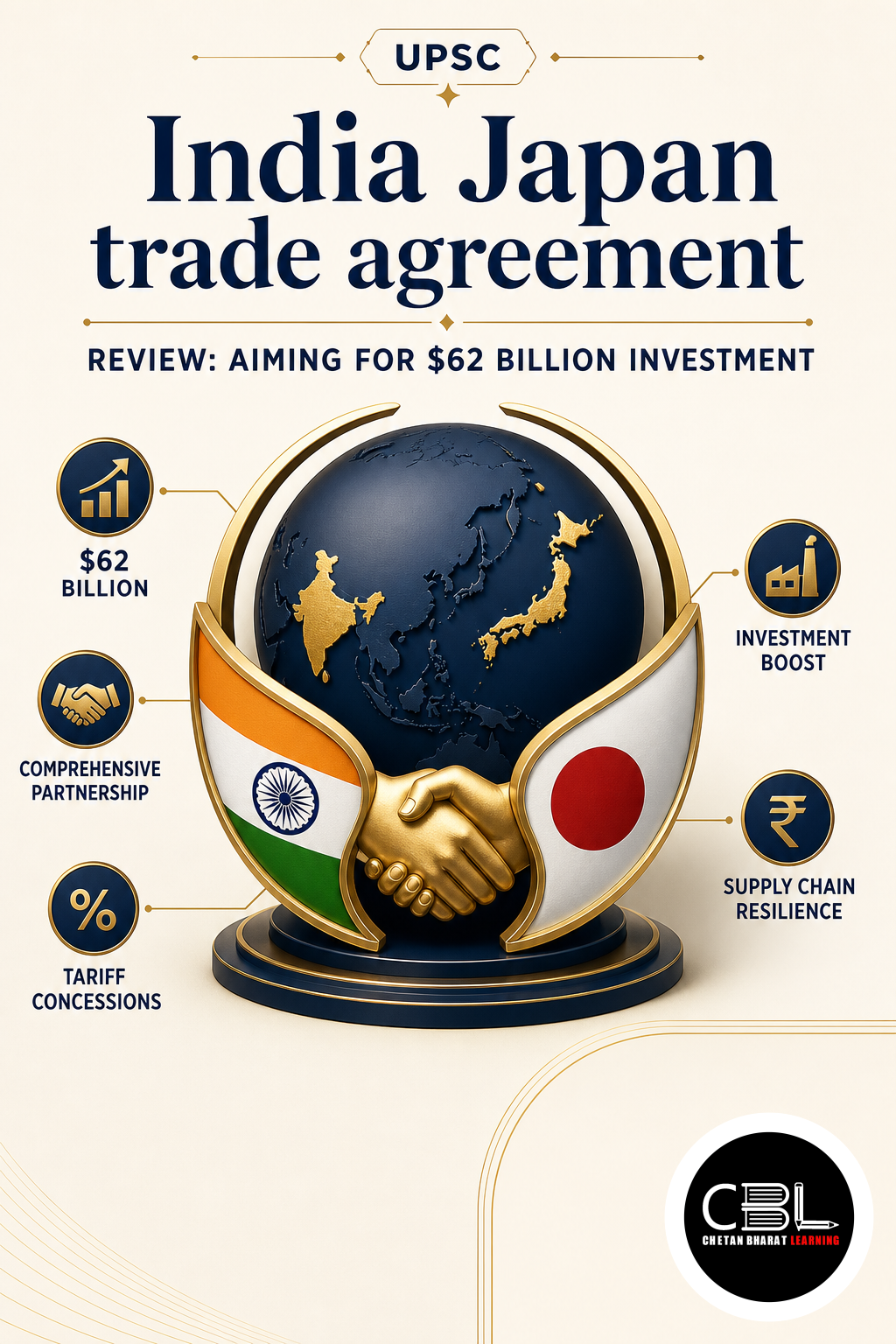
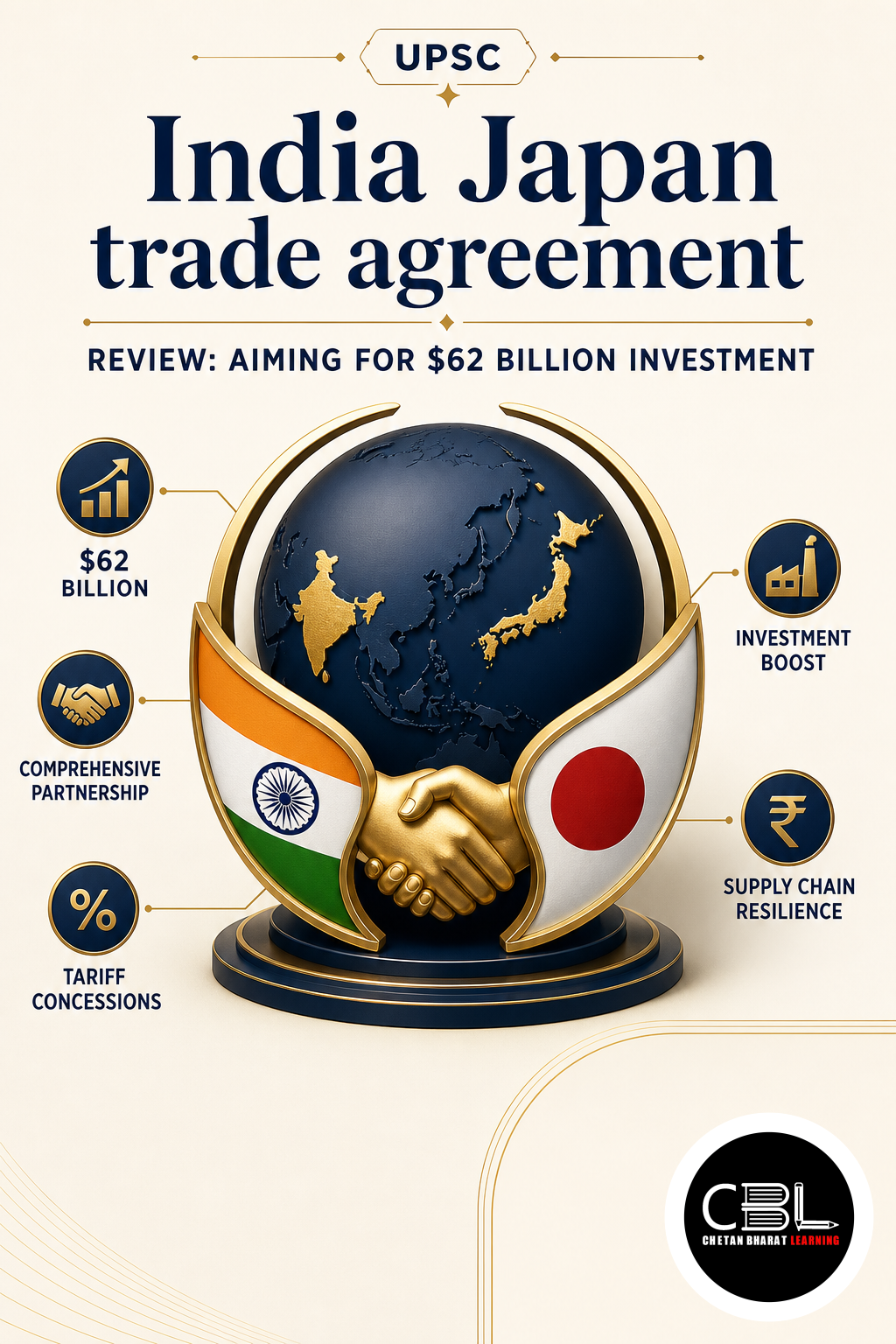
The India Japan trade agreement, officially the Comprehensive Economic Partnership Agreement (CEPA) signed in 2011, is being reviewed to fix the widening trade gap and streamline committed investments worth 10 trillion yen (over $62 billion) over the next decade. A high-level Indian delegation, led by Commerce and Industry Minister Piyush Goyal, is currently in Tokyo (24–27 August 2026) to deepen collaboration with Japanese counterparts. This move is part of India’s broader push to open its doors to international engagement, as highlighted in recent economy current affairs.
What is the India Japan Trade Agreement?
The India Japan trade agreement (CEPA) came into force in August 2011 and was the first comprehensive FTA that Japan signed with a major economy. It covers trade in goods, services, investment, intellectual property, customs, and government procurement. The agreement eliminated tariffs on over 90% of traded goods over a 10-year period, aiming to boost bilateral commerce and investment.
Despite the agreement, the trade balance has tilted in Japan’s favour, with India’s imports from Japan (especially machinery, electronics, and steel) far exceeding exports (mainly textiles, chemicals, and IT services). This asymmetry has prompted the review. India is also pushing for greater Japanese investment in infrastructure, renewable energy, and manufacturing under the ‘Make in India’ initiative.
Why is the India Japan Trade Agreement in News?
The India Japan trade agreement is back in the spotlight as a delegation of over 220 Indian industry stakeholders, led by Minister Piyush Goyal, is in Japan to review progress and explore new avenues. Goyal, at a roundtable, emphasized India’s goal to become a $30 trillion economy by 2047 and invited Japanese companies to leverage India’s cost competitiveness and engineering talent. He cited the success of Suzuki in India, whose market cap now exceeds its parent, as a model for what Japanese firms can achieve.
The minister also addressed Japanese concerns about the use of safeguard measures, suggesting that Japanese firms source steel from India rather than importing. The review aims to reset the trade relationship by addressing tariff barriers, enhancing investment protections, and streamlining regulations. An official PIB release on the visit outlines the key agenda.
Key Features of the Review
- Trade Gap Correction: The review aims to rebalance exports and imports, with India seeking greater market access for its pharmaceuticals, textiles, and agricultural products.
- Investment Commitment: Both sides have reaffirmed a target of 10 trillion yen (over $62 billion) in Japanese investment in India over the next 10 years, focusing on infrastructure, electronics, and auto components.
- Localisation and Supply Chains: Goyal urged Japanese companies to deepen localisation in India to become more cost-competitive and use India as a manufacturing hub for global exports.
- Technology Cooperation: The review includes collaboration in advanced manufacturing, AI, and renewable energy, with support for innovation funding from the Indian government.
- Regulatory Ease: India has set up ‘Invest India’ to handhold investors and address regulatory concerns, with Goyal stating that the ministry is always ready to sort out cases.
Challenges in Bilateral Trade
- Persistent Trade Deficit: India’s trade deficit with Japan has grown, with imports of high-value machinery and electronics outpacing exports of textiles and chemicals.
- Non-Tariff Barriers: Japanese standards for food, pharmaceuticals, and automobiles are stringent, making it difficult for Indian products to enter the market.
- Investment Hurdles: Japanese firms have cited land acquisition, bureaucratic delays, and tax complexities as deterrents to large-scale investment.
- Geopolitical Uncertainty: Global supply chain disruptions and the Russia-Ukraine war have affected raw material costs and shipping routes. For a deeper dive, explore the trade policy archive.
Way Forward for the Agreement
The India Japan trade agreement review offers a timely opportunity to deepen the economic partnership. India should focus on improving the ease of doing business and aligning its standards with Japanese norms to boost exports. At the same time, Japan can benefit from India’s large market and skilled workforce. The two sides are also discussing cooperation in digital trade and intellectual property rights.
As Goyal noted, the goal is not just to attract investment but to create a vibrant ecosystem where Japanese companies can thrive and contribute to India’s growth story. The Ministry of Commerce and Industry is also working on further FTAs with other countries, as per the official commerce ministry updates. The success of this review will depend on mutual trust and a shared vision for the future.
Prelims Practice Corner
Q1. The Comprehensive Economic Partnership Agreement (CEPA) between India and Japan was signed in which year?
(a) 2008 (b) 2011 (c) 2015 (d) 2020
Show answer
Answer: (b) 2011. It came into force in August 2011.
Q2. What is the target for Japanese investment in India over the next 10 years?
(a) 5 trillion yen (b) 10 trillion yen (c) 15 trillion yen (d) 20 trillion yen
Show answer
Answer: (b) 10 trillion yen (over $62 billion).
Mains Practice Questions
Q1. “The review of the India-Japan CEPA reflects the need to adapt trade agreements to changing economic realities.” Discuss the challenges and opportunities in the bilateral trade relationship. (250 words, 15 marks)
Intro: Introduce CEPA and its objectives, and the current review.
Body: Discuss trade imbalances, non-tariff barriers, investment potential, and strategic cooperation. Highlight the 10-trillion-yen target and steps taken by both sides.
Conclusion: Emphasize the importance of modernising the agreement to achieve mutual growth and resilience.
FAQs on India Japan Trade Agreement
What is the main reason for reviewing the India-Japan CEPA?
The review aims to address the widening trade imbalance, streamline Japanese investment commitments, and update the agreement to reflect current economic realities and supply chain needs.
How many Japanese companies operate in India, and what is the goal?
Currently, about 1,580 Japanese companies are in India. The goal is to double that number and create more successful ventures like Suzuki.
What sectors are targeted for investment?
Focus areas include capital goods, machinery, automotive, advanced manufacturing, aerospace, and fintech, along with infrastructure and renewable energy.
Related Current Affairs
Preparing for UPSC, PCS or HCS?
Talk to a mentor at Chetan Bharat Learning, Chandigarh. Free guidance on choosing the right exam and building a study plan.
Chat on WhatsAppCall 97793 53345UPSC / IAS / PCS coaching in Chandigarh · Trusted by aspirants across Punjab & Haryana
Leave a Reply
You must be logged in to post a comment.